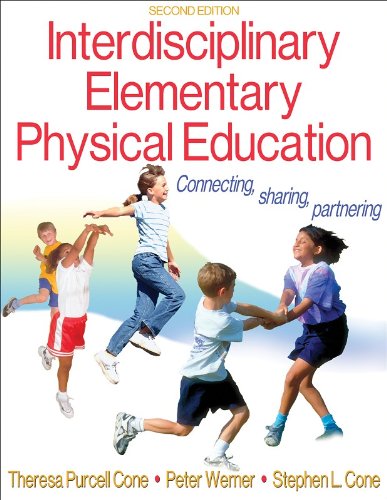

Interdisciplinary elementary physical education Theresa Purcell Cone, Peter H. Werner, Stephen L. Cone.
Detalles de publicación: Champaign, IL Human Kinetics c2009.Edición: 2nd edDescripción: xii, 331 p. ill. 28 cmISBN:- 9780736072151
- 0736072152 (soft cover)
| Imagen de cubierta | Tipo de ítem | Biblioteca actual | Biblioteca de origen | Colección | Ubicación en estantería | Signatura topográfica | Materiales especificados | Info Vol | URL | Copia número | Estado | Notas | Fecha de vencimiento | Código de barras | Reserva de ítems | Prioridad de la cola de reserva de ejemplar | Reservas para cursos | |
|---|---|---|---|---|---|---|---|---|---|---|---|---|---|---|---|---|---|---|
| Libro | Biblioteca de Mayagüez Colección General mb | LB1570 .I5669 2009 (Navegar estantería(Abre debajo)) | Disponible | 50000003192613 |
Descripciones mejoradas de Syndetics:
The popular Interdisciplinary Teaching Through Physical Education is back and better than ever. This new edition guides you in integrating the content of language arts, math, science, social studies, and the arts (music, theater arts, and visual arts) with the content of physical education through active learning experiences. This book has the following features:
-It provides 24 learning experiences in the five academic areas, 193 additional ideas for developing those learning experiences, and 37 new, ongoing strategies for teaching physical education through cross-curricular methods.
-It is revised and expanded, offering you more teaching tools to supplement, support, and enhance your teaching.
-It delivers new practical ideas and activities for classroom use, based on current theory and best practices.
In part I , you'll learn about the theoretical need for and benefits of interdisciplinary teaching and learning. The authors identify models for planning and implementing interdisciplinary experiences and provide ideas for getting started, building a support network, and assessing learning.
In part II , the authors describe sample learning experiences in each of the five academic disciplines and offer ideas for developing additional learning experiences. They also present suggested scope and sequence of concepts for each grade level and describe the concepts and skills that are appropriate for primary- and intermediate-grade students.
Interdisciplinary Elementary Physical Education will give your students a wealth of knowledge while they're being active. They'll have fun while they conjugate, calculate, investigate, explore, dance--and move across the curriculum.
Rev. ed. of: Interdisciplinary teaching through physical education / Theresa Purcell Cone ... [et al.]. c1998.
Connecting, sharing, partnering - on cover.
Foundational beginnings -- Successful planning and implementation -- Integrating physical education with language arts -- Integrating physical education with mathematics -- Integrating physical education with science -- Integrating physical education with social studies -- Integrating physical education with the arts.
gccmar2009
Tabla de contenidos provista por Syndetics
- Preface
- Acknowledgments
- How to Use This Book
- Part 1 Introduction to Interdisciplinary Education
- Chapter 1 Foundational Beginnings
- What Is Interdisciplinary Education?
- Benefits
- Challenges
- Historical Perspectives on Interdisciplinary Programming in Physical Education
- Standards-Based Curriculum
- National Physical Education Standards
- National Dance Standards
- National Standards for Beginning Physical Education Teachers
- Interdisciplinary Teaching Models
- Models for Physical Education
- The Connected Model
- The Shared Model
- The Partnership Model
- Summary
- Chapter 2 Successful Planning and Implementation
- Getting Started
- Review Curriculum Guides
- Select Content
- Gather Content Information
- Planning the Delivery
- Select a Model
- Create Lesson Plans and Address Logistics
- Assessment of Interdisciplinary Learning
- Link Assessment to Learning
- Alternative Assessment Strategies
- Examples of Assessment Instruments
- Developing a Successful Support Network
- Administrators
- Students
- Colleagues
- Parents
- Summary
- Part 2 Making It Work: Practical Applications
- Chapter 3 Integrating Physical Education With Language Arts
- Scope and Sequence for Language Arts
- Primary-Grade Language Arts Skills and Concepts
- Intermediate-Grade Language Arts Skills and Concepts
- Learning Experiences
- The Rumpus Dance
- Alphabet Gymnastics
- Create-a-Game
- Sport Words in Action
- A Moving Conversation
- Additional Ideas for Developing Learning Experiences
- Reading Skills
- Writing Skills
- Speaking, Listening, and Viewing Skills
- World Language Skills
- Ongoing Activities
- Summary
- Chapter 4 Integrating Physical Education With Mathematics
- Scope and Sequence for Mathematics
- Primary-Grade Mathematical Skills and Concepts
- Intermediate-Grade Mathematical Skills and Concepts
- Learning Experiences
- I'm Counting on You
- Pete and Repeat
- Playing the Field
- Measuring Sticks
- Additional Ideas for Developing Learning Experiences
- Numbers
- Measuring and Graphing
- Geometry
- Patterns and Functions
- Probability and Statistics
- Logic
- Algebra
- Ongoing Strategies for the Physical Education Classroom
- Summary
- Chapter 5 Integrating Physical Education With Science
- Scope and Sequence for Science
- Primary-Grade Science Skills and Concepts
- Intermediate-Grade Science Skills and Concepts
- Learning Experiences
- The Hip Bone Is Connected to the Thigh Bone
- The Simple Things in Life
- April Showers Bring May Flowers
- Rainbow Run
- Weather or Not
- Additional Ideas for Developing Learning Experiences
- Biological and Life Sciences
- Earth and Space Sciences
- Physical Sciences
- Ongoing Strategies for the Physical Education Classroom
- Summary
- Chapter 6 Integrating Physical Education With Social Studies
- Scope and Sequence for Social Studies
- Primary-Grade Social Studies Skills and Concepts
- Intermediate-Grade Social Studies Skills and Concepts
- Learning Experiences
- Moving Through the Years
- The Good Old Days
- Have a Good Day
- Games From Other Countries
- Heave, Hurl, Fling
- Hogmanay
- Additional Ideas for Developing Learning Experiences
- Family, School, and Community
- Citizenship
- Character Education
- Transportation
- Jobs
- Your State
- History
- Mapping and Globe Skills
- National Identity and Culture
- Geography
- Ongoing Strategies for the Physical Education Classroom
- Summary
- Chapter 7 Integrating Physical Education With the Arts
- Scope and Sequence for Music
- Primary-Grade Music Skills and Concepts
- Intermediate-Grade Music Skills and Concepts
- Scope and Sequence for Theater Arts
- Primary-Grade Theater Arts Skills and Concepts
- Intermediate-Grade Theater Arts Skills and Concepts
- Scope and Sequence for Visual Arts
- Primary-Grade Visual Arts Skills and Concepts
- Intermediate-Grade Visual Arts Skills and Concepts
- Learning Experiences
- The Circus Performers
- Patterns in Action
- Tempo Dance
- Lines of Expression
- Breaking It Down
- Additional Ideas for Developing Learning Experiences
- Music
- Theater Arts
- Visual Arts
- Theater Arts and Visual Arts
- Ongoing Strategies for the Physical Education Classroom
- Summary
- Selected Readings
- Appendix A
- Appendix B
- Index
- About the Authors
Notas de autor provistas por Syndetics
Theresa Purcell Cone, PhD , is an assistant professor in the department of health and exercise science at Rowan University in Glassboro, New Jersey. A coauthor of the first edition of this book, she is a past president of the National Dance Association and has held numerous leadership roles in physical education, including being president of New Jersey AHPERD and Eastern District AAHPERD. She has taught physical education and dance for 35 years in public schools and college and university settings.
Dr. Cone is also a frequent presenter at national conferences on interdisciplinary teaching, dance, and physical education. She has published extensively on these topics, and with her husband she is coauthor of Teaching Children Dance, Second Edition. In her leisure time, she enjoys time with her family, travel, and the arts.
Stephen L. Cone, PhD , is a professor in the department of health and exercise science at Rowan University. He coauthored the first edition of this book with his wife and has served as AAHPERD president. He has published and presented extensively in physical education, dance, and interdisciplinary teaching and has taught physical education and dance for 35 years in public schools and college and university settings. He also has served as president of Eastern District AAHPERD and New Hampshire AHPERD. Along with his wife, he enjoys time with his family, travel, and the arts in his leisure time.
Peter Werner, PED , is a distinguished professor emeritus at the University of South Carolina. His doctorate includes a specialization in physical education for children with a minor in elementary education. He is the coauthor of the first edition of this book and author of Teaching Children Gymnastics, Second Edition, among other titles, and has also written more than 100 journal articles on physical education for children. In addition, he has presented on interdisciplinary physical education for the past 35 years at the state, regional, and national levels.
Dr. Werner, a lifetime member of AAHPERD, edited the film series for the American Master teacher program. He has also served as senior editor of Teaching Elementary Physical Education from 2000 to 2003 and as the chair of the Editorial Review Board for Strategies from 2007 to 2008. In his spare time, his pursuits include whitewater canoeing, broom making, and fly fishing.