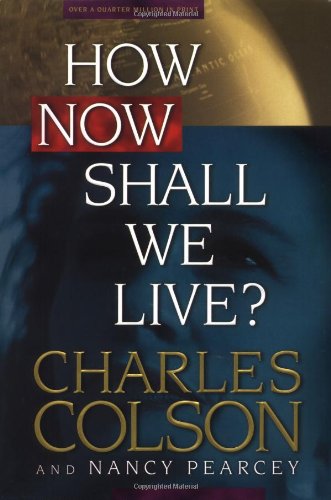

How now shall we live? Charles Colson and Nancy Pearcey.
Detalles de publicación: Wheaton, ILL Tyndale House Pub. 1999.Descripción: xiv, 574 pISBN:- 0842318089
| Imagen de cubierta | Tipo de ítem | Biblioteca actual | Biblioteca de origen | Colección | Ubicación en estantería | Signatura topográfica | Materiales especificados | Info Vol | URL | Copia número | Estado | Notas | Fecha de vencimiento | Código de barras | Reserva de ítems | Prioridad de la cola de reserva de ejemplar | Reservas para cursos | |
|---|---|---|---|---|---|---|---|---|---|---|---|---|---|---|---|---|---|---|
| Libro | Biblioteca de Mayagüez Colección General mb | BR115 .C8 C554 1999 (Navegar estantería(Abre debajo)) | Disponible | 50000002086063 |
Descripciones mejoradas de Syndetics:
2000 Gold Medallion Award winner! Christianity is more than a personal relationship with Jesus Christ. It is also a worldview that not only answers life's basic questions--Where did we come from, and who are we? What has gone wrong with the world? What can we do to fix it?--but also shows us how we should live as a result of those answers. How Now Shall We Live? gives Christians the understanding, the confidence, and the tools to confront the world's bankrupt worldviews and to restore and redeem every aspect of contemporary culture: family, education, ethics, work, law, politics, science, art, music. This book will change every Christian who reads it. It will change the church in the new millennium.
Includes bibliographical references and index.
Tabla de contenidos provista por Syndetics
- Introduction--How Now Shall We Live?(p. ix)
- Part 1 Worldview: Why it Matters
- 1 A New Creation(p. 3)
- 2 Christianity Is a Worldview(p. 13)
- 3 Worldviews in Conflict(p. 19)
- 4 Christian Truth in an Age of Unbelief(p. 27)
- Part 2 Creation: Where Did We Come From, and Who are We?
- 5 Dave and Katy's Metaphysical Adventure(p. 41)
- 6 Shattering the Grid(p. 51)
- 7 Let's Start at the Very Beginning(p. 57)
- 8 Life in a Test Tube?(p. 69)
- 9 Darwin in the Dock(p. 81)
- 10 Darwin's Dangerous Idea(p. 91)
- 11 A Matter of Life(p. 101)
- 12 Whatever Happened to Human Life?(p. 117)
- 13 In Whose Image?(p. 129)
- 14 God Makes No Mistakes(p. 141)
- Part 3 The Fall: What has Gone Wrong With the World?
- 15 The Trouble with Us(p. 147)
- 16 A Better Way of Living?(p. 151)
- 17 Synanon and Sin(p. 169)
- 18 We're All Utopians Now(p. 175)
- 19 The Face of Evil(p. 187)
- 20 A Snake in the Garden(p. 193)
- 21 Does Suffering Make Sense?(p. 203)
- Part 4 Redemption: What Can We do to Fix it?
- 22 Good Intentions(p. 217)
- 23 In Search of Redemption(p. 225)
- 24 Does It Liberate?(p. 231)
- 25 Salvation through Sex?(p. 237)
- 26 Is Science Our Savior?(p. 245)
- 27 The Drama of Despair(p. 253)
- 28 That New Age Religion(p. 263)
- 29 Real Redemption(p. 273)
- Part 5 Restoration: How Now Shall We Live?
- 30 The Knockout Punch(p. 283)
- 31 Saved to What?(p. 293)
- 32 Don't Worry, Be Religious(p. 307)
- 33 God's Training Ground(p. 317)
- 34 Still at Risk(p. 331)
- 35 Anything Can Happen Here(p. 345)
- 36 There Goes the Neighborhood(p. 361)
- 37 Creating the Good Society(p. 373)
- 38 The Work of Our Hands(p. 383)
- 39 The Ultimate Appeal(p. 397)
- 40 The Basis for True Science(p. 419)
- 41 Blessed Is the Man(p. 431)
- 42 Soli Deo Gloria(p. 439)
- 43 Touched by a Miracle(p. 455)
- 44 Does the Devil Have All the Good Music?(p. 465)
- 45 How Now Shall We Live?(p. 477)
- With Gratitude(p. 489)
- Notes(p. 493)
- Recommended Reading(p. 545)
- Index(p. 561)
- About the Authors(p. 573)
Reseñas proporcionadas por Syndetics
Publishers Weekly Review
International prison ministry leader Colson, most famous for his role in the Watergate scandal and his subsequent conversion to Christianity, has co-written with Pearcey what he believes to be the most important book of his career. Picking up where the late American theologian Francis Schaeffer's book and film series How Then Shall We Live? left off, Colson attempts to explain why American culture has become "post-Christian" and what must be done to "rebuild it with a biblical worldview." He believes that Christian salvation is not just personal but "cosmological," redeeming all of creation. Colson's work is a mixed bag. When he outlines his theology, shares personal stories or explains the various Supreme Court cases that touch upon religion's role in American life, he is thoughtful and articulate, yet the work suffers from a narrow perspective and an overdependence on the opinions of a few others, especially Schaeffer. As the author of a book that ostensibly engages recent developments in science, art and philosophy from a Christian point of view, Colson too easily dismisses opposing views without expressing a full understanding of them (Stephen Hawking's time theories amount to "little more than fantasy," for example). Such an approach to humanist ideas makes this a sermon strictly for the evangelical choir, although Colson intends the book to inspire debate in the wider culture and Tyndale is launching a $250,000 marketing campaign to sell it. (Sept.) (c) Copyright PWxyz, LLC. All rights reservedNotas de autor provistas por Syndetics
Charles Colson is a popular and widely known author, speaker, and radio commentator. A former presidential aide to Richard Nixon and founder of the international ministry Prison Fellowship, he has written several books, including Born Again, Loving God, Kingdoms in Conflict, and The Body, that have shaped Christian thinking on a variety of subjects. In 1993 Colson was awarded the prestigious Templeton Prize for Progress in Religion, given for extraordinary leadership and originality in advancing humanity's understanding of God.Nancy Pearcey is policy director of the Wilberforce Forum, executive editor of Chuck Colson's daily radio program BreakPoint, and coauthor of Colson's monthly column in Christianity Today. She is also a fellow at the Discovery Institute's Center for the Renewal for Science and Culture, and managing editor of the journal Origins and Design. Pearcey's expertise in worldview analysis began when she studied under Francis Schaeffer at L'Abri Fellowship in Switzerland in the early 1970s.