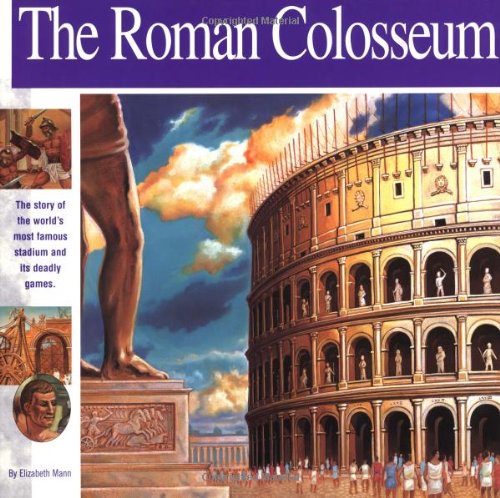

The Roman Colosseum Elizabeth Mann with illustrations by Michael Racz
Detalles de publicación: New York Mikaya Press 1998.Descripción: 45 p. 25cmISBN:- 0965049337
| Imagen de cubierta | Tipo de ítem | Biblioteca actual | Biblioteca de origen | Colección | Ubicación en estantería | Signatura topográfica | Materiales especificados | Info Vol | URL | Copia número | Estado | Notas | Fecha de vencimiento | Código de barras | Reserva de ítems | Prioridad de la cola de reserva de ejemplar | Reservas para cursos | |
|---|---|---|---|---|---|---|---|---|---|---|---|---|---|---|---|---|---|---|
| Libro | Biblioteca Mons. Iñaki Mallona (Arecibo) Colección General ab | 937.6 M281r (Navegar estantería(Abre debajo)) | Disponible | 60000010063235 |
Descripciones mejoradas de Syndetics:
The Roman Colosseum was the work of a brilliant and energetic civilization. The Roman Colosseum was the work of a cruel and brutal civilization.
Both are true.
The Roman Colosseum was one of the most extraordinary buildings in the ancient world, a work of engineering genius whose design is imitated every time a modern stadium is built. Yet, what went on inside this building is difficult to comprehend.
Over the centuries, tens of thousands of slaves, prisoners of war, and criminals were slaughtered in the Colosseum for the entertainment of over 50,000 cheering fans. So many animals were destroyed in gruesome "hunts" staged in the arena that entire species disappeared from the Roman colonies of North Africa.
The Roman Colosseum interweaves the impressive story of the construction of this remarkable building and the sobering tale of the "games" that went on inside it. In doing so, it reveals an entire civilization in all its genius and its brutality.
Wonders of the World series
The winner of numerous awards, this series is renowned for Elizabeth Mann's ability to convey adventure and excitement while revealing technical information in engaging and easily understood language. The illustrations are lavishly realistic and accurate in detail but do not ignore the human element. Outstanding in the genre, these books are sure to bring even the most indifferent young reader into the worlds of history, geography, and architecture.
"One of the ten best non-fiction series for young readers."
- Booklist
Includes index.
Describes the building of the Colosseeum in ancient Rome, and tells how it was used.
Extracto provisto por Syndetics
Reseñas proporcionadas por Syndetics
School Library Journal Review
Gr 4-6A colorful, informative introduction to the structure and history of gladiatorial games. The useful text provides fascinating facts about architectural and building innovations utilized in the construction of this arena and an explanation of the ingenious ticketing and numbered entrances that were designed to control the flow of 50,000 spectators. Details about gladiator training, styles of fighting, and the use of wild animals reinforce the author's contention that the Colosseum is both a symbol of Rome's greatness and its brutality. A clear, well-written text and full-color drawings and paintings graphically depict the events held there. Photographs of mosaics, relief carvings, and the site are also included. Richard Watkins's Gladiator (Houghton, 1997) offers more details about the games, the participants, and their social standing in Roman society and Don Nardo's The Roman Colosseum (Lucent, 1998) is hard to beat if additional background on the design and construction of the arena is needed.Cynthia M. Sturgis, Ledding Library, Milwaukee, OR (c) Copyright 2010. Library Journals LLC, a wholly owned subsidiary of Media Source, Inc. No redistribution permitted.Booklist Review
Gr. 4^-7. Like others in the Wonders of the World series, this has a picture-book-style look but is packed with history. Covering some of the same territory Richard Watkins did in his more specific book Gladiator (1997), Mann explores the history and the events that led to the building of the Coloseum, and then looks at some of the structure's unusual features, which continue to have an impact on the work of modern engineers and architects. The text is clear, informative, and flows well, but the illustrations, though plentiful, are an odd, unbalanced mix of photos, pictures of artifacts, and bold, full-page paintings. Some of the pictures are quite dramatic, with a few showing the violence of the events, including a little spilling of blood. The center foldout, however, is a disappointment: despite its panoramic view of the amphitheater and miniature show of battling warriors, it is neither as effective nor as dynamic as readers might have expected from the splashy presentation. Maps; time line; glossary. --Stephanie ZvirinNotas de autor provistas por Syndetics
Elizabeth Mann lives in New York City with her husband and their son, Lucas. Formerly a teacher in the New York City Public Schools, she holds an M.S.E. from Bank Street College of Education.
Michael Racz lives and works in New York City. He enjoys painting historical subjects, especially Civil War and World War II aviation themes. The Roman Colosseum is his first children's book.