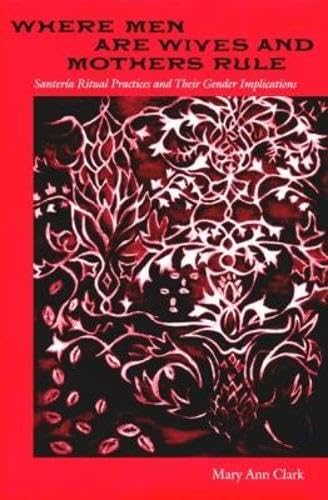

Where men are wives and mothers rule Santería ritual practices and their gender implications Mary Ann Clark.
Series The history of African-American religionsDetalles de publicación: Gainesville, FL University Press of Florida c2005.Descripción: xii, 185 p 24 cmISBN:- 0813028345 (alk. paper)
- 299.674082 C5921w 22
- BL2532.S3 C53 2005
| Imagen de cubierta | Tipo de ítem | Biblioteca actual | Biblioteca de origen | Colección | Ubicación en estantería | Signatura topográfica | Materiales especificados | Info Vol | URL | Copia número | Estado | Notas | Fecha de vencimiento | Código de barras | Reserva de ítems | Prioridad de la cola de reserva de ejemplar | Reservas para cursos | |
|---|---|---|---|---|---|---|---|---|---|---|---|---|---|---|---|---|---|---|
| Libro | Biblioteca Encarnación Valdés Colección General bev | 299.674082 C5921w (Navegar estantería(Abre debajo)) | Disponible | 80000002286535 |
Descripciones mejoradas de Syndetics:
While much theological thinking assumes a normative male perspective, this study demonstrates how our ideas of religious beliefs and practices change in the light of gender awareness. Exploring the philosophy and practices of the Orisha traditions (principally the Afro-Cuban religious complex known as Santería) as they have developed in the Americas, Clark suggests that, unlike many mainstream religions, these traditions exist within a female-normative system in which all practitioners are expected to take up female gender roles. Examining the practices of divination, initiation, possession trance, sacrifice, and witchcraft in successive chapters, Clark explores the ways in which Santería beliefs and practices deviate from the historical assumptions about and the conceptual implications of these basic concepts. After tracing the standard definition of each term and describing its place within the worldview of Santería, Clark teases out its gender implications to argue for the female-normative nature of the religion.nbsp;By arguing that gender is a fluid concept within Santería, Clark suggests that the qualities of being female form the ideal of Santeria religious practice for both men and women.nbsp;In addition, she asserts that the Ifa cult organized around the male-only priesthood of the babalawo is an independent tradition that has been incompletely assimilated into the larger Santería complex. Based on field research done in several Santería communities, Clark's study provides a detailed overview of the Santería and Yoruba traditional beliefs and practices.nbsp;By clarifying a wide range of feminist- and gender-related themes in Cuban Santería, she challenges the traditional gendering of the religion and provides an account that will be of significant interest to students of Caribbean studies and African religions, as well as to scholars in anthropology, sociology, and gender studies. nbsp;
Includes bibliographical references and index.
Tabla de contenidos provista por Syndetics
- Foreword(p. ix)
- Acknowledgments(p. xi)
- 1 Introduction(p. 1)
- 2 Gender(p. 25)
- 3 Destiny and Divination(p. 47)
- 4 Initiation(p. 71)
- 5 Possession Phenomena(p. 86)
- 6 Sacrifice and Violence(p. 102)
- 7 Witchcraft(p. 121)
- 8 Conclusion: A Distinction without a Difference(p. 143)
- Notes(p. 153)
- Glossary(p. 163)
- Bibliography(p. 169)
- Index(p. 179)