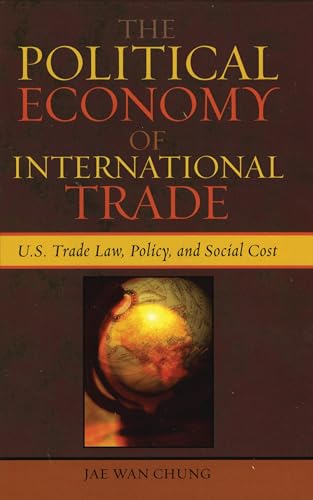

The political economy of international trade U.S. trade law social cost Jae Wan Chung.
Detalles de publicación: Lanham, Md. Lexington Books, a division of Rowman & Littlef Publishers c2006.Descripción: xxiv, 245 p. ill. 24 cmISBN:- 0739112910 (cloth : alk. paper)
- 9780739112915 (cloth : alk. paper)
- 0739112929 (pbk. : alk. paper)
- 9780739112922 (pbk. : alk. paper)
- 343 . 73/087 22
- KF 1976 .C458 2006
| Imagen de cubierta | Tipo de ítem | Biblioteca actual | Biblioteca de origen | Colección | Ubicación en estantería | Signatura topográfica | Materiales especificados | Info Vol | URL | Copia número | Estado | Notas | Fecha de vencimiento | Código de barras | Reserva de ítems | Prioridad de la cola de reserva de ejemplar | Reservas para cursos | |
|---|---|---|---|---|---|---|---|---|---|---|---|---|---|---|---|---|---|---|
| Libro | Biblioteca de Derecho Mons. Fremiot Torres Oliver Colección General biblioteca derecho | KF 1976 .C458 2006 (Navegar estantería(Abre debajo)) | Disponible | 70000000775226 |
Descripciones mejoradas de Syndetics:
American trade policy is a crucial subject to not only the United States but also foreign countries. Free trade has been a long-standing U.S. policy position, playing the lead role in the international free trade framework and contributing to this framework through multilateral trade negotiations. As both trade deficits and fiscal deficits steadily increased during the 1980s in the U.S., free trade has not stood without its share of suffering. Chung investigates American trade policy from the perspectives of U.S. trade laws and international trade agreements by outlining the primary trade laws of the past; considering the trade laws of the present; and delving into various trade agreements, disputes, and reforms. Looking to the future, Chung offers a unique argument for the enforcement of trade remedy laws and the reform of the international trade framework. The Political Economy of International Trade is certain to be of interest to academics, policymakers, trade industry practitioners, and politicians in the United States as well as around the world.
Includes bibliographical references (p. 215-228) and index.
Tabla de contenidos provista por Syndetics
- List of Figures(p. xi)
- List of Tables(p. xiii)
- Abbreviations(p. xv)
- Preface(p. xvii)
- Acknowledgments(p. xxiii)
- Part I U.S. Trade Laws and International Trade Agreements
- 1 Constitutional Mandate of Trade Policy and Trade Protection(p. 3)
- 1.1 Trade Legislation and Trade Policy(p. 4)
- 1.2 Procedures for Trade Legislation(p. 5)
- 1.3 Causes of Protective Trade Legislation(p. 7)
- 1.4 Summary and Conclusions(p. 9)
- Notes(p. 10)
- 2 Primary Trade Laws in the Past(p. 13)
- 2.1 The Smoot-Hawley Tariff Act of 1930(p. 14)
- 2.2 The Reciprocal Trade Agreements Act of 1934(p. 21)
- 2.3 Trade Expansion Act of 1962(p. 23)
- 2.4 Trade Reform Act of 1974(p. 24)
- 2.5 Trade Agreements Act of 1979(p. 25)
- 2.6 Summary and Conclusions(p. 27)
- Notes(p. 28)
- 3 Trade Law of the Present Era: An Overview(p. 31)
- 3.1 Background and Purpose of OTCA(p. 33)
- 3.2 Legislation(p. 35)
- 3.3 Statutory Composition and Trade Remedy Laws(p. 35)
- 3.4 Summary and Conclusions(p. 37)
- Appendix 3.1 House Votes on H.R. 4848(p. 38)
- Appendix 3.2 Senate Votes on H.R. 4848(p. 42)
- Notes(p. 43)
- 4 Principal Trade Policy Instruments(p. 45)
- 4.1 Enforcement of U.S. Rights and Responses to Foreign Unfair Trade Practices(p. 47)
- 4.2 Identification of Trade Liberalization Priorities(p. 49)
- 4.3 Identification of Intellectual Property Rights Priorities(p. 50)
- 4.4 Countervailing Duties(p. 51)
- 4.5 Antidumping Duties(p. 54)
- 4.6 Safeguard Measure(p. 57)
- 4.7 Antecedents of Trade Remedy Statutes(p. 58)
- 4.8 Other Provisions(p. 60)
- 4.9 Summary and Conclusions(p. 61)
- Notes(p. 62)
- 5 The World Trade Framework(p. 65)
- 5.1 Multilateral Agreements(p. 67)
- 5.2 Regional Agreements(p. 77)
- 5.3 Bilateral Agreements(p. 82)
- 5.4 Recent Development of Multilateral Agreements(p. 83)
- 5.5 Summary and Conclusions(p. 87)
- Appendix 5.1 House Roll Call Votes on the Uruguay Round(p. 88)
- Appendix 5.2 Senate Roll Call Votes on the Uruguay Round(p. 93)
- Appendix 5.3 Highlights of the U.S.-Canada Trade Pact(p. 94)
- Notes(p. 95)
- Part II U.S. Trade Policy, Social Cost, and Policy Reform
- 6 Trade Policy Institutions(p. 101)
- 6.1 The Legislative Branch(p. 101)
- 6.2 The Executive Branch(p. 102)
- 6.3 The International Trade Commission(p. 108)
- 6.4 Private Sector Advisory Committees(p. 109)
- 6.5 Policy Implications(p. 109)
- 6.6 Summary and Conclusions(p. 110)
- Notes(p. 111)
- 7 Trade Policy in Action(p. 113)
- 7.1 Trade Policy under Multilateral Agreements(p. 115)
- 7.2 Trade Policy under Regional Agreements(p. 116)
- 7.3 Bilateral Initiatives(p. 118)
- 7.4 Enforcement Activities by Trade Remedy Measures(p. 123)
- 7.5 Future Course of U.S. Trade Policy(p. 137)
- 7.6 Summary and Conclusions(p. 140)
- Notes(p. 141)
- 8 Trade Disputes and Settlements(p. 143)
- 8.1 Foreign Trade Barriers(p. 144)
- 8.2 Complaints about U.S. Trade Remedy Policy(p. 146)
- 8.3 Are the U.S. Trade Remedy Statutes in Accord with Multilateral Agreements?(p. 151)
- 8.4 Trade Disputes and Settlements(p. 154)
- 8.5 Summary and Conclusions(p. 160)
- Appendix 8.1 Disputes Brought to the WTO by the United States against Foreign Countries(p. 161)
- Appendix 8.2 Disputes Brought to the WTO by Foreign Countries against the United States(p. 166)
- Notes(p. 173)
- 9 Adjudicatory Behavior of Trade Policy Institutions and Effectiveness of Trade Remedy Policy(p. 175)
- 9.1 Determinants of Petition(p. 176)
- 9.2 ITC's Decision-Making Behavior(p. 178)
- 9.3 Effectiveness of Trade Remedy Policy(p. 180)
- 9.4 Trade Remedy Policy and Trade Disparity(p. 182)
- 9.5 Summary and Conclusions(p. 184)
- Notes(p. 185)
- 10 Fair Trade Policy, Social Cost, and Trade Policy Reform(p. 187)
- 10.1 Legal Perspective on Trade Policy(p. 189)
- 10.2 Economic Perspective on Trade Policy(p. 191)
- 10.3 Social Cost of Trade Policy, Optimal Trade Intervention, and Trade Policy Reform(p. 194)
- 10.4 Summary and Conclusions(p. 196)
- Notes(p. 198)
- Epilogue(p. 201)
- Appendix
- I GATT[subscript 1947]: Components(p. 205)
- II Uruguay Round Agreements: Components(p. 207)
- III NAFTA: Outline(p. 209)
- Bibliography(p. 215)
- Index(p. 229)
- About the Author(p. 245)