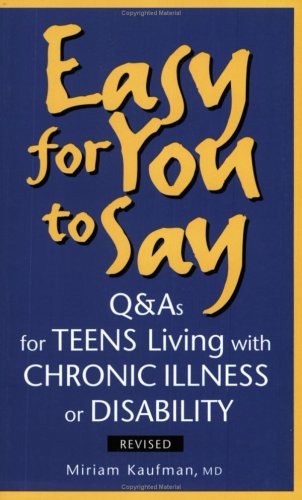
Imagen de portada de Amazon
Imagen de Amazon.com
Imagen de cubierta Syndetics
Portada de Syndetics
Imagen de OpenLibrary

Easy for you to say Q & As for teens living with chronic illness or disability Miriam Kaufman.

Por: Detalles de publicación: Buffalo, N.Y. Firefly 2005.Edición: Rev. [ed.]Descripción: xiii, 285 p. 21 cmISBN:
  • 1554070783 (pbk.)
Tema(s): Clasificación CDD:
  • 616.00835 K212e 22
Clasificación LoC:
  • RJ380 .K385 2005
Resumen: Addresses both the medical and social challenges faced by teens living with chronic illnesses and disabilities.
Valoración
    Valoración media: 0.0 (0 votos)
Existencias
Imagen de cubierta Tipo de ítem Biblioteca actual Biblioteca de origen Colección Ubicación en estantería Signatura topográfica Materiales especificados Info Vol URL Copia número Estado Notas Fecha de vencimiento Código de barras Reserva de ítems Prioridad de la cola de reserva de ejemplar Reservas para cursos
Libro Biblioteca Encarnación Valdés Colección General bev 616.00835 K212e (Navegar estantería(Abre debajo)) Disponible 80000002180068
Total de reservas: 0

Descripciones mejoradas de Syndetics:

Practical information for teens and their families.

The teen years are some of the most demanding. Even the most well-adjusted youth struggles with the intense daily challenges of friends, family, school, and wider society.

These problems pale in comparison to those faced by teenagers with a handicap or chronic illness such as spina bifida or cystic fibrosis. Get over it, or It's just a phase, just don't work and can be offensive. Easy for you to say, is the teenager's often-heard-and accurate-response.

Easy for You to Say profiles the lives of uniquely challenged teens as they work hard to make sense of the world and their place in it. The book includes street language that teens can identify with and readily understand.

The questions posed are frank, courageous and cover such issues as:

Sex Drugs Family Death.

With answers that often are not easy or pretty Easy for You to Say offers practical advice, straight talk and honest answers to questions that many would be too embarrassed to ask.

Addresses both the medical and social challenges faced by teens living with chronic illnesses and disabilities.

Includes bibliographical references (p. 273-276) and index.

Tabla de contenidos provista por Syndetics

  • Preface(p. vii)
  • Acknowledgments(p. xi)
  • 1 Family Relationships(p. 1)
  • 2 Doctors and Medical Issues(p. 35)
  • 3 Friends and Dating(p. 65)
  • 4 School and Work(p. 87)
  • 5 Alcohol, Drugs and Medications(p. 108)
  • 6 Sexuality(p. 128)
  • 7 Recreation(p. 206)
  • 8 Transitions(p. 234)
  • Appendix Charts
  • A Drugs That Can Cause Acne(p. 251)
  • B Drugs That Can Cause Hairiness(p. 251)
  • C Medications That Can Cause Decreased Sexual Desire(p. 252)
  • D Medications That Can Cause Erectile Problems(p. 252)
  • E Medications That Can Lead to Male Breast Enlargement(p. 253)
  • F Some Medications That Interact with Birth Control Pills(p. 253)
  • G Some Over-the-Counter/Prescription Drug Interactions(p. 255)
  • H Street Drugs and Their Possible Effect on Sexual Function(p. 256)
  • I Possible Effects of Drinking Alcohol When Taking Medication(p. 256)
  • J Possible Effects of Tobacco Use with Medication(p. 259)
  • K Possible Effects of Marijuana Use with Medication(p. 259)
  • L Possible Effects of Cocaine Use with Medication(p. 261)
  • M Possible Effects of Amphetamine (including Ecstasy) Use with Medication(p. 262)
  • N Drugs That Combined with PCP Can Lead to Seizures, High Blood Pressure, High Temperature and Muscle Destruction(p. 263)
  • O Possible Effects of LSD Use with Medication(p. 263)
  • P Other Combinations to Avoid(p. 264)
  • Glossary(p. 265)
  • Resources(p. 273)

Extracto provisto por Syndetics

Preface I am a doctor in a clinic for teens at a large hospital. Some teens come because they have questions about sexuality, contraception and pregnancy. Others are having problems with their parents or school, are using drugs or have been sexually abused. Other teens bring their own children for medical care. Many have concerns about their bodies not looking like the models they see in magazine ads. In all these groups are teens who have a chronic illness or disability. In 1991 and 1992 I was asked to talk to a group called Teens of Ontario Living with Lupus. I gave the group file cards and asked them to write down questions about being a teen with a chronic condition. I was stunned by the honesty of their questions. As a teen, I never would have been able to ask questions such as theirs, even anonymously. As I was standing in front of them, I decided to write a book, one that would answer their questions and those of teens with asthma, Crohn's disease, spina bifida, cystic fibrosis, seizure disorders, kidney disease, cancer and other conditions. I knew that there was a growing body of literature written for professionals, and also quite a bit for parents of children with specific diseases or disabilities. I felt it was time to translate some of this important information into English, out of whatever language it is that doctors, nurses and social workers speak. I did not want this book to be for people who share one illness or disability. There is too much of that already -- separating people into little compartments. Teens with long-term conditions have a lot in common. They also have a lot in common with other teens who are not affected by any medical problem. The questions in this book (it is in a question-and-answer format) come from teens I met with while researching the book, in addition to teens who have been patients of mine and of my colleagues in several cities. Some of the questions are combinations of things asked by several kids. Some I have put together from concerns that I have heard expressed over the years. I have been careful to make sure that no one can tell who asked the question. I may have changed the diagnosis (so don't skip through looking for questions from people who have the same thing as you -- you might miss the sections that apply to you). Since the first edition, I have met many more teens, some of whom have asked why I didn't include a certain topic, or who had advice to add to what I suggested. I have updated the book based on their input.In the process of writing this book, I had the opportunity to meet with a number of adolescents with chronic conditions. It was clear to me that most of them did not see themselves as particularly disabled or sick. They had decided to get on with their lives, and despite the many questions and comments they gave me to help me with this book, I felt their lives were healthy and adjusted. I couldn't help believing that there was another group of teens, feeling very sick and very disabled, who couldn't manage to get out to meet me. My suspicion is that if they exist, these teens are, by any objective standard, no more disabled or sick than the ones I talked with. Because I think that attitude has a big impact on how disabling any condition is, some readers may feel I have a "Pollyanna" type approach to problems. I don't want to minimize how difficult it can be to be singled out as different when you are an adolescent. But standing out from the crowd isn't always bad, and you may be able to turn it to your advantage. You may also have problems with my strong belief in fighting for what you need and want. My answers often involve suggestions about writing letters, making phone calls, being an activist. I try to provide alternatives for people who don't want to try these things, but I do think that fighting for what you need often works and helps you feel in control and powerful. Because of the way this book has been put together, you don't have to pick it up at the beginning and read it through. You can easily skip around and read a question here, and another there (that is, once you have read the sex chapter from beginning to end). You will find a glossary at the back of the book, so you can look up unfamiliar medical-type words that may have been explained in a section you jumped over. If you are reading this to someone, be prepared for discussion. There is a lot to think about in it. I was never a teen with a chronic illness or disability. I got my chronic condition much later in life (when I was 31) So there is no way I can understand completely what you are going through. On the other hand, I was a teen who was an outcast for other reasons, I know what it is like to have a chronic condition as an adult, and I have spent more than 20 years talking with teens about their concerns. If you have better answers than mine, write and tell me about them. I asked the teenagers I met with what they would like to say to a teen who has just found out that he or she has a serious condition. I got answers like "Just look around when you are in the hospital, you'll realize it could have been worse," "Show your parents and doctors you're capable, then tell them, not the other way around," "You are going to gain respect for other people, like you never had before," "If doctors and nurses are getting on your nerves, let them know," "Don't be scared, just go with it" and "You are still the same person. As far as I'm concerned, these teens are the real experts. Excerpted from Easy for You to Say: Q and A's for Teens Living with Chronic Illness or Disability by Miriam Kaufman All rights reserved by the original copyright owners. Excerpts are provided for display purposes only and may not be reproduced, reprinted or distributed without the written permission of the publisher.

Reseñas proporcionadas por Syndetics

Booklist Review

Gr. 9^-12. Nobody's venting anger or hurt feelings here, as they did in Cheney's Teens with Physical Disabilities [BKL Ag 95]; and unlike Kriegsman's Taking Charge (1992), this concentrates only partly on issues common among teens with disabilities. Instead, this very unusual book, aimed exclusively at teens who are disabled or who have a chronic illness, focuses on individual needs. Written by a Canadian physician who works with adolescents, it is filled with very personal, even courageous questions from teens with varied medical conditions--from spina bifida to cystic fibrosis, to kidney disease. There are a few fairly general chapters--on family dynamics, friendship, and recreation. But the best sections concern medical issues and sexuality. Here, teens ask about drug interactions and side effects (Kaufman has included several useful appendixes) and broach some very specific sex-related concerns. At times, Kaufman sounds a little too much like an all-wise counselor, but she's always frank and careful to remind teens to act safely and responsibly, especially in terms of sex. Kaufman might have given teens stronger encouragement to communicate with their doctors or parents, but as it is, this is loaded with the kind of information disabled teens often need but may be too embarrassed to ask for. --Stephanie Zvirin

Notas de autor provistas por Syndetics

Miriam Kaufman, BScN, MD, FRCPC is the medical director of the Complex Adolescent Problem Program at The Hospital for Sick Children and associate professor in the Department of Paediatrics, at the University of Toronto
Compartir
logopucpr-y-vive

Contáctanos

¡Queremos saber de ti!

Tel. 787.841.2000 Ext. 1801

bibliotecavaldes@pucpr.edu

⁣Búscanos en las redes

© 2026 Desarrollado por Ignite Online • All Rights Reserved • Powered by Koha.