Imagen de Amazon.com

Portada de Syndetics
Imagen de OpenLibrary
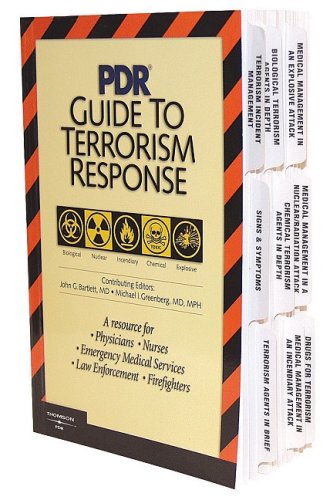
PDR guide to terrorism response a resource for physicians, nurses, emergency medical services, law enforcement, firefighters contributing editors, John G. Bartlett, Michael I. Greenberg.
Detalles de publicación: Montvale, NJ Thomson PDR c2005.Descripción: ii, 341 p. ill. 23 cmISBN:- 156363550X
- RC88.9.T47 .P37 2005
- WA 39
| Imagen de cubierta | Tipo de ítem | Biblioteca actual | Biblioteca de origen | Colección | Ubicación en estantería | Signatura topográfica | Materiales especificados | Info Vol | URL | Copia número | Estado | Notas | Fecha de vencimiento | Código de barras | Reserva de ítems | Prioridad de la cola de reserva de ejemplar | Reservas para cursos | |
|---|---|---|---|---|---|---|---|---|---|---|---|---|---|---|---|---|---|---|
| Referencia | Biblioteca Encarnación Valdés Sala de Referencia bev | 616.025 P3489 2005 (Navegar estantería(Abre debajo)) | Disponible | 80000002282799 |
Total de reservas: 0
Descripciones mejoradas de Syndetics:
A step-by-step guide for emergency responders, covering biological, chemical, incendiary, explosive and nuclear attacks, with in-depth information on biological and chemical agents written by experts in the field.
Includes bibliographical references.
Tabla de contenidos provista por Syndetics
- How to Use This Book(p. i)
- Part 1 Terrorism Incident Management
- Checklists for First Responders in the Field(p. 1)
- Part 2 Signs & Symptoms(p. 17)
- Part 3 Terrorism Agents in Brief
- Biological Terrorism Agents(p. 37)
- Chemical Terrorism Agents(p. 46)
- Explosives(p. 90)
- Burns(p. 91)
- Nuclear/Radiation(p. 92)
- Part 4 Biological Terrorism Agents in Depth
- CDC Category A Bioterrorism Agents (Most likely to be used by terrorists)(p. 97)
- CDC Category B Bioterrorism Agents (Less likely but still possible to be used by terrorists)(p. 151)
- Part 5 Chemical Terrorism Agents in Depth
- Acids(p. 173)
- Blood Agents(p. 177)
- Choking/Pulmonary Agents(p. 183)
- Incapacitating Agents(p. 201)
- Long-Acting Anticoagulants(p. 207)
- Metals(p. 209)
- Nerve Agents(p. 215)
- Organic Solvents(p. 225)
- Riot Control Agents(p. 229)
- Urticants (nettle agents)(p. 239)
- Vesicants (blister agents)(p. 241)
- Part 6 Medical Management in an Incendiary Attack
- ABCs of Burns: Initial Management of a Major Burn: I-Overview(p. 245)
- ABCs of Burns: Initial Management of a Major Burn: II-Assessment and Resuscitation(p. 251)
- ABCs of Burns: Intensive Care Management and Control of Infection(p. 257)
- Where There's Fire, There's Smoke: Assessing and Managing Inhalation Injury in the ED(p. 263)
- Part 7 Medical Management in an Explosive Attack
- Explosions and Blast Injuries: A Primer for Clinicians(p. 281)
- Blast Lung Injury: What Clinicians Need to Know(p. 285)
- Suicide Bombing Attacks: Update and Modifications to the Protocol(p. 287)
- Part 8 Medical Management in a Nuclear/Radiation Attack
- Interim Guidelines for Hospital Response to Mass Casualties from a Radiological Incident(p. 297)
- Acute Radiation Syndrome: A Fact Sheet for Physicians(p. 309)
- Cutaneous Radiation Injury: A Fact Sheet for Physicians(p. 315)
- Part 9 Drugs for Terrorism Response
- Anthrax Treatment(p. 321)
- Brucellosis Treatment(p. 323)
- BZ Treatment(p. 325)
- Cholera Treatment(p. 325)
- Cryptosporidium Treatment(p. 326)
- Cyanide Treatment(p. 326)
- Fentanyl Treatment(p. 327)
- Glanders Treatment(p. 327)
- Melioidosis Treatment(p. 328)
- Nerve Gas Treatment(p. 328)
- Plague Treatment(p. 329)
- Psittacosis Treatment(p. 330)
- Q Fever Treatment(p. 331)
- Radiation Exposure Treatment(p. 331)
- Salmonella Treatment(p. 332)
- Sarin Treatment(p. 332)
- Shigella Treatment(p. 333)
- Smallpox Treatment(p. 334)
- Tabun Treatment(p. 334)
- Tularemia Treatment(p. 334)
- Typhus Fever Treatment(p. 335)
- Viral Hemorrhagic Fever Treatment(p. 336)
- VX Treatment(p. 336)
- Supportive Care(p. 337)