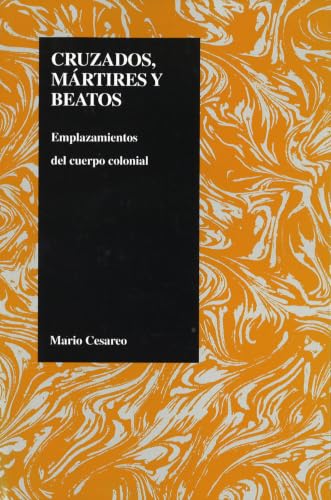

Cruzados, mártires y beatos emplazamientos del cuerpo colonial Mario Cesareo.
Series Purdue studies in Romance literatures ; v. 9Detalles de publicación: West Lafayette, Ind. Purdue University Press c1995.Descripción: xi, 201 p. 24 cmISBN:- 1557530750 (alk. paper)
- Missions -- Theory -- History of doctrines -- 17th century
- Christian literature, Spanish -- History and criticism -- Theory, etc
- Spanish American literature -- To 1800 -- History and criticism -- Theory, etc
- Spanish literature -- Classical period, 1500-1700 -- History and criticism -- Theory, etc
- Christian saints -- Portugal -- Colonies
- Christian saints -- Spain -- Colonies
- Missions -- Portugal -- Colonies
- Missions -- Spain -- Colonies
- Spain. -- Colonies -- Religion
- Latin America -- Civilization -- Philosophy
- Portugal -- Colonies -- Religion
- 266/.28 20
- BV2063 .C425 1995
| Imagen de cubierta | Tipo de ítem | Biblioteca actual | Biblioteca de origen | Colección | Ubicación en estantería | Signatura topográfica | Materiales especificados | Info Vol | URL | Copia número | Estado | Notas | Fecha de vencimiento | Código de barras | Reserva de ítems | Prioridad de la cola de reserva de ejemplar | Reservas para cursos | |
|---|---|---|---|---|---|---|---|---|---|---|---|---|---|---|---|---|---|---|
| Libro | Biblioteca Encarnación Valdés Colección General bev | 266.28 C421c (Navegar estantería(Abre debajo)) | Disponible | 80000002068727 |
Descripciones mejoradas de Syndetics:
By analyzing a varied body of writing--hagiographies, histories, treatises, and correspondence--in the context of religious colonial culture and European mercantilism, Mario Cesareo shows how Portuguese and Spanish missionaries created a Christian understanding of the colonial process. The material excess of the colonial world, experienced as a capricious parade of signs, masks, objects, races, languages, and bodies subjected to European exploitation, presented a problem of the first magnitude for Christian missionaries. In order to render intelligible the incongruities of the colonial experience, the missionary turned the materiality of the Indian and the black body of the slave into God's privileged instruments for revelation. Materiality, in its remotest minutiae, became understood as an enigmatic system of signs, as a divine riddle to be discerned. The attempts to recognize, elaborate, and synthesize this new experience constitute the Christian hermeneutics that is the focus of the study. The book posits the existence of a repertoire of stances through which the missionary was able to represent, perform, and theorize the colonial experience. In this social sensibility, the body emerges as a privileged locus for the aesthetic, theoretic, and practical experimentation that allowed the missionary to carry on his utopian ideals within the imperialist workings of European mercantilism.
Includes bibliographical references (p. 187-193) and index.
Notas de autor provistas por Syndetics
Mario Cesareo es miembro del departamento de estudios hispánicos de Vassar College. Ha publicado sobre la semiótica teatral, las literaturas coloniales brasileña e hispanoamericana, la producción novelesca bajo el neoliberalismo militarizado, la cultura poblacional y la estética de los movimientos de liberación negra en Norteamérica.
Mario Cesareo, originally from Buenos Aires, Argentina, holds a B.A. from the University of California, Irvine and a Masters and Ph.D. from the University of Minnesota. His research and publications include Latin American colonial studies, Goden Age theatre, contemporary popular culture, Argentine literature, culture and cinema, Caribbean literature, US social movements, postcolonial studies, theatre semiotics, aesthetic and subaltern theory.