Imagen de Amazon.com

Portada de Syndetics
Imagen de OpenLibrary
Developing reference collections and services in an electronic age a how-to-do-it manual for librarians Kay Ann Cassell.
Series Detalles de publicación: New York Neal-Schuman Publishers c1999.Descripción: x, 138 p. 28 cmISBN:- 155570364X (alk. paper)
- 1555703631
- 025.5/24 21
- Z711.45 .C37 1999
Contenidos parciales:
Introduction -- The changing face of reference collections -- Changing reference service patterns and models -- User and staff education needs -- Planning for the future -- Bibliography -- Reference resources cited -- Index -- About the author.
| Imagen de cubierta | Tipo de ítem | Biblioteca actual | Biblioteca de origen | Colección | Ubicación en estantería | Signatura topográfica | Materiales especificados | Info Vol | URL | Copia número | Estado | Notas | Fecha de vencimiento | Código de barras | Reserva de ítems | Prioridad de la cola de reserva de ejemplar | Reservas para cursos | |
|---|---|---|---|---|---|---|---|---|---|---|---|---|---|---|---|---|---|---|
| Libro | Biblioteca de Mayagüez Colección General mb | Z711.45 .C37 1999 (Navegar estantería(Abre debajo)) | Disponible | 50000002181021 | ||||||||||||||
| Referencia | Biblioteca Encarnación Valdés Sala de Referencia bev | 025.04 C344d (Navegar estantería(Abre debajo)) | Disponible | 80000002103276 | ||||||||||||||
| Libro | Biblioteca Encarnación Valdés Colección General bev | 025.04 C344d (Navegar estantería(Abre debajo)) | Disponible | 80000002132580 |
Total de reservas: 0
Descripciones mejoradas de Syndetics:
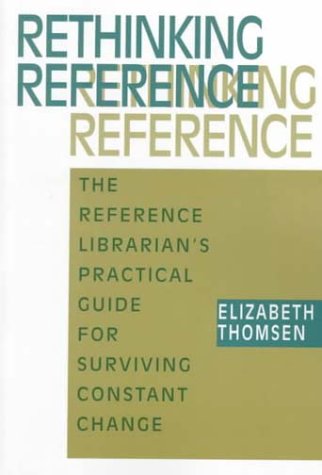
A survival guide for professionals working in, planning, or managing reference services in libraries. Discusses changing roles and new relationships with paraprofessionals and techies, and discusses new resources, time and space considerations, reference questions on the Web, and new services such
Includes bibliographical references (p. 125-131) and index.
Introduction -- The changing face of reference collections -- Changing reference service patterns and models -- User and staff education needs -- Planning for the future -- Bibliography -- Reference resources cited -- Index -- About the author.
Tabla de contenidos provista por Syndetics
- List of Figures(p. ix)
- Preface(p. xi)
- Acknowledgments(p. xv)
- Chapter 1 Reference: The Nature of the Business(p. 1)
- In the Beginning: 1875-1900(p. 1)
- A Century Later: 1975-2000(p. 6)
- The Economics of the Industrial Age and the Information Age(p. 8)
- Disintermediation(p. 11)
- New Challenges(p. 12)
- Libraries or Computer Centers?(p. 14)
- Reference Service: Traditional and Proactive(p. 17)
- Chapter 2 The Changing Role of the Reference Librarian(p. 23)
- Characteristics of Reference Librarians(p. 25)
- Nonjudgmental Desire to Help Others(p. 25)
- Curiosity(p. 26)
- Ability to Shift Focus(p. 26)
- General Knowledge(p. 26)
- Good Memory(p. 27)
- Excellent Communication Skills(p. 28)
- Patience(p. 28)
- Joy of the Hunt(p. 29)
- Creativity(p. 29)
- Reference Librarians and Other Staff Members(p. 30)
- Current Awareness(p. 31)
- Managing Change(p. 37)
- Changed Relationships(p. 38)
- New Relationships(p. 41)
- Paraprofessionals(p. 41)
- Librarians versus Techies(p. 44)
- Four Strategies for Success(p. 46)
- Chapter 3 Communication Skills(p. 49)
- What's the Question? The Reference Interview(p. 53)
- The Best Approach(p. 54)
- Understanding the Goal of the Question(p. 55)
- Starting the Search(p. 56)
- Serving Multilingual Patrons(p. 57)
- Multilingual Electronic Resources(p. 61)
- Translation Aids(p. 68)
- Other Language Issues(p. 70)
- Communication Challenges(p. 70)
- Mainstreaming(p. 73)
- Four Strategies for Success(p. 75)
- Chapter 4 Resources(p. 77)
- A Brief History of the Reference Collection(p. 77)
- Reference Books(p. 81)
- Ready Reference Collections(p. 85)
- Accuracy and Bias(p. 87)
- Creating Our Own Reference Resources(p. 90)
- Format versus Content(p. 92)
- Full-Text Periodicals Databases(p. 94)
- Books in Print(p. 98)
- Outside Competition(p. 99)
- Unpublished Sources(p. 102)
- Evaluation of Web Resources(p. 104)
- Five Strategies for Success(p. 108)
- Chapter 5 Time and Space(p. 111)
- The Reference Area(p. 113)
- The Reference Desk(p. 115)
- Height of the Reference Desk(p. 116)
- Beyond the Desk(p. 119)
- Roving Reference(p. 120)
- Technical Assistance(p. 122)
- Other Reference Services(p. 122)
- Research Consultation(p. 122)
- Bibliographic Instruction(p. 126)
- Staffing(p. 127)
- On-Desk/Off-Desk Time(p. 127)
- When Does Reference Happen?(p. 129)
- Extended Services(p. 131)
- Remote Access for Patrons(p. 132)
- Distance Education(p. 133)
- Four Strategies for Success(p. 134)
- Chapter 6 Questions, in and Out(p. 137)
- Types of Questions(p. 138)
- Questions with Answers(p. 138)
- Information Requests(p. 141)
- Pointers(p. 141)
- Tricksters(p. 142)
- Problematic Questions(p. 143)
- Criss-Cross(p. 143)
- Trivia Contests(p. 145)
- Homework Questions(p. 149)
- Reference Policy(p. 150)
- Intake Methods(p. 151)
- Walk-Up(p. 151)
- Telephone Reference(p. 153)
- Offline Methods(p. 155)
- Question-and-Answer Services(p. 156)
- Ask the Expert(p. 157)
- Virtual Reference Desk(p. 159)
- Ask Jeeves(p. 161)
- Library Reference Questions on the World Wide Web(p. 164)
- Falmouth Public Library(p. 165)
- Chicago Public Library(p. 166)
- Internet Public Library(p. 167)
- Four Strategies for Success(p. 168)
- Chapter 7 Reference Librarians as Trainers and Pathfinders(p. 171)
- Training(p. 171)
- Bibliographic Instruction(p. 173)
- The Art of Training(p. 175)
- Learning Styles(p. 175)
- Ambience(p. 178)
- Beyond Leaning Styles(p. 179)
- Training Techniques(p. 181)
- Keep It Real(p. 181)
- Avoid Demo-itis(p. 185)
- Handouts, Follow-Up, and Evaluation(p. 185)
- Flow(p. 186)
- Pathfinders(p. 187)
- From Paper to the Web(p. 188)
- Class Project Pathfinders(p. 191)
- Beyond Libraries(p. 193)
- Special Projects(p. 195)
- Partnerships(p. 198)
- Five Strategies for Success(p. 201)
- Chapter 8 Statistics Can Help Ensure Quality(p. 203)
- Counting(p. 204)
- Fewer Questions, Better Service(p. 207)
- New Statistics(p. 209)
- Accuracy(p. 211)
- Room for Improvement(p. 216)
- Focus Groups(p. 220)
- Five Strategies for Success(p. 221)
- Chapter 9 World Wide Web: Challenges and Opportunities(p. 225)
- Public Workstations(p. 229)
- Sound(p. 230)
- Software Changes(p. 235)
- Printing(p. 237)
- Confidentiality: New Concerns(p. 238)
- Problems for Shared Workstations(p. 239)
- Sources of Information(p. 241)
- Acceptable Use(p. 242)
- Filtering Software(p. 243)
- Policies(p. 244)
- Beyond Reference(p. 245)
- Chat and E-mail(p. 245)
- Personalized Information Services(p. 249)
- Reference and Library Web Pages(p. 251)
- Special Collections(p. 253)
- The World Wide Web, Today and Beyond(p. 260)
- Looking Ahead: Five Trends that Will Affect Reference Services(p. 261)
- Appendix A Sample Reference Policy(p. 267)
- Appendix B Sample Survey Form(p. 279)
- Sources Cited(p. 283)
- Index(p. 285)
- About the Author(p. 291)