Reseñas proporcionadas por Syndetics
Library Journal Review
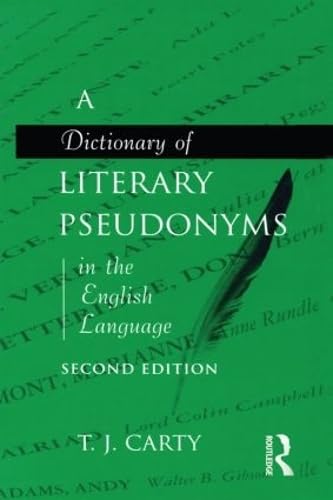
Carty, a British secondhand book dealer, has expanded the second edition of this work to include nearly 17,000 pseudonyms of more than 10,500 authors. (The first edition, published in 1995, included 12,000 pseudonyms for 7500 authors.) Following a brief "Select Bibliography," the dictionary is divided into two parts. Part 1 lists pseudonyms (both proper names and attributions such as "A Russian Lady") and initialisms in alphabetical order with references to the real name or names. Nicknames or diminutive forms of names are also included, such as Peter Marcus Adlard's pseudonym, Mark Adlard. Part 2 lists real names with vital dates, nationality, a brief description of the person, pseudonyms used, and representative titles in which pseudonyms are used. Pseudonyms used in journals and newspapers as well as names used in books are noted. The text does not indicate whether the writer uses his or her given name in addition to a pseudonym or whether one pseudonym predominates. Writers from the early 17th century to the present day are included, but the emphasis is decidedly British and historical. Although this book is not as authoritative as Contemporary Authors or as browsable as Adrian Room's Dictionary of Pseudonyms (LJ 10/1/98. 3d ed.), which often describes the origins of the pseudonyms of people in many other fields as well as writers, it is an easy-to-use one-volume resource. Recommended for libraries looking for a new reference source in this subject.DVivian Reed, Long Beach P.L., CA (c) Copyright 2010. Library Journals LLC, a wholly owned subsidiary of Media Source, Inc. No redistribution permitted.
CHOICE Review
Pseudonym dictionaries have a long and honorable history. The classic work, Halkett and Laing's Dictionary of Anonymous and Pseudonymous English Literature (1926-62), has been known and used with confidence by generations of reference workers. More recent works, e.g., Frank Atkinson's Dictionary of Literary Pseudonyms (4th ed., 1987) and Pseudonyms and Nicknames Dictionary (Gale, 3rd ed., 1987), provide an important ingredient of currency. Carty's Dictionary is the newest attempt to identify those who for various reasons did not wish to identify themselves. On the basis of sheer numbers, Carty's total, some 8,000 real names, falls considerably short of the 17,000 real names provided in the Gale volume. As to descriptive information, the two works are comparable--both give birth and death dates along with a brief identifying note (e.g., "English crime writer," "US physician," "Scottish cleric"). Atkinson does not compare well, since his entries lack both dates and descriptive identification. Carty shows a strong bias toward names of English, Irish, and Scottish descent and a heavy concentration of writers active in the 18th and 19th centuries. Carty's overall organization is straightforward--one list of pseudonyms, another of real names. Although the editing seems careful, a list of this size is certain to contain errors. Carty identifies only one pseudonym (Ogdred Weary) for author/illustrator Edward Gorey, but other sources include such delightful pseudonyms (most of them anagrammatic) as Eduard Blutig, Regera Dowdy, Dreary Wodge, and Redway Grode. Libraries that already own the Gale volume will only have marginal use for Carty. D. C. Dickinson; University of Arizona
Booklist Review
A standard component of most card catalogs was the provision of cross-references between variant forms of an author's name. This useful feature not only assisted patrons who were interested in reading all books by a certain author, regardless of the name used on the title page, but also frequently enabled reference librarians to answer questions regarding pseudonyms more quickly than by consulting printed sources. Although today's online catalogs offer many advantages over card catalogs, many do not yet provide cross-references that link the various names under which an author has chosen to write. Thus, the need for accurate and up-to-date printed guides to pseudonyms is even more important than ever. Compiled by a secondhand-book dealer in London, this dictionary identifies the real names behind approximately 12,000 pseudonyms used by about 7,500 English-language writers from the seventeenth century to the present. Therefore, it includes pen names for figures ranging chronologically from Daniel Defoe and Henry Fielding to Stephen King and Joyce Carol Oates. The dictionary is divided into two sections, the first of which lists pseudonyms and identifies the writer who used each name. The second section is arranged by the authors' original names. Each entry includes the person's dates and a brief phrase identifying the writer by nationality and genre, for example, "English romantic novelist." Pseudonyms used by the author are then listed alphabetically, with one or two representative titles provided in parentheses following each. Although Carty makes several factual errors (the most glaring of which is the identification of Harriet Stratemeyer Adams, the American writer who penned most of the Nancy Drew books, as an "English science-fiction writer" ), the most disappointing aspect of this work is its incompleteness. Many authors who used pseudonyms (e.g., Ian Fleming, Louis L'Amour, Edgar Lee Masters, John Steinbeck) are not here at all, while the lists of pseudonyms for those who are included are often incomplete. For example, Carty identifies three pseudonyms for T. S. Eliot, twelve for Harlan Ellison, two for Ken Follet, and one for P. G. Wodehouse. Major 20th-Century Writers (Gale, 1991) lists six for Eliot, twenty-one for Ellison, four for Follet, and six for Wodehouse. Comparisons of this work to other guides revealed that it is not as comprehensive as Pseudonyms and Nicknames Dictionary (3d ed., Gale, 1987) and Harold S. Sharp's Handbook of Pseudonyms and Personal Nicknames (Scarecrow, 1972; suppl., 1975; second suppl., 1982). Although this dictionary cannot stand alone as a reliable source of literary pseudonyms, it does include some unique entries. Therefore, large libraries will want to add it to complement the above mentioned sources. (Reviewed June 1 & 15, 1995)