Imagen de Amazon.com

Portada de Syndetics
Imagen de OpenLibrary
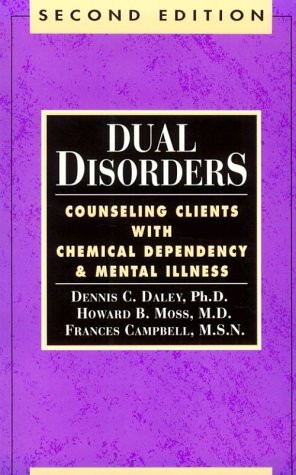
Dual disorders counseling clients with chemical dependency and mental illness Dennis C. Daley, Howard Moss, Frances Campbell.
Detalles de publicación: Center City, Minn. Hazelden 1993.Edición: 2nd edDescripción: xii, 237 p. 22 cmISBN:- 0894864491
- 616.86/0651 20
- RC564.68 .D35 1993
- WM 274 D139d
| Imagen de cubierta | Tipo de ítem | Biblioteca actual | Biblioteca de origen | Colección | Ubicación en estantería | Signatura topográfica | Materiales especificados | Info Vol | URL | Copia número | Estado | Notas | Fecha de vencimiento | Código de barras | Reserva de ítems | Prioridad de la cola de reserva de ejemplar | Reservas para cursos | |
|---|---|---|---|---|---|---|---|---|---|---|---|---|---|---|---|---|---|---|
| Libro | Biblioteca Encarnación Valdés Colección General bev | 616.860651 D141d2 (Navegar estantería(Abre debajo)) | Disponible | 80000002053653 |
Total de reservas: 0
Descripciones mejoradas de Syndetics:
More than 60 million books sold in the Teach Yourself series!
The secret behind boosting your baby's brain power and encouraging his or her development
Brain Training for Babies uses cutting-edge research, delivered by an author team which includes a leading child psychologist and a mother of two, to give you unparalleled insight into the miracle of your baby's mind and what really works to enhance it (and what doesn't).
There are hundreds of "brain training" games for you to try out with your baby, boosting everything from his or her language to physical development.
Includes:
Plenty of practical exercises to keep both you and your child interested and engaged One, five and ten-minute introductions to key principles to get you started Lots of instant help with common problems and quick tips for success, based on the authors' many years of experience Tests in the book and online to keep track of your progress Quick refreshers to help you remember the key factsIncludes bibliographical references (p. 215-232) and index.
Tabla de contenidos provista por Syndetics
- Preface to the Third Edition(p. xv)
- Acknowledgments(p. xix)
- Chapter 1 Dual Disorders: An Overview(p. 1)
- Introduction(p. 1)
- Prevalence of Dual Disorders(p. 4)
- Origins of Mental Disorders(p. 6)
- Relationships Between Chemical Dependency and Psychiatric Illness(p. 9)
- Three Perspectives on Dual Disorders(p. 13)
- Assessment of Dual-Diagnosis Clients(p. 20)
- Treatment of Psychiatric and Dual Disorders(p. 25)
- Treatment Adherence(p. 31)
- Systems Issues in the Treatment of Dual Disorders(p. 36)
- Summary(p. 37)
- Chapter 2 Chemical Dependency: Treatment and Recovery(p. 39)
- Understanding Chemical Dependency(p. 39)
- Classification and Assessment of Substance Use Disorders(p. 44)
- Psychosocial Treatment of Chemical Dependency(p. 54)
- Medications for Chemical Dependency(p. 57)
- Outcomes of Treatment for Chemical Dependency(p. 62)
- Summary(p. 63)
- Chapter 3 Recovery from Dual Disorders(p. 65)
- Overview of Recovery and Stages of Change(p. 65)
- Physical and Lifestyle Issues in Recovery(p. 67)
- Psychological and Behavioral Issues in Recovery(p. 69)
- Social, Interpersonal, and Family Issues in Recovery(p. 72)
- Spiritual Issues in Recovery(p. 75)
- Tailoring Recovery to the Dual-Disordered Client(p. 77)
- Summary(p. 78)
- Chapter 4 Family Involvement in Treatment and Recovery(p. 79)
- Impact of Psychiatric Disorders on the Family(p. 79)
- Impact of Substance Use Disorders on the Family(p. 81)
- Impact of Dual Disorders on the Family(p. 82)
- Factors Mediating the Impact of Dual Disorders on the Family(p. 84)
- Practical Strategies to Help Families(p. 87)
- Family Recovery(p. 96)
- Summary(p. 97)
- Chapter 5 Personality Disorders and Chemical Dependency(p. 99)
- An Overview(p. 99)
- Temperament and Character(p. 101)
- DSM Classification of Personality Disorders(p. 102)
- Types of Personality Disorders(p. 105)
- Treatment of Personality Disorders(p. 109)
- Summary(p. 111)
- Chapter 6 Antisocial Personality Disorder and Chemical Dependency(p. 113)
- An Overview(p. 113)
- DSM Assessment Criteria(p. 119)
- Counseling Issues(p. 121)
- The Continuum of Care(p. 124)
- Summary(p. 134)
- Chapter 7 Borderline Personality Disorder and Chemical Dependency(p. 137)
- An Overview(p. 137)
- DSM Assessment Criteria(p. 144)
- Counseling Issues and the Continuum of Care(p. 146)
- Medications(p. 156)
- Summary(p. 159)
- Chapter 8 Depression and Chemical Dependency(p. 161)
- An Overview(p. 161)
- Major Depression(p. 165)
- DSM Assessment Criteria for Major Depression(p. 168)
- Counseling Issues(p. 170)
- The Continuum of Care(p. 189)
- Medications(p. 192)
- Electroconvulsive Therapy(p. 196)
- Dysthymia(p. 198)
- Assessment of Suicidal Risk(p. 201)
- Summary(p. 203)
- Chapter 9 Bipolar Disorder and Chemical Dependency(p. 205)
- An Overview(p. 205)
- DSM Assessment Criteria for Bipolar I Disorder(p. 213)
- Assessment Issues(p. 214)
- Medications(p. 215)
- Counseling Issues(p. 219)
- The Continuum of Care(p. 227)
- Summary(p. 230)
- Chapter 10 Anxiety Disorders and Chemical Dependency(p. 233)
- An Overview(p. 233)
- Panic Disorder(p. 235)
- DSM Assessment of Panic Disorder(p. 239)
- Counseling Issues for Panic Disorder(p. 241)
- Medications for Panic Disorder(p. 245)
- Assessment Issues for Phobic Disorders(p. 247)
- Counseling Issues with Phobias(p. 250)
- Medication Issues for Phobic Disorders(p. 253)
- Assessment of Obsessive-Compulsive Disorder(p. 253)
- Counseling Issues for OCD(p. 254)
- Medications for OCD(p. 256)
- Posttraumatic Stress Disorder(p. 256)
- Assessment of PTSD(p. 260)
- Counseling Issues for PTSD(p. 262)
- Medication for PTSD(p. 266)
- Generalized Anxiety Disorder(p. 266)
- Assessment Issues for GAD(p. 269)
- Medication for GAD(p. 270)
- Counseling Issues for GAD(p. 271)
- The Continuum of Care(p. 272)
- Summary(p. 274)
- Chapter 11 Schizophrenia and Chemical Dependency(p. 277)
- An Overview(p. 277)
- Characteristics of Schizophrenia(p. 280)
- DSM Assessment Criteria for Schizophrenia(p. 283)
- Assessment Issues(p. 287)
- The Continuum of Care and Counseling Issues(p. 291)
- Summary(p. 308)
- Chapter 12 Cognitive Disorders and Chemical Dependency(p. 311)
- An Overview(p. 311)
- Delirium(p. 312)
- DSM Assessment Criteria for Delirium(p. 313)
- Dementia(p. 313)
- DSM Assessment Criteria for Dementia(p. 314)
- Amnestic Disorders(p. 315)
- DSM Assessment of Alcohol-Induced Persisting Amnestic Disorder(p. 317)
- Diagnosing Cognitive Disorders(p. 318)
- Counselor Assessment(p. 320)
- Medications(p. 323)
- Counseling Issues(p. 324)
- Summary(p. 326)
- Chapter 13 Relapse Prevention and Dual Disorders(p. 329)
- An Overview(p. 329)
- Clinical Interventions to Reduce Relapse Risk(p. 334)
- Summary(p. 347)
- Chapter 14 Group Treatment of Dual Disorders(p. 349)
- Goals and Curative Factors in Groups(p. 349)
- Summary(p. 365)
- Chapter 15 Issues in Dual Disorders Program Development(p. 367)
- Integrated Services and Counseling Approaches(p. 367)
- Developing Dual-Diagnosis Programming(p. 372)
- Review of Recovery Skills for Dual-Diagnosis Clients(p. 379)
- Summary(p. 380)
- Bibliography(p. 381)
- Index(p. 421)
- About the Authors(p. 447)
Notas de autor provistas por Syndetics
Dennis C. Daley, Ph.D., is director of the Center for Psychiatric and Chemical Dependency Services at Western Psychiatric Institute and Clinic of the University of Pittsburgh Medical CenterHoward B. Moss, M.D., is an addiction psychiatrist and a professor of psychiatry at the University of Pennsylvania School of Medicine