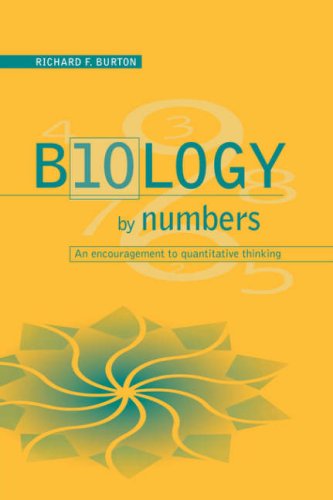

Biology by numbers an encouragement to quantitative thinking Richard F. Burton.
Detalles de publicación: New York, NY Cambridge University Press 1998.Descripción: xvi, 238 p. ill. 24 cmISBN:- 0521571561
- QH438.4 .M33 B87 1998
| Imagen de cubierta | Tipo de ítem | Biblioteca actual | Biblioteca de origen | Colección | Ubicación en estantería | Signatura topográfica | Materiales especificados | Info Vol | URL | Copia número | Estado | Notas | Fecha de vencimiento | Código de barras | Reserva de ítems | Prioridad de la cola de reserva de ejemplar | Reservas para cursos | |
|---|---|---|---|---|---|---|---|---|---|---|---|---|---|---|---|---|---|---|
| Libro | Biblioteca de Mayagüez Colección General mb | QH438.4 .M33 B87 1998 (Navegar estantería(Abre debajo)) | Disponible | 50000002119724 |
Descripciones mejoradas de Syndetics:
Biologists are notoriously reticent about using mathematics. This textbook is both an introduction to quantitative biology and a guide for the number-shy. Richard Burton fosters a sense of the fundamental importance and usefulness of mathematical principles in biology, with a fascinating range of examples. The book is geared towards the non-mathematician, and covers the basics as well as various more advanced topics from many diverse biological disciplines. Questions and calculations encourage active participation without holding up the reader. A key feature is the structure of the book. Rather than building it around biological disciplines, Dr Burton emphasises the common ways of reasoning used in areas as diverse as insect and population growth, seed mortality and sensory response (to mention a few that use logarithms). Written primarily for beginning undergraduates, this enlightening text will also be an essential aid for students throughout their undergraduate and graduate years.
Includes bibliographical references (p. 217-223) and index.
Tabla de contenidos provista por Syndetics
- Preface
- A guide to the book
- 1 Putting two and two together
- 2 Units, formulae and the use of old envelopes: confronting some obstacles to quantitative thinking
- 3 Aspects of energy metabolism
- 4 Getting things in proportion
- 5 Perilous percentages, dangerous ratios
- 6 Building a trophic pyramid
- 7 Sodium in animals and plants
- 8 Exchanges of water and carbon dioxide
- 9 A geometric series
- 10 Introduction to logarithms
- 11 Bringing logarithms to life
- 12 Exponential relationships
- 13 Aspects of allometry
- 14 More on allometry, and on quantitative patterns in nature
- 15 How the abundance of food affects rates of feeding
- 16 The characterization of trees and other branching systems
- 17 Epilogue
- References
- Notes
- Index
Notas de autor provistas por Syndetics
Richard Francis Burton 1821-1890 Sir Richard Burton, the explorer, adventurer, translator, and student of Eastern sexual customs, was born in Torquay, England. He received an irregular education, which included an expulsion from Oxford University. In 1842 Burton enlisted in army of the East India Company and went to India, where he learned the Persian, Hindustani, Afghan, and Arabic languages. Burton was the first European to reach Harar, the religious capital of Somaliland. He was the discoverer of Lake Tanganyika and explored in the Congo, the Cameroons, Dahomey, and Brazil. He was a pioneer ethnologist and anthropologist.Burton was a linguist of dazzling ability, speaking 29 languages and 11 dialects. He wrote 43 books on his travels and two volumes of poetry. In addition to translating The Arabian Nights, he translated six volumes of Portuguese literature, two volumes of Latin poetry, and four volumes of Neapolitan, African, and Hindu folklore.
Burton, together with Forster Fitzgerald Arbuthnot, created The Kama Shastra Society to print and circulate books that would be illegal to publish in public. This society fulfilled his ability to write about his deep interest in sexuality. Best known in this vein is his translation of The Kama Sutra, printed by the society in 1883. He was working on an English translation from the French edition of the arabic erotic guide called The Perfumed Garden. His manuscript entitled The Scented Garden was burned after his death by his wife, Isabel Arundel. It is rumored that Burton wanted this book to be published after his death to provide an income for Isabel, but she destroyed it in an effort to preserve his reputation. Burton died of a heart attack on October 20, 1890.
Both Burton and his wife are buried in a tomb that is shaped like a Bedouin tent, designed by Isabel. The tomb is in St. Mary Magdalen's Roman Catholic Church Mortlake, southwestern London.
(Bowker Author Biography)