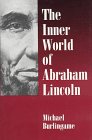
Abraham Lincoln's excruciating, yet highly productive, midlife crisis; his woeful marriage to a dishonest woman who often embarrassed and sometimes physically abused him; his intense estrangement from a shiftless father; his streak of cruelty; his explosive temper; and his aversion to women are among the topics covered by Michael Burlingame in The Inner World of Abraham Lincoln. Based primarily on long-neglected manuscript and newspaper sources - especially on reminiscences of people who knew Lincoln - this psychobiography casts new light on the emotional origins of Lincoln's deep hatred of slavery, on his transformation from a party hack to a statesman, on his relations with his family, on the causes of his depressions, and on the roots of his ambition. Burlingame uses a blend of Freudian and Jungian theory to interpret the psyche of the sixteenth president.
Includes bibliographical references and index.
Reseñas proporcionadas por Syndetics
Library Journal Review
In the tradition of psychobiography epitomized by Fawn Brodie (Thomas Jefferson: An Intimate History, LJ 4/15/94), Connecticut College historian Burlin-game opens the psychiatrist's couch to Lincoln. The author claims no attempt to rewrite the story of Lincoln's life; rather, he traces the origin of Lincoln's furious temper, cruel streak, aversion to women, hatred of slavery, and stormy relationship with his temperamental wife. Lincoln has been the subject of other psychobiographies (e.g., Charles B. Strozier's Lincoln's Quest for Union, LJ 4/15/82), and Burlingame does much to synthesize these other works. At the same time, he challenges the work of Lincoln's traditional biographer, James G. Randall. Utilizing the papers of Lincoln's law partner, William H. Herndon, and contemporary newspaper accounts, the author gives us an aggregate picture of a troubled man. Whether you agree with Burlingame or not, his analysis is an important new look at the man who shaped the course of a nation in peril. Highly recommended for all academic and public libraries.-Boyd Childress, Auburn Univ. Lib., Ala. (c) Copyright 2010. Library Journals LLC, a wholly owned subsidiary of Media Source, Inc. No redistribution permitted.
CHOICE Review
Burlingame (Connecticut College), following the footsteps of Dwight Anderson, George Forgie, Charles Strozier, and others, has essayed a psychological study of Abraham Lincoln; and perhaps he has left a deeper imprint than his predecessors. Employing Jungian interpretation, he fits his subject into Jung's Old Man archetype, combining the qualities of the Wise Elder and the Great Father, driven by a "transpersonal unconscious ... given at birth." The book examines such subjects as Lincoln's hatred of slavery, his attitude toward women, his anger and cruelty, and his marriage--"a fountain of misery." Burlingame's broad reading is notable. He relies heavily on reminiscences told after Lincoln had become a martyr and near saint. In a controversial chapter on Lincoln's marriage, Burlingame acknowledges that most evidence about Mary Lincoln's nagging is secondhand. What it all comes down to is puzzling: after examining shortcomings of his subject apparently influenced by Lincoln's personal experience, not by a "transpersonal unconscious," Burlingame remarks that "what stands out about Lincoln's inner life is not his psychological weakness but his remarkable strength." This provocative book is suitable for college and university libraries and Lincoln buffs. J. A. Rawley; University of Nebraska-Lincoln
The inner world of Abraham Lincoln
APA
Burlingame M., . (1994). The inner world of Abraham Lincoln. Urbana: University of Illinois Press.
Chicago
Burlingame Michael, . 1994. The inner world of Abraham Lincoln. Urbana: University of Illinois Press.
Harvard
Burlingame M., . (1994). The inner world of Abraham Lincoln. Urbana: University of Illinois Press.
MLA
Burlingame Michael, . The inner world of Abraham Lincoln. Urbana: University of Illinois Press. 1994.