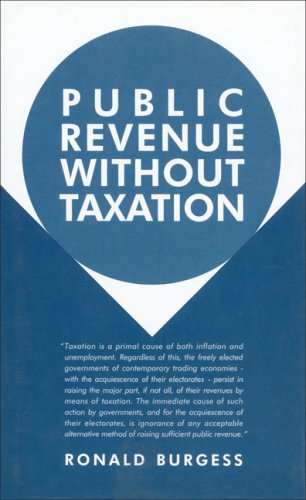
Imagen de portada de Amazon
Imagen de Amazon.com
Imagen de cubierta Syndetics
Portada de Syndetics
Imagen de OpenLibrary

Public revenue without taxation Ronald Burgess.

Por: Detalles de publicación: London Shepheard-Walwyn 1993.Descripción: vii, 120 p. ill. 23 cmISBN:
  • 0856831352
Tema(s): Clasificación CDD:
  • 336.02 20
Clasificación LoC:
  • HJ2305 .B87 1993
Valoración
    Valoración media: 0.0 (0 votos)
Existencias
Imagen de cubierta Tipo de ítem Biblioteca actual Biblioteca de origen Colección Ubicación en estantería Signatura topográfica Materiales especificados Info Vol URL Copia número Estado Notas Fecha de vencimiento Código de barras Reserva de ítems Prioridad de la cola de reserva de ejemplar Reservas para cursos
Libro Biblioteca Encarnación Valdés Colección General bev 336.02 B955p (Navegar estantería(Abre debajo)) Disponible 80000001747032
Total de reservas: 0

Descripciones mejoradas de Syndetics:

The author argues that the recurrent economic ills that beset modern industrial economies are the result of the failure of orthodox economic theories. At the heart of the problem lies a lack of understanding of the harmful effects of taxation on a trading economy. Governments must raise revenue to finance their operations, but it has been assumed that taxation is the only means. Dr. Burgess maintains that this is an error that has distorted the efficient operation of modern trading economies and that there is a natural source of government revenue, natural in the sense of arising from the nature of a trading economy. Having argued his case by reference to classical, neoclassical, and modern economists, he indicates how reform may be introduced with a minimum of disruption, so that politicians, with an eye to the next election, may reap some results within the life of a parliament.

Includes bibliographical references and index.

Reseñas proporcionadas por Syndetics

CHOICE Review

Inflation, unemployment, and a lack of justice characterize modern trading economies and flow directly from government failure to recognize the principle of private property. Burgess views as failures the contemporary macro-policy approaches of both the demand-side school, whose solutions to the problem of unemployment have been inflation and central planning, and the supply-side school, whose efforts to reduce inflation via monetary control and privatization have led to the return of high levels of unemployment. A fatal flaw in the approaches of both schools is seen to result from their blind acceptance of taxation as a customary and usual payment for government services. Burgess argues that as compulsory payments for which there is no quid pro quo, taxes appropriate and erode private income to the detriment of society in general and to the employee class in particular. From Smith to the Physiocrats to Marshall to Keynes and especially to Henry George, Burgess seeks to establish support for his view that the price of land must serve both as the bedrock for the collection of public revenues and as the ultimate limit on government spending. Public value, defined as the residual when private value is deducted from market value of land, appropriately belongs to the state. The argument is theoretical, and geometry is the primary expository tool. Upper-division undergraduate; graduate. R. Kelly; Fairfield University

Notas de autor provistas por Syndetics

Ronald Burgess was the director of the Economic Study Association from its inception in 1965 until his death in 2002. He was a life member of the Royal Economic Society and a member of the Academic Advisory Council of the Bruges Group. He contributed actively to a number of programs for the BBC, BFBS, and LBC and contributed articles to national newspapers and magazines.
Compartir
logopucpr-y-vive

Contáctanos

¡Queremos saber de ti!

Tel. 787.841.2000 Ext. 1801

bibliotecavaldes@pucpr.edu

⁣Búscanos en las redes

© 2026 Desarrollado por Ignite Online • All Rights Reserved • Powered by Koha.