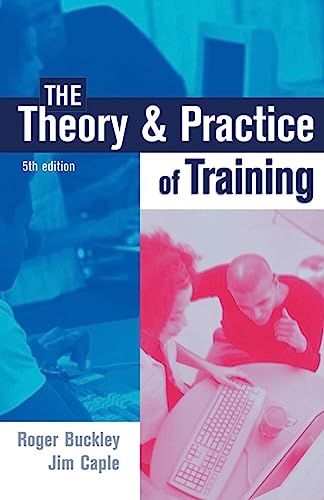

The theory and practice of training Roger Buckley & Jim Caple.
Detalles de publicación: London Sterling, VA Kogan Page 2004.Edición: 5th edDescripción: vii, 324 p. ill. 24 cmISBN:- 0749441569
- 658.3124 B9244t5 22
- HF5549.5.T7 B757 2004
| Imagen de cubierta | Tipo de ítem | Biblioteca actual | Biblioteca de origen | Colección | Ubicación en estantería | Signatura topográfica | Materiales especificados | Info Vol | URL | Copia número | Estado | Notas | Fecha de vencimiento | Código de barras | Reserva de ítems | Prioridad de la cola de reserva de ejemplar | Reservas para cursos | |
|---|---|---|---|---|---|---|---|---|---|---|---|---|---|---|---|---|---|---|
| Libro | Biblioteca Encarnación Valdés Colección General bev | 658.3124 B9244t5 (Navegar estantería(Abre debajo)) | Disponible | 80000002214271 |
Descripciones mejoradas de Syndetics:
Praise and Reviews`A valuable resource for trainers, both new and experienced... and others with responsibility for training and development.` The Training Officer"As an introduction to the field of training, the book has much to offer."Dr Alan Mumford'The way in which the authors deal with real issues is most impressive'Financial Adviser, 25 June 2002`This book should be compulsory reading every five years for all those in the training profession.`Careers ExtraFirmly established as a reliable and comprehensive introduction to the topic, this updated edition has been expanded to include information on recent changes in the field of training. For this fifth edition, the authors have expanded on and amplified the wide-ranging structure of the book to produce a comprehensive outline of the major instructional and training concepts, and their relationship to training in practice. The book is illustrated throughout with real-life examples and numerous figures and diagrams, and issues examined in detail include:the role of training in organisationsproactive and reactive assessments of training needstheoretical models of trainingcompetence-based trainingtraining objectivestraining strategies and training methodsvalidation, evaluation and assessment of trainingWritten with the newcomer to the training function particularly in mind, this practical and engaging book is as valuable to those seeking to put their training experience into a coherent context as it is to managers who need to understand the role that training can play.
Includes bibliographical references (p. [310]-316) and index.
Tabla de contenidos provista por Syndetics
- Foreword(p. ix)
- Acknowledgments(p. xi)
- Introduction(p. 1)
- 1 Training and the Organizational Environment(p. 5)
- The distinction between training and education(p. 6)
- Training, education and experience(p. 8)
- Benefits of training(p. 9)
- The image of training(p. 13)
- Training and corporate strategy(p. 17)
- Training and systems thinking(p. 21)
- 2 A Systematic Approach to Training(p. 24)
- Stages in a systematic approach to training(p. 27)
- 3 The Reactive Route into Training(p. 38)
- 4 The Proactive Route into Training(p. 58)
- Summary and conclusions(p. 74)
- 5 Analyses for Training(p. 75)
- Job analysis(p. 79)
- Job synthesis and future-oriented job analysis(p. 80)
- Functional analysis(p. 85)
- Knowledge and topic analysis(p. 99)
- Manual skills analysis(p. 101)
- Social skills analysis(p. 102)
- Analysis of the target population(p. 103)
- Training needs/content analysis(p. 108)
- Training criteria and standards(p. 108)
- Evaluating criteria(p. 113)
- 6 Training Objectives(p. 116)
- Training objectives(p. 117)
- Structure of objectives(p. 118)
- Sources of information for objectives(p. 119)
- Writing performance statements(p. 120)
- Establishing standards and developing end-of-training criteria measures(p. 123)
- Dealing with attitudes(p. 124)
- Identifying the conditions(p. 126)
- The value of training objectives(p. 127)
- Dissenting views on objectives(p. 128)
- A response to the dissenting view(p. 130)
- 7 Learning Principles and Conditions(p. 133)
- Sequencing the training material(p. 134)
- Readiness of the learner(p. 135)
- Ways of learning(p. 143)
- General conditions of learning(p. 144)
- Principles and specific conditions supporting learning(p. 148)
- Conclusion(p. 183)
- 8 The Training Programme: Selection, Design and Delivery(p. 185)
- Constraints(p. 185)
- Target population(p. 188)
- Strategies and learning tactics(p. 188)
- Tactics(p. 190)
- Reinforcement and transfer tactics(p. 199)
- Selecting the strategy and tactics(p. 201)
- 9 Assessing the Effectiveness of Training(p. 208)
- Reaction level(p. 209)
- Learning level(p. 214)
- Job behaviour and performance level(p. 222)
- Organization level(p. 230)
- Conclusion(p. 233)
- 10 Auditing Training(p. 234)
- Auditing the training system at the event level(p. 234)
- Auditing the training system at the functional level(p. 249)
- Auditing the training system at the organizational level(p. 250)
- The training auditor(p. 251)
- 11 The Role of the Trainer(p. 253)
- The trainer in context(p. 253)
- Who are the trainers?(p. 254)
- Trainer skills(p. 256)
- Changing roles of the trainer(p. 264)
- Managing the transfer of training(p. 266)
- The consultancy role of the trainer(p. 269)
- Marketing the training function(p. 275)
- A final word(p. 279)
- Appendix 1 Methods for Obtaining Information about Performance Problems and Job/Task Content(p. 280)
- Structured interview(p. 280)
- Observation(p. 282)
- Questionnaire(p. 283)
- Participation(p. 284)
- Self-written job description(p. 285)
- Work diary(p. 287)
- Film-video-photography(p. 288)
- Study of existing personnel records(p. 289)
- Technical conference/Group discussion(p. 290)
- Appendix 2 Sampling(p. 292)
- Methods of sampling(p. 293)
- Sample size(p. 294)
- Appendix 3 Example of a Learning Journal(p. 295)
- Appendix 4 Illustration of a Tutor's Review of a Course(p. 299)
- Appendix 5 Example of a Checklist to Assess Trainer Performance(p. 303)
- References(p. 310)
- Index(p. 317)