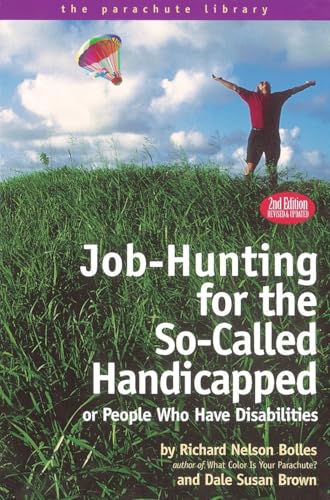
Imagen de portada de Amazon
Imagen de Amazon.com
Imagen de cubierta Syndetics
Portada de Syndetics
Imagen de OpenLibrary

Job-hunting for the so-called handicapped or people who have disabilities.

Por: Colaborador(es): Series Bolles, Richard Nelson. Parachute library ; Detalles de publicación: Berkeley Ten Speed Press c2001.Edición: 2nd ed. Richard Nelson Bolles, Dale Susan BrownDescripción: 159 p. ill. 23 cmISBN:
  • 1580081959 (alk. paper)
Tema(s): Clasificación CDD:
  • 650.14087 B6918j2 21
Clasificación LoC:
  • HV1568.5 .B65 2001
Contenidos:
A short course on disabilities for those of us who do not (yet) have a disability -- The Americans with Disabilities Act : what it can do, and what it cannot do -- Job-hunting and people with disabilities -- The fears an employer has when interviewing people with disabilities and how you can persuade them that you are qualified -- Overcoming your own fears and avoiding self-sabotage -- Eight reasons for hope that are important to those of us with disabilities (as well as to our would-be employers, counselors, friends, and families).
Valoración
    Valoración media: 0.0 (0 votos)
Existencias
Imagen de cubierta Tipo de ítem Biblioteca actual Biblioteca de origen Colección Ubicación en estantería Signatura topográfica Materiales especificados Info Vol URL Copia número Estado Notas Fecha de vencimiento Código de barras Reserva de ítems Prioridad de la cola de reserva de ejemplar Reservas para cursos
Libro Biblioteca Encarnación Valdés Colección General bev 650.14087 B6918j2 (Navegar estantería(Abre debajo)) Disponible 80000002285784
Libro Biblioteca Mons. Iñaki Mallona (Arecibo) Colección General ab 650.14087 B6918j2 (Navegar estantería(Abre debajo)) Disponible 60000010017686
Total de reservas: 0

Descripciones mejoradas de Syndetics:

Richard Bolles's WHAT COLOR IS YOUR PARACHUTE? has helped millions of readers find their path in life, and now his creative approach to job-hunting is brought to bear on the specific challenges faced by job hunters with disabilities. In JOB-HUNTING FOR THE SO-CALLED HANDICAPPED, Bolles and Dale Susan Brown guide readers through the often-frustrating, but ultimately rewarding process of securing independence in their lives and personal satisfaction in their careers. The authors begin by demystifying the intricacies of the ADA, describing in clear terms what the act does and does not guarantee disabled job hunters, and then move on to job-hunting strategies tailored specifically to people with disabilities.

Rev. ed. of: Job-hunting tips for the so-called handicapped or people who have disabilities / by Richard Nelson Bolles.

Includes bibliographical references (p. 140-150) and index.

A short course on disabilities for those of us who do not (yet) have a disability -- The Americans with Disabilities Act : what it can do, and what it cannot do -- Job-hunting and people with disabilities -- The fears an employer has when interviewing people with disabilities and how you can persuade them that you are qualified -- Overcoming your own fears and avoiding self-sabotage -- Eight reasons for hope that are important to those of us with disabilities (as well as to our would-be employers, counselors, friends, and families).

Tabla de contenidos provista por Syndetics

  • Acknowledgments(p. 9)
  • A Word About This Edition: A Foreword(p. 11)
  • Chapter 1 A Short Course on Disabilities for Those of Us Who Do Not (Yet) Have a Disability(p. 19)
  • Chapter 2 The Americans with Disabilities Act: What It Can Do--and What It Cannot Do(p. 28)
  • What the ADA Can Do for Us(p. 29)
  • What the ADA Cannot Do for Us(p. 31)
  • Legal Action: How Do You Proceed?(p. 34)
  • Chapter 3 Job-Hunting and People with Disabilities(p. 37)
  • Rejection Shock(p. 40)
  • The Truth About Job-Hunting(p. 40)
  • The Numbers Game and How It Works Against People with Disabilities(p. 41)
  • The Creative Job-Hunting Technique(p. 43)
  • Handling Your Disability While You Look for Work the Creative Way(p. 44)
  • The Job Accommodation Network (JAN)(p. 52)
  • Resources for Recorded Materials(p. 55)
  • Creative Job-Hunting: An Excellent Strategy for People with Disabilities(p. 61)
  • Rules About Competing for Openings(p. 64)
  • Chapter 4 The Fears an Employer Has When Interviewing People with Disabilities and How You Can Persuade Them That You Are Qualified(p. 66)
  • Employer Fears: What They Are and How to Handle Them(p. 66)
  • Persuading Employers That You Are Qualified(p. 75)
  • Chapter 5 Overcoming Your Own Fears and Avoiding Self-Sabotage(p. 79)
  • Internal and External Oppression(p. 80)
  • Examples of Botched-Up Interviews(p. 84)
  • Asking Employers for Feedback(p. 87)
  • Overcoming Internalized Oppression(p. 88)
  • Chapter 6 Eight Reasons for Hope That Are Important to Those of Us with Disabilities (As Well As to Our Would-Be Employers, Counselors, Friends, and Families)(p. 93)
  • 1. Everyone is disabled And everyone is employable(p. 93)
  • 2. Everyone is a member of many "tribes."(p. 95)
  • 3. People with disabilities are forming their own tribe or tribe(s)(p. 100)
  • 4. People with disabilities are getting better educated(p. 102)
  • 5. Employers never hire a stranger(p. 103)
  • 6. The nation is changing its attitude toward people with disabilities in a positive direction--from paternalism to productivity(p. 106)
  • 7. In many places, ramps have replaced steps and access has improved(p. 107)
  • 8. Everyone redesigns or modifies their job so as to highlight their abilities and get around their limitations(p. 109)
  • Appendix A Handling Special Situations(p. 115)
  • Getting Help: Should You Hire a Counselor?(p. 115)
  • Resources for People Who Are Newly Disabled or New to the Disability Community(p. 120)
  • Resources and Information for People Who Are Receiving Social Security Benefits and Are Considering Going to Work(p. 121)
  • Appendix B Organizations and Resources to Help You and Other Job Seekers with Disabilities(p. 128)
  • National Organizations(p. 129)
  • Resume Databases(p. 130)
  • Connecting You to Individuals with Disabilities(p. 131)
  • Resources for People Who Are Blind(p. 132)
  • State and Local Resources for People with Disabilities(p. 133)
  • Other Sources of Help(p. 135)
  • Information About the Americans with Disabilities Act(p. 137)
  • If All Else Fails, Call Your Congressperson(p. 138)
  • Appendix C List of Written Resources(p. 140)
  • National Resource Directories for People with Disabilities(p. 141)
  • Periodicals to Connect You with the Community of People with Disabilities(p. 142)
  • Annotated List of Books that Provided Background for Job-Hunting for the So-Called Handicapped(p. 143)
  • Some Recommended Reading(p. 145)
  • Some Books and Booklets Specifically for Job Seekers with Disabilities(p. 146)
  • Annotated List of Selected Reports and Surveys Used to Research this Book(p. 148)
  • P.S. to Employers(p. 151)
  • Index(p. 152)
  • About the Authors(p. 157)

Extracto provisto por Syndetics

Chapter One A Short Course on Disabilities FOR THOSE OF US WHO DO NOT (YET) HAVE A DISABILITY The word "disability" is defined in many different ways. Ironically, the U.S. Census defines disability as " a condition that limits or prevents working ." According to the latest published survey, 17.4 million people who are working age (16-64) had such a disability.     Of course, that's a pretty bad definition. The government is trying to improve it, because so many people with severe disabilities do succeed in working. The very point of this book is that everyone is employable.     Another definition, from the Survey of Income and Program Participation (SIPP), includes more people. Of course, it covers people who are unable to work or limited in the work they can do. But, it also includes people qualified for Social Security, who use wheelchairs, who report limits in what they can do, and those with other specified conditions. When this broader definition was used, the SIPP found 32 million working-age people with disabilities. The SIPP defined "working age" as 15-64.     Vocabulary is very important to all of us with disabilities. Generalizations are difficult to make, because vocabulary is hotly debated even within the disability community. But as a general rule , people with disabilities prefer to call themselves "people" or "people with disabilities," thus making each one a person primarily and one with a disability secondarily. "Disabled" is second on the list of preferred terms. Unfortunately many employers think of "disabled workers" as people who are out on workers' compensation.     "Handicapped" has come into great disfavor, although it does remain, in some public signs. The reason it is not liked is because of the history of the word. Veterans of the Crimean War used to beg with their cap in their hands. So, the term "handicapped" came to be.     People who use wheelchairs do not like the terminology "confined to a wheelchair," because many can transfer out of their chair to another seat or can use crutches. In addition, they feel a wheelchair liberates them from staying home. People with mental retardation prefer the term "cognitively disabled" or "self-advocate." People with psychiatric disabilities vary in the terminology they like. Some common ones include "mental health client," "consumer of mental health services," "mental health disability," and "psychiatric system survivor." People who cannot see, generally prefer to be called "people who are blind," though some do like the term "the blind." Some who can see a little prefer "visually impaired," "partially sighted," or "print impaired." People who are deaf come in two groups. Some people who are deaf consider themselves part of the "deaf culture." They use the term "Deaf" with a capital D. This refers to the group of people that communicates primarily through American Sign Language. Many of them are deaf children born in deaf families. Gallaudet University in Washington, DC, is a center of the "deaf culture." Those people who cannot hear but are not in the Deaf culture say they are "people who are deaf" or that they "can't hear." Other people who cannot hear well but have some hearing prefer "a person with a hearing impairment."     About 36 percent of men with disabilities who are of working age (16-64 years) are in the labor force or actively seeking work and for women with disabilities, that figure is 30 percent. That means that 64 percent of the men and 70 percent of the women are not in the labor force. These latter figures are often quoted as the unemployment rate among people with disabilities, though technically one is unemployed only if one wants to work and cannot find a job despite looking for one. Nonetheless, even with some allowance for this fact, people with disabilities remain the group with by far the highest unemployment rate in the United States today . A Harris Poll showed that seven out of ten people with disabilities who are not working do want to work. This, of course, represents an untapped labor pool that employers desperately need, in order to fill the many open jobs in today's economy. No matter how the labor market changes, the United States needs the skills and talents of all of its citizens.     Before this untapped labor pool of people with disabilities can be utilized, employers will have to discard many of the myths they believe without thinking, such as "People who are retarded are great at single-step repetitious tasks, and they don't mind doing them." Or, "People with quadriplegia are naturally good computer programmers." Or, "He's disabled--so he can't work here. We are too high pressure." Forty-two percent of people with disabilities say that an important reason they aren't working is because employers won't recognize that they are capable of doing a full-time job despite their disability or health problem.     Consider the kinds of jobs people with disabilities actually hold. Let's take people who are blind as an example. The full-time jobs they hold down include artists, auto mechanics, ballerinas, beekeepers, bicycle repair people, boatbuilders, carpenters, chiropractors, college professors, counselors (drug/ alcohol/youth/marriage), court reporters, dispatchers for 911 transportation companies, finger painters, fish-cleaners, food service managers, inventors, lawyers, licensed practical nurses, machinists, managers of snack stands and cafeterias in federal and other government buildings, marketing specialists, massage therapists, medical and legal transcribers, models (on runways as well as for magazines), musicians, packagers/assemblers in all kinds of manufacturing, painters, peanut vendors in stands at basketball or football games, professional storytellers, psychiatrists, public relations professionals, sculptors, strippers, teachers, word-processing and data-entry people, writers--and various kinds of self-employment. And this is only a sampling.     What kinds of salaries do people with disabilities make? Well in 1994-95, male workers with severe disabilities who were working full-time earned $1,262 a month. Those who did not have a disability earned $2,190 a month. Women with severe disabilities earned $1,000 a month. Those who had no disability earned $1,470 a month.     A survey in which people with disabilities were questioned about their earnings showed that: * 33 percent of people with disabilities who work make $25,000 or less a year; * 40 percent make between $25,001 and $50,000 a year; and * 20 percent make more than $50,001. While the average salary earned may seem respectable, it must be weighed against economic disincentives for ever going to work that confront a person once they have a disability and are receiving some sort of disability payments from a former employer or government, state or federal. These disincentives include: * The loss of sizable medical insurance that they may have been receiving from state/federal programs (e.g., SSDI --Social Security Disability Insurance, or SSI--Supplemental Security Income), though the recent passage of The Ticket to Work and Work Incentives Improvement Act of 1999 may ameliorate this problem in the future. * The inability to get similar insurance from one's new employer, since most private insurance companies will not cover preexisting conditions. * The mandatory time gap of up to two years a person faces between the time one may lose a job (due to "downsizing," "hostile takeovers," or being fired) and the time that one's old state/federal medical insurance can be reinstated.    Other factors include the need for time off for medical treatment (69 percent), the need for equipment or special devices (28 percent), and the lack of convenient and accessible transportation (24 percent). Also, some workplaces are still inaccessible, even though it is usually illegal. This happens despite the tax incentives to help small businesses that want to develop access.     What all of this adds up to is that a person with a disability may receive less total income (including medical payments) if they go to work than if they stay home. Nonetheless, people with disabilities still elect to seek work, even when it is economically disadvantageous for them to do so--even as people from "the private sector" may go into government service despite a similar loss of income. When people with disabilities do so, at such great personal cost, it is usually because of their driving need to put their God-given abilities into the service of the world. And, because of their need to maintain or increase their own sense of self-worth, as well as to prevent their skills from deteriorating through disuse.     It is certainly to our nation's advantage to assure that each person with a disability is employed inasmuch as the costs to the nation of their not working are: * the loss of taxes they would otherwise pay; * the loss of the money they would otherwise put into the economy through their purchases of life's necessities; * the loss of family income and taxes , where family members are forced to take part-time work or give up work all together; and * the cost of government funds to support the unemployed person who has a disability.     While throughout this book, we will be speaking of "people with disabilities" as though they are one "tribe," there is in actual fact, no such thing as a typical disabled person. As experts point out, every disability is a mix of three things: An Impairment (the actual limitations caused by the disability), The Individual (their personality, attitude, resources, etc.), and The Environment (how friendly or barring it is to that disability, how much support it offers to that individual). The outcome of that mix will vary widely from one person with a disability to another. The chart on the facing page, however, shows something of the immense varieties of disability.     Not mentioned in the chart are the varying causes of any specific disability. For example, if we see someone using a wheelchair, their "impairment of motion" may be due to amputation after an auto accident, arthritis, cerebral palsy, epilepsy, muscular dystrophy, polio, spina bifida, spinal cord injuries, or a variety of other causes.     What do these varying causes signify? They signify that disability is not like race, or height, or your birthplace. Where you were born will always be where you were born. Your race and height will also not change. But whether or not you are one of "the so-called handicapped or disabled" can change during the next twenty-four hours. This is why people with disabilities sometimes call everyone else TABs--for "temporarily able-bodied."     Five out of every six people with disabilities were NOT born with that disability. New causes of disability are constantly appearing; among those in the news recently include AIDS, chronic fatigue syndrome, children of mothers who take crack cocaine, attention deficit disorder, and carpal tunnel syndrome.     All of us , therefore, are only one incident or microbe away from joining this group of "people with disabilities." You can become permanently disabled with one accident at home, one fall (on an icy step, on a slippery sidewalk, on a newly waxed floor, down a flight of stairs, off a ladder, off a roof, on a ski slope, on an amateur playing field), one unexpected crippling illness (arthritis, heart disease, among others), one auto accident, one encounter with the wrong insect, or virus, or chemical agent. And this book, which you read today out of curiosity or compassion for others, may tomorrow become words you need for your very own life. Chapter Two The Americans with Disabilities Act WHAT IT CAN DO--AND WHAT IT CANNOT DO The Americans with Disabilities Act (ADA), signed by President George Bush in 1990, was a major step forward for people with disabilities. It gave people with disabilities civil rights--much like the ones held by minorities and women. The ADA covers transportation, public accommodations such as stores and hotels, telecommunications, and, of course, employment. The ADA makes it illegal for employers to discriminate against you because you have a disability.     And it has helped some people with disabilities get and keep jobs. Approximately 800,000 more severely disabled individuals were working in 1994 than in 1991 according to the Census Bureau's Survey of Income Program and Participation (SIPP).     We thought the legislation would be our knight in shining armor, riding to our rescue on a dazzling white steed. We thought that knight would guarantee us jobs. Well, the knight has indeed come along--except the armor is tarnished and the horse needs a good wash.     Much like a knight on a white horse, there are things the ADA can do for us--and things that it cannot do for us. This chapter will begin to describe what it can do--as well as what we must do for ourselves. WHAT THE ADA CAN DO FOR US     The Americans with Disabilities Act stated officially that people with disabilities experienced discrimination and tried to address that discrimination. It was passed by a massive effort of people with disabilities. They showed the nation (including many employers) that we were capable of organizing ourselves to pass a law.     Before the ADA passed, business owners could refuse to serve us in restaurants or not let us stay in a hotel. A grocery store clerk could refuse to take groceries down from high shelves -- even if that meant a customer with a disability then could not shop there.     It is hard to believe that before the ADA passed, applications had long lists of disabilities and health conditions. The job seeker had to check off those that they had--and these check marks were sometimes used to throw out the forms and not even interview those people.     No employer can look at us straight in the eye and say, "I am sorry, but we don't hire blind people." Or, "You have learning disabilities. So, we aren't willing to promote you." Or, "We don't pay for training for people who are deaf. It's just too expensive."     These things were said in the past--and the ADA has almost ended that era of blatant oppression.     The passage of the ADA--and the activities to publicize the law and make it work--awakened the conscience of many employers. They also became aware of the loss to their companies because of discrimination. They realized that they were missing out on valuable workers--and became determined to assure that everyone who was qualified could compete for jobs in their company. They also saw that they were losing money when good, experienced people went out on disability instead of producing on the job.     The Americans with Disabilities Act has rules (some legal and complicated and still wending their way through various levels of court) that set up a fair competition for each open job with employers that have fifteen or more employees. It basically covers announced openings where applicants are selected in a competitive manner. During the job interview, the employer may not ask you whether you have a disability or ask questions about your disability, unless you bring it up yourself (often a good idea if your disability is visible). Employers can give medical exams, only after they have made a job offer. And then, all people who received offers for the same type of employment would have to take the exam. (Continues...) Excerpted from Job-Hunting for the So-Called Handicapped by Richard Nelson Bolles & Dale S. Brown. Copyright (c) 2001 by Richard Nelson Bolles and Dale S. Brown. Excerpted by permission. All rights reserved. No part of this excerpt may be reproduced or reprinted without permission in writing from the publisher.

Notas de autor provistas por Syndetics

Richard Nelson Bolles was born in Milwaukee, Wisconsin on March 19, 1927. During World War II, he served in the Navy. He studied chemical engineering for two years at the Massachusetts Institute of Technology, then transferred to Harvard University, where he received a bachelor's degree in physics. After graduation, he decided to become an Episcopal minister. He received a master's degree in New Testament studies from General Theological Seminary in New York and was ordained in 1953.

He had been a clergyman for 18 years when a combination of budget problems and philosophical differences with superiors led to the elimination of his job and his dismissal in 1968 as a pastor at Grace Cathedral in San Francisco. After six months of searching, he got a job with United Ministries in Higher Education, an interdenominational church organization that recruited and supported college chaplains across the country. However, when the college chaplains were increasingly being laid off, he decided to help the chaplains find new careers. He was an ordained Episcopal minister until 2004, when he left the ministry.

In 1970, he self-published What Color Is Your Parachute?: A Practical Manual for Job-Hunters and Career-Changers as a photocopied how-to booklet for unemployed ministers. In 1972, he recast it to appeal to a wider audience and found an independent publisher willing to print small batches so that it could be frequently updated. His other books included How to Find Your Mission in Life and The Three Boxes of Life and How to Get Out of Them. He died on March 31, 2017 at the age of 90.

(Bowker Author Biography)

Compartir
logopucpr-y-vive

Contáctanos

¡Queremos saber de ti!

Tel. 787.841.2000 Ext. 1801

bibliotecavaldes@pucpr.edu

⁣Búscanos en las redes

© 2026 Desarrollado por Ignite Online • All Rights Reserved • Powered by Koha.