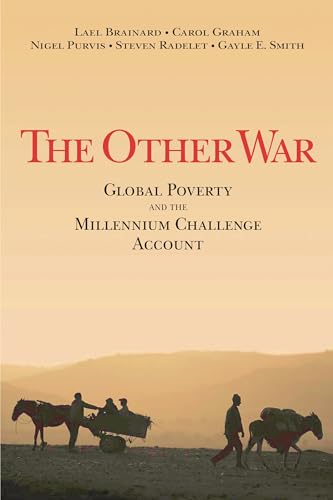

The other war global poverty and the Millennium Challenge Account Lael Brainard ... [et al.].
Detalles de publicación: Washington, D.C. Brookings Institution Press 2003.Descripción: x, 265 p. 24 cmISBN:- 081571114X (cloth : alk. paper)
- 0815711158 (pbk. : alk. paper)
- Global poverty and the Millennium Challenge Account
- Millennium Challenge Account
- 338.9173 O877 21
- HC60 .O84 2003
| Imagen de cubierta | Tipo de ítem | Biblioteca actual | Biblioteca de origen | Colección | Ubicación en estantería | Signatura topográfica | Materiales especificados | Info Vol | URL | Copia número | Estado | Notas | Fecha de vencimiento | Código de barras | Reserva de ítems | Prioridad de la cola de reserva de ejemplar | Reservas para cursos | |
|---|---|---|---|---|---|---|---|---|---|---|---|---|---|---|---|---|---|---|
| Libro | Biblioteca Encarnación Valdés Colección General bev | 338.9173 O877 (Navegar estantería(Abre debajo)) | Disponible | 80000002250192 |
Descripciones mejoradas de Syndetics:
A Brookings Institution Press and the Center for Global Development publication
The plight of the poorest around the world has been pushed to the forefront of America's international agenda for the first time in many years by the war on terrorism and the formidable challenges presented by the HIV/AIDS pandemic. In March 2002, President Bush announced the creation of the Millennium Challenge Account (MCA). This bilateral development fund represents an increase of $5 billion per year over current assistance levels and establishes of a new agency to promote growth in reform-oriented developing countries.
Amounting to a doubling of U.S. bilateral development aid--the largest increase in decades--the MCA offers a critical chance to deliberately shape the face that the United States presents to people in poor nations around the world. This book makes concrete recommendations on crafting a new blueprint for distributing and delivering aid to make the MCA an effective tool, not only in its own right, but also in transforming U.S. foreign aid and strengthening international aid cooperation more generally.
The book tackles head on the tension between foreign policy and development goals that chronically afflicts U.S. foreign assistance; the danger of being dismissed as one more instance of the United States going it alone instead of buttressing international cooperation; and the risk of exacerbating confusion among the myriad overlapping U.S. policies, agencies, and programs targeted at developing nations, particularly USAID.
In doing so, The Other War draws important lessons from new international development initiatives, such as the Global Fund to Fight AIDS, TB, and Malaria, the mixed record of previous U.S. aid efforts, trends in the U.S. budget for foreign assistance, the agencies currently involved in administering U.S. development policy, and the importance of the relationship between Congress and the executive branch in determining aid outcomes. The MCA holds the promise of substantially increasing U.S. development assistance and piolicy, and the importance of the relationship between Congress and the executive branch in determining aid outcomes. The MCA holds the promise of substantially increasing U.S. development assistance and pioneering a new era in aid, but the authors caution against creating yet another example of wasted aid that could undermine political support for foreign assistance for decades to come.
Includes bibliographical references and index.
Tabla de contenidos provista por Syndetics
- Foreword(p. vii)
- 1 Introduction(p. 1)
- 2 Global Aid Trends and Donor Coordination(p. 9)
- 3 Who Should Qualify?(p. 28)
- 4 Policy Framework for the Millennium Challenge Account(p. 87)
- 5 A New Approach to Aid(p. 101)
- 6 Institutional and Operational Guidelines(p. 127)
- 7 U.S. Foreign Assistance and Development Programs(p. 146)
- 8 A New Partnership between Congress and the Administration(p. 170)
- 9 Funding the Millennium Challenge Account(p. 194)
- 10 Making a Difference to Global Poverty(p. 211)
- Appendixes
- A Environment Assessments: The OPIC Model(p. 231)
- B Congressional Budgetary Basics(p. 234)
- Notes(p. 237)
- Contributors(p. 253)
- Index(p. 255)
Reseñas proporcionadas por Syndetics
CHOICE Review
Brainard (Brookings Institution) and coauthors Carol Graham, Nigel Purvis, Gayle E. Smith (all of Brookings), and Steve Radelet (Center for Global Development) present an insightful examination of the proposed Millennium Challenge Account (MCA). In March 2002, President Bush announced the MCA as a bold initiative to free development aid from its sordid history of politics and bureaucracy. The MCA promises $5 billion annually, improved performance through limited country eligibility, and a recipient-driven approach. However, emerging details undermine this purist vision of the MCA: the administration's plans dramatically underfund the MCA; give the State Department leverage while excluding USAID; expand coverage to include geopolitically important states; and ignore other U.S. and multilateral aid initiatives. The subtext is that the MCA is intended as a State Department slush fund and to undermine USAID. Nonetheless, the bulk of the book develops a design for the MCA to avoid these outcomes. The administration is unlikely to adopt this design, and many academic readers will find the level of detail (such as 60 pages on 16 country eligibility criteria) excessive. The book's intended audience appears to be other policy lobbyists and the Congress. ^BSumming Up: Recommended. Research and professional collections. C. Kilby Vassar CollegeNotas de autor provistas por Syndetics
Lael Brainard is director of the Brookings/CGD Project on the Millennium Challenge Account and holds the New Century Chair in Economic Studies and Foreign Policy Studies at the Brookings InstitutionCarol Graham is vice president and director of the Governance Studies Program at the Brookings Institution, where she also directs the Global Poverty Reduction Initiative
Steven Radelet is a senior fellow at the Center for Global Development
Nigel Purvis is a Brookings scholar on environment, development, and global issues
Gayle E. Smith is a guest scholar at the Brookings Institution and formerly was senior director for African affairs at the National Security Council