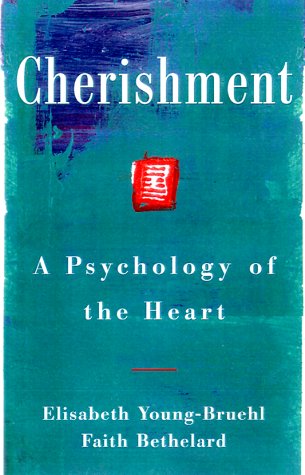

Cherishment a psychology of the heart Elisabeth Young-Bruehl, Faith Bethelard.
Detalles de publicación: New York The Free Press c2000.Descripción: xiv, 254 p. ill. 22 cmISBN:- 0684859661 :
| Imagen de cubierta | Tipo de ítem | Biblioteca actual | Biblioteca de origen | Colección | Ubicación en estantería | Signatura topográfica | Materiales especificados | Info Vol | URL | Copia número | Estado | Notas | Fecha de vencimiento | Código de barras | Reserva de ítems | Prioridad de la cola de reserva de ejemplar | Reservas para cursos | |
|---|---|---|---|---|---|---|---|---|---|---|---|---|---|---|---|---|---|---|
| Libro | Biblioteca de Mayagüez Colección General mb | BF175.5 .L68 Y68 2000 (Navegar estantería(Abre debajo)) | Disponible | 50000002169224 |
Descripciones mejoradas de Syndetics:
"Cher-ish-ment," n. F. "cher," dear. Sweet, indulgent love, esp. of children. Emotional equivalent of nourishment; soul food. What the world needs now.
Elisabeth Young-Bruehl and Faith Bethelard give a name to the kind, warm, tender, and affectionate love that babies expect before they can speak of it and that we all desire our whole lives long. As adults, they note, we all desire our whole lives long. As adults, they note, we don't often acknowledge or even understand our need for this "cherishment." Their book is a rare effort to explore that need, to create a "psychology of the heart."
In "Cherishment," Young-Bruehl and Bethelard provide a wholly original way of thinking about familiar concepts such as love, attachment, and care, showing how deep-seated disappointments and fears of dependency keep so many of us from forming healthy relationships. Questioning the traditional, celebratory view of independence and self-reliance, they argue that cherishment is the emotional foundation,formed in childhood, that sustains all kinds of growth-promoting adult bonds.
Blending the philosophical writing that has won Young-Bruehl i
Tabla de contenidos provista por Syndetics
- Illustrations(p. ix)
- Preface: Dear Reader(p. xi)
- Chapter 1 Discovering Cherishment(p. 1)
- Chapter 2 Amae in Infancy and After(p. 39)
- Chapter 3 Cherishment in Therapy and Therapists(p. 77)
- Chapter 4 When Cherishment Is Missing(p. 115)
- Chapter 5 The Amae of Everyday Adolescent Life(p. 161)
- Chapter 6 Cherishment Culture(p. 207)
- Suggestions for Further Reading and Acknowledgments(p. 251)
Extracto provisto por Syndetics
Reseñas proporcionadas por Syndetics
Library Journal Review
Young-Bruehl, whose books include biographies of Hannah Arendt and Anna Freud, teams with psychotherapist Bethelard to create a conversational look at developmental and clinical psychology using their own dreams, diary excerpts, and therapy cases. Sparked by the writings of Michael Balint and Japanese psychoanalyst Takeo Doi, with excursions into the I Ching and The Iliad, the book argues that human development has its emotional foundation in "cherishment" (Japanese amae, which holds that infants expect to be wholly loved). Rich with ideas and cross-cultural sophistication, the book reflects what good therapy always has included--acceptance of others' need for love and working through one's inevitable ambivalence about dependency. The mix of Freudian theory, linguistic sleuthing, and informality will disarm some and dismay others, but it represents an important attempt at a friendly takeover of psychoanalysis. Recommended for public libraries and psychology and social sciences collections.--E. James Lieberman, George Washington Univ. Sch. of Medicine, Washington, DC (c) Copyright 2010. Library Journals LLC, a wholly owned subsidiary of Media Source, Inc. No redistribution permitted.Publishers Weekly Review
Synthesizing classical Freudian theory and the writings of Japanese psychoanalyst Takeo Doi, biographer Young-Bruehl (Anna Freud, etc.) and psychotherapist Bethelard attempt to improve our understanding of infant psychology. Although Freud's drive theory describes a range of sexual and aggressive desires, it offers little to account for a baby's preverbal expectation of care--what Doi calls amae--which the authors believe is an essential characteristic of infancy. Amae, translated here as "cherishment," can be thought of as the dependence that derives from the self-preservative interests of the ego; therefore, the authors contend, it can be included among Freud's ego instincts. Using a collage of "memoir, dialogue, theoretical exposition, poetry, meditation, travelogue, joke, essay, dreamtext, anecdote and vignette," Young-Bruehl and Bethelard argue that cherishment is a need that persists throughout a person's psychological development and can lead to psychopathology if unfulfilled. Although they succeed in showing the relevance of Doi's theory to modern infant research, they fall short of demonstrating that cherishment truly fills a gap in psychoanalytic language. A vast literature already demonstrates the "preadaptedness" of the infant to recognize its mother and to expect to be loved. Additionally, Ronald Fairbairn long ago attempted to describe human development in terms of striving for "mature dependence." Nonetheless, the authors' personal style and therapeutic tales make their intriguing exploration accessible to general readers. Agent, Georges Borchardt. (Feb.) (c) Copyright PWxyz, LLC. All rights reservedBooklist Review
Young-Bruehl, a psychoanalyst, and Bethelard, a psychotherapist, merge Eastern philosophy and Western psychoanalysis to explore the concept of cherishment, the expectation to be loved. The authors focus on the Japanese concept of amae, roughly translated as cherishment, and trace similar concepts in early Greek literature that were devalued as Western civilization developed. But the authors see cherishment at the root of human relationships. The authors incorporate the material from the I Ching (the Chinese book of philosophy and divination), Homeric poetry, their patient sessions, and their own dreams to illustrate the significance of cherishment in healthy emotional development. The authors also examine encouraging trends (focus on emotional development from infancy), and opposing trends (disdain for emotional dependence), which are at the heart of cherishment. The authors look beyond contemporary psychoanalysis to offer an accessible book that is as much spiritual as it is psychoanalytical. --Vanessa BushNotas de autor provistas por Syndetics
Elisabeth Young-Bruehl was born in Elkton, Maryland on March 3, 1946. She received bachelor's, master's, and doctoral degrees in philosophy from the New School for Social Research in New York. She later trained as a psychoanalyst. She taught for many years at Wesleyan University and Haverford College. She wrote numerous books including Hannah Arendt: For Love of the World, Anna Freud: A Biography, Mind and the Body Politic, Why Arendt Matters, The Anatomy of Prejudices, and Childism: Confronting Prejudice Against Children. She died of pulmonary embolism on December 1, 2011 at the age of 65.(Bowker Author Biography)