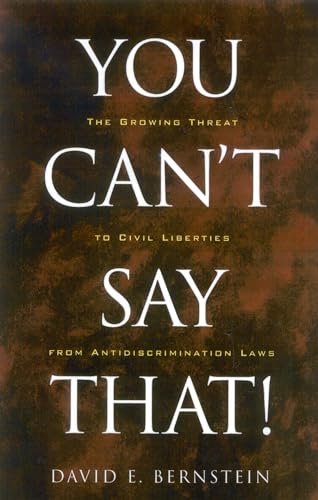

You can't say that the growing threat to civil liberties from antidiscrimination laws David E. Bernstein.
Detalles de publicación: Washington, D.C. Cato Institute c2003.Descripción: x, 197 p. 24 cmISBN:- 1930865538 (cloth : alk. paper)
- KF 4749 .B47 2003
| Imagen de cubierta | Tipo de ítem | Biblioteca actual | Biblioteca de origen | Colección | Ubicación en estantería | Signatura topográfica | Materiales especificados | Info Vol | URL | Copia número | Estado | Notas | Fecha de vencimiento | Código de barras | Reserva de ítems | Prioridad de la cola de reserva de ejemplar | Reservas para cursos | |
|---|---|---|---|---|---|---|---|---|---|---|---|---|---|---|---|---|---|---|
| Libro | Biblioteca de Derecho Mons. Fremiot Torres Oliver Colección General biblioteca derecho | KF 4749 .B47 2003 (Navegar estantería(Abre debajo)) | Disponible | 70000000765318 |
Descripciones mejoradas de Syndetics:
In a misguided attempt to eradicate every vestige of discrimination in our society, activists and courts are using antidiscrimination laws to erode civil liberties such as free speech, the free exercise of religion, and freedom of association.
Includes bibliographical references (p. 167-188) and index.
Why civil liberties should be protected from antidiscrimination laws - - The threat to freedom of expression in the workplace - - The threat to artistic freedom - - Political speech as illegal discrimination - - Censoring campus speech - - Compelled speech - - Public accommodations laws and the threat to the autonomy of private organizations - - Stifling expressive associations - - Regulating religious schools - - Religious landlords: antidiscriminations law as a weapon in the culture wars - - The right to privacy and the right to be left alone - - The ACLU and the abandonment of civil liberties.
Tabla de contenidos provista por Syndetics
- Acknowledgments(p. ix)
- Introduction(p. 1)
- 1. Why Civil Liberties Should Be Protected from Antidiscrimination Laws(p. 11)
- 2. The Threat to Freedom of Expression in the Workplace(p. 23)
- 3. The Threat to Artistic Freedom(p. 35)
- 4. Political Speech as Illegal Discrimination(p. 47)
- 5. Censoring Campus Speech(p. 59)
- 6. Compelled Speech(p. 73)
- 7. Public Accommodations Laws and the Threat to the Autonomy of Private Organizations(p. 85)
- 8. Stifling Expressive Associations(p. 97)
- 9. Regulating Religious Schools(p. 111)
- 10. Religious Landlords: Antidiscrimination Law as a Weapon in the Culture Wars(p. 121)
- 11. The Right to Privacy and the Right to Be Left Alone(p. 131)
- 12. The ACLU and the Abandonment of Civil Liberties(p. 145)
- Conclusion(p. 155)
- Notes(p. 167)
- Index(p. 189)