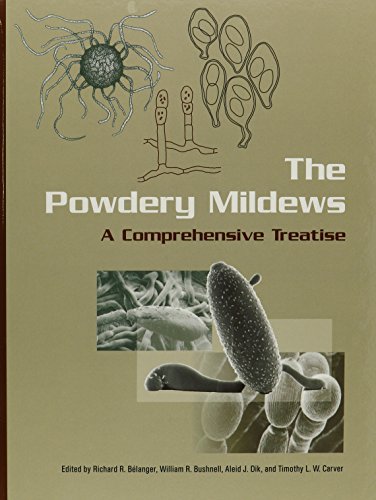

The Powdery mildews a comprehensive treatise edited by Richard R. Bélanger ... [et al.].
Detalles de publicación: St. Paul, Minn. APS Press, American Phytopatholgical Society c2002.Descripción: viii, 292 p. ill. (some col.) 29 cmISBN:- 0890542910
- 21 632.43 P881
- SB741.P72
| Imagen de cubierta | Tipo de ítem | Biblioteca actual | Biblioteca de origen | Colección | Ubicación en estantería | Signatura topográfica | Materiales especificados | Info Vol | URL | Copia número | Estado | Notas | Fecha de vencimiento | Código de barras | Reserva de ítems | Prioridad de la cola de reserva de ejemplar | Reservas para cursos | |
|---|---|---|---|---|---|---|---|---|---|---|---|---|---|---|---|---|---|---|
| Libro | Biblioteca Encarnación Valdés Colección General bev | 632.43 P881 (Navegar estantería(Abre debajo)) | Disponible | 80000002160458 |
Descripciones mejoradas de Syndetics:
A text comprising 18 chapters, written by international specialists in the powdery mildews, organized into five sections. The first part addresses the taxonomy, genetics, and infection structures of the powdery mildew fungi. Much new nomenclature is used in this section, along with the more familiar names. Research techniques are then covered, followed by a section discussing host-parasite interactions. Epidemiology and population genetics of powdery mildews are next covered, followed by five chapters addressing control methods including breeding for resistance, the development and use of fungicides, alternative controls employing biological agents and other environmental manipulations, and the potential for developing transgenic, mildew resistant plants. Includes a few color illustrations. Annotation c. Book News, Inc., Portland, OR (booknews.com)
Includes bibliographical references and index.
Tabla de contenidos provista por Syndetics
- Chapter 1 The Role of Powdery Mildew Research in Understanding Host-Parasite Interaction: Past, Present, and Future(p. 1)
- Chapter 2 The Taxonomy of the Powdery Mildew Fungi(p. 13)
- Chapter 3 Comparative Genetics of Avirulence and Fungicide Resistance in the Powdery Mildew Fungi(p. 56)
- Chapter 4 The Formation and Function of Infection and Feeding Structures(p. 66)
- Chapter 5 Basic Methods for Epidemiological Studies of Powdery Mildews: Culture and Preservation of Isolates, Production and Delivery of Inoculum, and Disease Assessment(p. 83)
- Chapter 6 DNA-Mediated Transformation of Blumeria graminis f.sp. hordei(p. 100)
- Chapter 7 Epidermal Cell Papillae(p. 107)
- Chapter 8 Localized Induction of Accessibility and Inaccessibility by Powdery Mildew(p. 126)
- Chapter 9 Genes and Molecular Mechanisms Controlling Powdery Mildew Resistance in Barley(p. 134)
- Chapter 10 The Nature and Role of Defense Response Genes in Cereals(p. 146)
- Chapter 11 Powdery Mildew of Arabidopsis: A Model System for Host-Parasite Interactions(p. 161)
- Chapter 12 Epidemiology of Powdery Mildews in Agricultural Pathosystems(p. 169)
- Chapter 13 Population Genetics of Powdery Mildew-Natural Plant Pathosystems(p. 200)
- Chapter 14 Breeding for Powdery Mildew Resistance in Common Wheat (Triticum aestivum L.)(p. 219)
- Chapter 15 Breeding Cucurbit Crops for Powdery Mildew Resistance(p. 239)
- Chapter 16 Controlling Powdery Mildews with Chemistry(p. 249)
- Chapter 17 Control of Powdery Mildews Without Chemicals: Prophylactic and Biological Alternatives for Horticultural Crops(p. 256)
- Chapter 18 Powdery Mildew Control Through Transgenic Expression of Antifungal Proteins, Resistance Genes, and Systemic Acquired Resistance(p. 268)
- Index(p. 289)