Reseñas proporcionadas por Syndetics
CHOICE Review
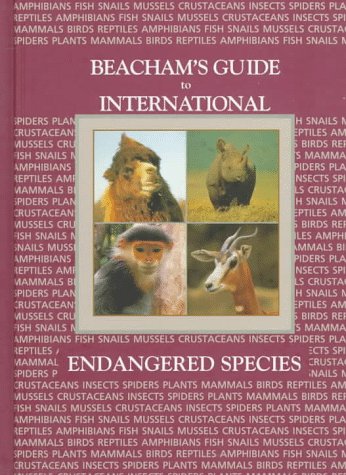
Beacham's contains synopses of 351 endangered mammalian species that appear as of July 1997 in lists maintained by the US Fish and Wildlife Service (ASFWS), the Convention on International Trade in Endangered Species of Wild Fauna and Flora (CITES), and the Species Survival Commission of the International Union for Conservation of Nature and Natural Resources (IUCN). The mammals are grouped by taxonomic family, and each family section begins with an informative description of its general characteristics. Within families, species are arranged alphabetically by scientific name, and each is accompanied by a stunning photograph or illustration in color. Species accounts include sections for description, behavior, habitat, distribution, threats, conservation, and recovery, following the model used in The Official World Wildlife Fund Guide to Endangered Species of North America (4 v., CH, Sep'90, Jan'93, Mar'95). Besides a general index, there is a country index and a helpful glossary. Readers may be confused by the use of "international" to describe the region covered, since it excludes the US. Unlike WWF Guide, which includes scholarly references in the species accounts, Beacham's has only general references at the end of each volume, which reduces its value as a source for upper-division students, faculty, and professionals. Apart from that, the set is recommended for reference collections in public, college, and research libraries that support study of endangered species. C. Rinaldo; Dartmouth College
Booklist Review
This new set is another entry in the growing collection of Beacham's guides to endangered, threatened, and extinct species. Previous volumes include the one-volume World Wildlife Fund Guide to Extinct Species of Modern Times [RBB S 1 97] and the four-volume Official World Wildlife Fund Guide to Endangered Species of North America (1994). The current set treats 351 species, mammals only, and appears to be derived from the same database of information presented in Beacham's International Threatened, Endangered and Extinct Species on CD-ROM [RBB My 15 97], which covers 1,400 species. Data are provided on mammalian species listed as threatened or endangered by the USFWS (U.S. Fish and Wildlife Service). A third volume will cover all other foreign species listed by this agency. (A master list of protected species is available at FWS' Web site at risk by the IUCN (The World Conservation Union) or by CITES (Convention on International Trade in Endangered Species of Wild Fauna and Flora). There is an entry for the previously endangered eastern gray kangaroo to show the process by which one species has been successfully recovered. The authors use the above-mentioned organizations as the authorities for their work. For example, in the introductory section on "Gorillas and Orangutans," they have chosen to follow the USFWS' designation for endangered species and the IUCN's placement of apes in the Pongidae family rather than Hominidae. Each set of species accounts includes a general introductory section giving the popular name, the family and subfamily scientific names, and a general description of the characteristics of the species. These sections often include information on threats and are especially revealing, telling us, for example, that mountain gorillas are killed occasionally by carnivores but their main predator is man. The specific accounts follow, in typical Beacham format, with scientific and familiar names, a color photo, and an accompanying list giving status, date listed, family, description, habitat, food, reproduction, threats, and range. Short paragraphs expand on these themes and add information on conservation and recovery efforts. Several pages of references, a glossary, and a useful country index complete volume two. Sponsored by the IUCN, Encyclopedia of Endangered Species [RBB F 1 95] is handy because it includes mammals, birds, reptiles, amphibians, fish, invertebrates, and plants in one volume. However, the black-and-white photographs do not compare to those in the Beacham volumes or in the ten volumes of Marshall Cavendish's Endangered Wildlife of the World [RBB My 1 93]. The latter is best suited for young readers, whereas Beacham guides are suitable for any age level in any library collecting material on endangered species. The photographs on the Beacham CD-ROM are the ones used in the print volumes but are much less clear. The CD-ROM enables users to move around in the database via hyperlinks. However, at this time, the books are easier to use because of the confusing structure of the user interface on the disk.