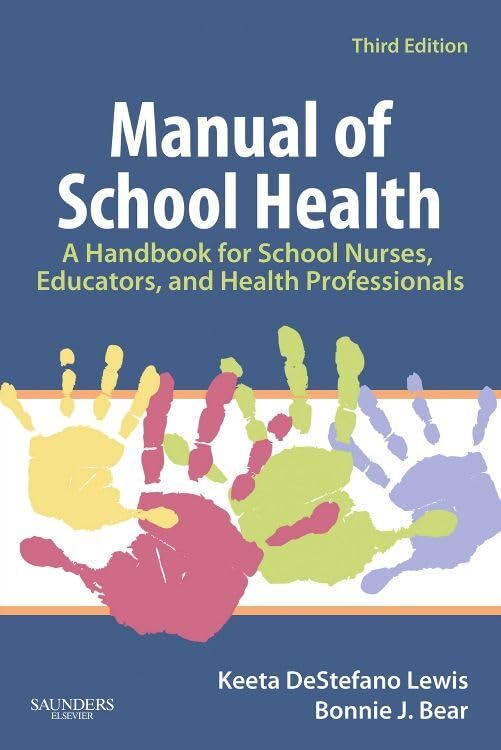

Manual of school health a handbook for school nurses, educators, and health professionals Keeta DeStefano Lewis, Bonnie J. Bear.
Detalles de publicación: St. Louis, Mo. Saunders c2009.Edición: 3rd edDescripción: xviii, 654 p., [8] p. of plates ill. (some col.) 23 cmISBN:- 9781416037781 (pbk. : alk. paper)
- 1416037780 (pbk. : alk. paper)
- 371.7/12 22
- RJ247 .L48 2009
- WY 49
| Imagen de cubierta | Tipo de ítem | Biblioteca actual | Biblioteca de origen | Colección | Ubicación en estantería | Signatura topográfica | Materiales especificados | Info Vol | URL | Copia número | Estado | Notas | Fecha de vencimiento | Código de barras | Reserva de ítems | Prioridad de la cola de reserva de ejemplar | Reservas para cursos | |
|---|---|---|---|---|---|---|---|---|---|---|---|---|---|---|---|---|---|---|
| Libro | Biblioteca Encarnación Valdés Colección General bev | 371.712 L6731m3 (Navegar estantería(Abre debajo)) | Disponible | 80000002362401 |
Descripciones mejoradas de Syndetics:
Completely updated, the 3rd edition of this practical, highly portable manual offers quick access to the most relevant health and wellness information for children -- from birth through age 21 - in the school setting. You'll find valuable guidance on developmental stages, learning domains, acute and chronic illnesses, first aid, medical syndromes, special education, and emergency illness. This edition also addresses the growing array of issues affecting today's children, including mental health disorders, disaster management, substance abuse, and school violence, as well as new threats such as West Nile virus, dermatological conditions, and the reemergence of tuberculosis. Ideal for use in school and community settings, this manual is a must-have resource for anyone who works with children. A best practice approach to health issues and concerns helps you provide the best possible care to students A clear, consistent outline format and straightforward writing style make it easy to locate and apply essential information Updated content includes important contemporary issues in schools, such as body piercing, backpack syndrome, and computer ergonomics Brain Findings section offers relevant information about recent brain and neurology research, with insights on how it relates to childhood development and health Numerous appendices, including the latest growth charts and immunization schedules, provide essential information for assessing school age children English-Spanish translation guide for common health terms and phrases helps you communicate more effectively with Hispanic students Web site resources at the end of each chapter provide reliable sources for further information and research A convenient Glossary familiarizes you with important terminology and definitions used throughout the book New, user-friendly design helps you find key information quickly with helpful boxes, tables, and headings. New 8-page color insert serves as an instant visual reference to help you identify rashes, skin lesions, and other dermatological conditions that are common among school-age children. A separate chapter on first aid walks you through the management of common injuries and emergency situations. Revised mental health chapter presents current, detailed information on the major mental disorders that affect school-age children such as depression, autism, and Asperger's, with an extensive psychotropic medication table. A new chapter devoted to disaster management includes the latest information on bioterrorism and homeland security threats to help you create an action plan for disaster situations. A revised chapter on violence addresses sexual assault, self-mutilation, suicide, domestic violence, and violence in the schools, to help you stay informed about current societal trends, issues, and developments. New information on teen pregnancy offers helpful guidelines on communicating with students about this important issue.
Includes bibliographical references and index.
Growth and development characteristics -- Vision and hearing -- Acute conditions -- Chronic conditions -- Mental health disorders -- Substance abuse -- Violence -- Adolescent and gender-specific issues -- Special education -- Twenty-first century health challenges -- Emergency and disaster preparedness -- First aid.
Tabla de contenidos provista por Syndetics
- Chapter 1 Growth and Development Characteristics(p. 1)
- Prenatal and Postnatal Development(p. 2)
- Early Childhood: Birth to 5 Years(p. 6)
- Elementary/Latency Child: 6 to 12 Years(p. 22)
- Adolescence: 13 to 19 Years(p. 31)
- Young Adult: 19 to 21 Years(p. 34)
- Adolescent Gender Developmental Characteristics(p. 35)
- Gender Development(p. 35)
- Chapter 2 Vision and Hearing(p. 38)
- Major Characteristics of Visual Development(p. 40)
- Refractive Errors(p. 46)
- Color Disorders(p. 51)
- Binocular Disorders(p. 54)
- Other Visual Conditions(p. 57)
- Testing Procedures(p. 62)
- Infant, Preschool, and Special Education Screening(p. 71)
- Major Characteristics of Hearing Development(p. 82)
- High-Risk Conditions for Hearing Impairment of the Newborn(p. 83)
- Hearing Conditions(p. 85)
- Hearing Aids(p. 94)
- Testing Procedures(p. 96)
- Infant, Preschool, and Special Education Screening(p. 101)
- Chapter 3 Acute Conditions(p. 110)
- Blepharitis(p. 111)
- Conjunctivitis(p. 112)
- Diaper Dermatitis(p. 114)
- Diarrhea(p. 116)
- Eczema (Atopic Dermatitis)(p. 117)
- Erythema Infectiosum, Human Parvovirus Infection (Fifth Disease)(p. 118)
- Fever(p. 119)
- Frostbite(p. 121)
- Giardiasis(p. 122)
- Hand, Foot, and Mouth Disease(p. 124)
- Hepatitis A(p. 125)
- Impetigo(p. 127)
- Kawasaki Disease(p. 128)
- Measles (Rubeola)(p. 129)
- Infectious Mononucleosis(p. 131)
- Mumps (Infectious Parotitis)(p. 132)
- Otitis Media(p. 133)
- Pediculosis Capitis (Head Lice)(p. 135)
- Pinworms (Enterobiasis)(p. 137)
- Poison Ivy, Oak, and Sumac Dermatitis(p. 138)
- Upper Respiratory Tract Infection (Common Cold)(p. 139)
- Ringworm of the Body (Tinea Corporis)(p. 141)
- Roseola Infantum (Exanthem Subitum)(p. 142)
- Rubella (German Measles)(p. 142)
- Scabies(p. 143)
- Scarlet Fever(p. 144)
- Shigellosis (Acute Diarrhea)(p. 146)
- Streptococcal Pharyngitis (Strep Throat)(p. 147)
- Sty (Hordeolum)(p. 148)
- Tapeworm(p. 149)
- Testicular Torsion(p. 152)
- Urinary Tract Infection(p. 152)
- Varicella-Zoster Virus (Chickenpox)(p. 154)
- Chapter 4 Chronic Conditions(p. 158)
- Ambiguous Genitalia(p. 159)
- Iron Deficiency Anemia(p. 163)
- Sickle Cell Anemia(p. 165)
- Juvenile Arthritis(p. 168)
- Asthma(p. 173)
- Cerebral Palsy(p. 185)
- Cleft Lip and/or Palate(p. 190)
- Cystic Fibrosis(p. 193)
- Cytomegalovirus(p. 196)
- Diabetes Mellitus: Type 1 and Type 2(p. 201)
- Down Syndrome(p. 210)
- Eating Disorders(p. 214)
- Encopresis (Chronic Constipation/Retention)(p. 218)
- Enuresis(p. 220)
- Fetal Alcohol Syndrome and Effects(p. 222)
- Fragile X Syndrome(p. 226)
- Hemophilia A, B, and C(p. 229)
- Hepatitis Infections A, B, C, D, E, and G(p. 233)
- Herpes Simplex Virus Infection Type 1(p. 236)
- Herpes Simplex Virus Infection Type 2(p. 237)
- Human Immunodeficiency Virus/Acquired Immunodeficiency Syndrome(p. 239)
- Hydrocephalus(p. 244)
- Klinefelter's Syndrome(p. 248)
- Lead Poisoning(p. 249)
- Lyme Disease(p. 252)
- Muscular Dystrophy, Duchenne's and Becker's(p. 255)
- Obesity(p. 257)
- Idiopathic Scoliosis(p. 262)
- Seizure Disorder(p. 265)
- Spina Bifida/Myelodysplasia(p. 277)
- Tuberculosis(p. 281)
- Turner's Syndrome(p. 284)
- Chapter 5 Mental Health Disorders(p. 290)
- Attention Deficit-Hyperactivity Disorder(p. 291)
- Oppositional Defiant Disorder(p. 298)
- Pervasive Developmental Disorders(p. 300)
- Pervasive Developmental Disorder-Not Otherwise Specified(p. 315)
- School Avoidance/Refusal and School Phobia(p. 316)
- Tics and Tourette's Disorder(p. 318)
- Major Depressive Disorder(p. 322)
- Chapter 6 Substance Abuse(p. 330)
- The Neurobiology of Reinforcement and Drug Addiction(p. 331)
- Drug Actions on the Brain(p. 332)
- The Widespread Problem of Alcohol Abuse and Dependency(p. 352)
- School Nursing Role in Substance Abuse(p. 355)
- Chapter 7 Violence(p. 362)
- Violence Toward Self(p. 364)
- Violence Toward Others(p. 369)
- Violence in the Home(p. 373)
- Violence in the Schools(p. 380)
- Chapter 8 Adolescent and Gender-Specific Issues(p. 389)
- General Conditions(p. 391)
- Gender-Specific Conditions(p. 403)
- Sexually Transmitted Infections(p. 415)
- Breast and Testicular Self-Examinations(p. 424)
- Chapter 9 Special Education(p. 427)
- The Law(p. 429)
- Specialized Health Care Procedures and Related Adaptations(p. 436)
- Chapter 10 Twenty-first Century Health Challenges(p. 465)
- Backpack Complications(p. 465)
- Computer Ergonomics(p. 469)
- School Trends and Phenomena(p. 473)
- School Social Issues(p. 483)
- Chapter 11 Emergency and Disaster Preparedness(p. 489)
- Preparation for Emergencies and Disasters(p. 490)
- School Nurse's Role in Crisis Situations(p. 497)
- Bioterrorism and Pandemic Flu(p. 499)
- Chapter 12 First Aid(p. 509)
- Abdominal Pain(p. 511)
- Bee, Wasp, Yellow Jacket, and Hornet Stings(p. 511)
- Warm-Blooded Animal Bites(p. 512)
- Human Bites(p. 512)
- Insect Bites(p. 513)
- Tick Bites(p. 513)
- Bleeding(p. 514)
- Blisters(p. 514)
- Bruises(p. 514)
- Burns(p. 515)
- Chemical Burns(p. 516)
- Chemical Burns of the Eye(p. 516)
- Dislodged Contact Lens(p. 516)
- Diabetes Mellitus(p. 516)
- Eye Injury(p. 517)
- Foreign Body in Eye(p. 518)
- Fainting(p. 518)
- Severe Fall(p. 518)
- Flesh Wounds/Lacerations(p. 518)
- Fractures(p. 519)
- Headache(p. 520)
- Head Injury(p. 520)
- Epistaxis (Nosebleed)(p. 521)
- Foreign Body in Nose(p. 521)
- Heat Cramps(p. 521)
- Heat Exhaustion(p. 522)
- Heatstroke/Sunstroke(p. 522)
- Shock(p. 523)
- Splinters(p. 523)
- Sprains and Strains(p. 523)
- Tooth Injuries(p. 524)
- Appendixes
- A Assessment Tools(p. 529)
- B Growth Measurements (Anthropometry)(p. 556)
- C Immunizations(p. 576)
- D Dental Development(p. 582)
- E Conversion Tables, Formulas, and Biostatistics(p. 583)
- F Recommended Energy Intake for Age(p. 587)
- G Vital Signs for Normal Values(p. 588)
- H Abbreviations and Symbols for Laboratory Tests(p. 593)
- I Weights and Measures(p. 596)
- J National Health and Educational Resources(p. 603)
- Glossary(p. 608)
Notas de autor provistas por Syndetics
Keeta DeStefano Lewis, RN, MSN, PhD, FNASN, Healthink, Child Health Consultant, Napa, CaliforniaBonnie J. Bear, RN, BSN, MA, School Health Consultant, San Diego, California