
| Imagen de cubierta | Tipo de ítem | Biblioteca actual | Biblioteca de origen | Colección | Ubicación en estantería | Signatura topográfica | Materiales especificados | Info Vol | URL | Copia número | Estado | Notas | Fecha de vencimiento | Código de barras | Reserva de ítems | Prioridad de la cola de reserva de ejemplar | Reservas para cursos | |
|---|---|---|---|---|---|---|---|---|---|---|---|---|---|---|---|---|---|---|
| Libro | Biblioteca Encarnación Valdés Colección General bev | 823.914 C5971L (Navegar estantería(Abre debajo)) | Disponible | 80000002322603 |
Descripciones mejoradas de Syndetics:
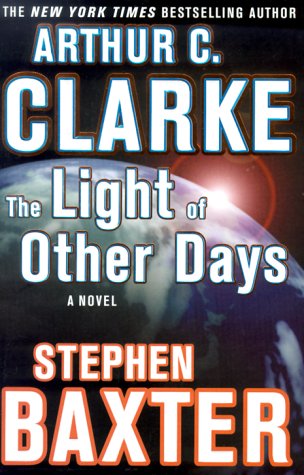
The Light of Other Days tells the tale of what happens when a brilliant, driven industrialist harnesses the cutting edge of quantum physics to enable people everywhere, at a trivial cost, to see one another at all times: around every corner, through every wall, into everyone's most private, hidden and even intimate moments. It amounts to the sudden and complete abolition of human privacy -- forever. Then, as society reels, the same technology proves able to look backward in time as well. Nothing can prepare us for what this means. It is a fundamental change in the terms of the human condition.
"A Tom Doherty Associates book."
Extracto provisto por Syndetics
Reseñas proporcionadas por Syndetics
Publishers Weekly Review
HTwo titans of hard SF--multiple award-winning British authors Clarke (Rendezvous with Rama, etc.) and Baxter (The Time Ships, etc.)--team up for a story of grand scientific and philosophical scope. Ruthless Hiram Patterson, the self-styled "Bill Gates of the twenty-first century," brings about a communication revolution by using quantum wormholes to link distant points around Earth. Not content with his monopoly on the telecommunications industry, Patterson convinces his estranged son, David, a brilliant young physicist, to work for him. While humanity absorbs the depressing news that an enormous asteroid will hit Earth in 500 years, David develops the WormCam, which allows remote viewers to spy on anyone, anytime. The government steps in to direct WormCam use--but before long, privacy becomes a distant memory. Then David and his half-brother, Bobby, discover a way to use the WormCam to view the past, and the search for truth leads to disillusionment as well as knowledge. Only by growing beyond the mores of the present can humanity hope to survive and to deal with the threats of the future, including that asteroid. The exciting extrapolation flows with only a few missteps, and the large-scale implications addressed are impressive indeed. For both authors the novel's conclusion takes place in familiar thematic territory, offering a final, hopeful transcendence for humanity. With Clarke's and Baxter's names behind its potent story, this one could sell big--and to the movies as well as to the reading public. $250,000 ad/promo. (Feb.) (c) Copyright PWxyz, LLC. All rights reservedBooklist Review
The year 1984 has come and gone, and Clarke's projected 2001 looms. With Baxter, Clarke carries Orwell's vision to an extreme and turns it around through speculation on humanity's next metamorphosis. It is the mid-2300s, and as the last archaic rocket-boosted spaceship is launched in Russia, world attention is turning to entrepreneur Hiram Patterson, who is launching wormhole technology that allows instant visual access to anybody anywhere. Hiram has two sons: David, an expert on the mathematics of quantum physics, and Bobby, who bears a brain stud, implanted in infancy, that ensures his loyalty to Hiram. Then there is journalist Kate Manzoni, whose relationship with Bobby earns her Hiram's hateful determination to get her after she convinces Bobby to turn off his stud and experience emotions for the first time. The plot escalates when David discovers that wormholes can also be used to view the past, which can make politicians and criminals, for example, incapable of hiding from the limelight of true hindsight. Moreover, events in the lives of historical figures, such as Lincoln and Jesus, can be verified or debunked. The complete loss of privacy that wormhole technology effects and the knowledge that a giant comet will annihilate Earth in 500 years wreak havoc and force people to make fundamental changes in their lives. The story's human interrelationships have a soap-operatic quality, but Clarke and Baxter's extrapolations, based on current theories, of what could be and how humanity might adapt or fail to adapt make for a sweeping, mind-boggling read that takes us back to the primordial ooze and far enough into the future for incredible things to be possible. --Sally Estes YA: For teens who like hard sf. SE.Notas de autor provistas por Syndetics
Arthur C. Clarke was born in Minehead, Somerset, England, on December 16, 1917. During World War II, he served as a radar specialist in the RAF. His first published piece of fiction was Rescue Party and appeared in Astounding Science, May 1946. He graduated from King's College in London with honors in physics and mathematics, and worked in scientific research before turning his attention to writing fiction.His first book, Prelude to Space, was published in 1951. He is best known for his book 2001: A Space Odyssey, which was later turned into a highly successful and controversial film under the direction of Stanley Kubrick. His other works include Childhood's End, Rendezvous with Rama, The Garden of Rama, The Snows of Olympus, 2010: A Space Odyssey II, 2062: Odyssey III, and 3001: The Final Odyssey. During his lifetime, he received at least three Hugo Awards and two Nebula Awards. He died of heart failure on March 19, 2008 at the age of 90.
(Bowker Author Biography)