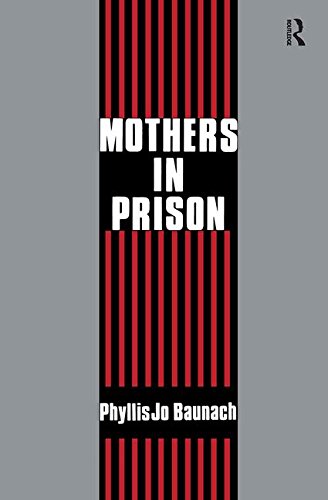

Mothers in prison Phyllis Jo Baunach.
Detalles de publicación: New Brunswick, N.J. Transaction Books c1985.Descripción: xii, 147 p. 24 cmISBN:- 0887380271
- 365/.43 19
- HV9471 .B39 1985
| Imagen de cubierta | Tipo de ítem | Biblioteca actual | Biblioteca de origen | Colección | Ubicación en estantería | Signatura topográfica | Materiales especificados | Info Vol | URL | Copia número | Estado | Notas | Fecha de vencimiento | Código de barras | Reserva de ítems | Prioridad de la cola de reserva de ejemplar | Reservas para cursos | |
|---|---|---|---|---|---|---|---|---|---|---|---|---|---|---|---|---|---|---|
| Libro | Biblioteca Encarnación Valdés Colección General bev | 365.43 B349m (Navegar estantería(Abre debajo)) | Disponible | 80000000548795 |
Descripciones mejoradas de Syndetics:
Several years ago, Terry Moore, a young first offender at the Florida Correctional Institution for Women, gave birth to a baby whose father was a prison guard. Mrs. Moore won the right to have her baby stay with her in prison until she was released a few months later. Although this incarcerated mother was reunited with her child shortly after giving birth, many inmate mothers are not able to be with or see their children on a regular basis during incarceration. Little is known about this significant and emotionally traumatic problem that confronts nearly two-thirds of incarcerated women.
Building upon previous work, this extraordinarily insightful volume offers fresh perspective on issues which surround the separation of inmate mothers and their children, using questionnaire, standardized scales, and individual taped interviews. The author examines issues such as the impact of separation by race; the child's whereabouts at the time of the crime; the child's placement and legal custody during the mother's incarceration; inmate mothers' interest in resuming the parental role after release; child-rearing attitudes of inmate mothers; and the effects of the involvement of drugs on the mothers' relationship with their children.
Through interviews with administrators, staff, and inmates, Dr. Baunach provides a detailed, descriptive analysis of the development and operations of programs to retain mother-child bonds in women's prisons in a variety of states. Dr. Baunach discusses day-long/overnight/weekend visitations, foster care placements, and similar problems of the sort that mothers in prison uniquely must face. The work also has a strong policy content, providing unique and practical recommendations for policies and programs benefiting inmate mothers and children that at the same time can be implemented within the framework of current penological practices.
Includes index.
Bibliography: p. 141-144.
Reseñas proporcionadas por Syndetics
CHOICE Review
Baunach is an experienced researcher and has done a commendable job in spotlighting an issue of paramount importance. Her study concerns the separation of prison-inmate mothers and their children. Baunach treats the impact of separation by race; the child's whereabouts at the time of the crime; the child's placement and legal custody during the mother's incarceration; inmate-mothers' interest in resuming the parental role after release; child-rearing attitudes of inmate mothers; and the effects of drug involvement on the mother's relationship with her children. Baunach also discusses the development and operation in several states of programs to retain mother-child bonds in women's prisons. Recommendations for policies and practices are set forth. The tables and bibliography are impressive, and the writing style makes for enjoyable reading. General, community college, and undergraduate readership.-A.J.T. Zumbrun, Catonsville Community CollegeNotas de autor provistas por Syndetics
Phyllis Jo Baunach is a statistician at the Bureau of Justice Statistics in Washington, D.C. She has taught in the Criminal Justice Department of the University of Minnesota, George Washington University, and the University of Maryland. For this book she was honored as Young Scholar of the Year by the American Association of University Women Educational Foundation. She is currently chairperson for the Division of Women and Crime for the American Society of Criminology.