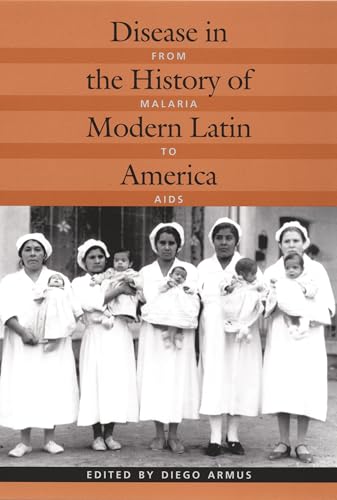

Disease in the history of modern Latin America from malaria to AIDS edited by Diego Armus.
Detalles de publicación: Durham Duke University Press 2003.Descripción: viii, 326 p. ill. 24 cmISBN:- 0822330571 (cloth : alk. paper)
- 0822330695 (pbk. : alk. paper)
- 614.428 D6118 21
- RA418.3.L29 D575 2003
| Imagen de cubierta | Tipo de ítem | Biblioteca actual | Biblioteca de origen | Colección | Ubicación en estantería | Signatura topográfica | Materiales especificados | Info Vol | URL | Copia número | Estado | Notas | Fecha de vencimiento | Código de barras | Reserva de ítems | Prioridad de la cola de reserva de ejemplar | Reservas para cursos | |
|---|---|---|---|---|---|---|---|---|---|---|---|---|---|---|---|---|---|---|
| Libro | Biblioteca Encarnación Valdés Colección General bev | 614.428 D6118 (Navegar estantería(Abre debajo)) | Disponible | 80000002360751 |
Descripciones mejoradas de Syndetics:
Challenging traditional approaches to medical history, Disease in the History of Modern Latin America advances understandings of disease as a social and cultural construction in Latin America. This innovative collection provides a vivid look at the latest research in the cultural history of medicine through insightful essays about how disease--whether it be cholera or aids, leprosy or mental illness--was experienced and managed in different Latin American countries and regions, at different times from the late nineteenth century to the present.
Based on the idea that the meanings of sickness--and health--are contestable and subject to controversy, Disease in the History of Modern Latin America displays the richness of an interdisciplinary approach to social and cultural history. Examining diseases in Mexico, Brazil, Argentina, Colombia, Peru, and Bolivia, the contributors explore the production of scientific knowledge, literary metaphors for illness, domestic public health efforts, and initiatives shaped by the agendas of international agencies. They also analyze the connections between ideas of sexuality, disease, nation, and modernity; the instrumental role of certain illnesses in state-building processes; welfare efforts sponsored by the state and led by the medical professions; and the boundaries between individual and state responsibilities regarding sickness and health. Diego Armus's introduction contextualizes the essays within the history of medicine, the history of public health, and the sociocultural history of disease.
Contributors. Diego Armus, Anne-Emanuelle Birn, Kathleen Elaine Bliss, Ann S. Blum, Marilia Coutinho, Marcus Cueto, Patrick Larvie, Gabriela Nouzeilles, Diana Obregón, Nancy Lays Stepan, Ann Zulawski
Includes bibliographical references and index.
Tabla de contenidos provista por Syndetics
- Preface(p. vii)
- Disease in the Historiography of Modern Latin America(p. 1)
- "The Only Serious Terror in These Regions": Malaria Control in the Brazilian Amazon(p. 25)
- An Imaginary Plague in Turn-of-the-Century Buenos Aires: Hysteria, Discipline, and Languages of the Body(p. 51)
- Tropical Medicine in Brazil: The Case of Chagas' Disease(p. 76)
- Tango, Gender, and Tuberculosis in Buenos Aires, 1900-1940(p. 101)
- The State, Physicians, and Leprosy in Modern Colombia(p. 130)
- Revolution, the Scatological Way: The Rockefeller Foundation's Hookworm Campaign in 1920s Mexico(p. 158)
- Between Risk and Confession: State and Popular Perspectives of Syphilis Infection in Revolutionary Mexico(p. 183)
- Dying of Sadness: Hospitalism and Child Welfare in Mexico City, 1920-1940(p. 209)
- Mental Illness and Democracy in Bolivia: The Manicomio Pacheco, 1935-1950(p. 237)
- Stigma and Blame during an Epidemic: Cholera in Peru, 1991(p. 268)
- Nation, Science, and Sex: AIDS and the New Brazilian Sexuality(p. 290)
- Contributors(p. 315)
- Index(p. 317)
Reseñas proporcionadas por Syndetics
CHOICE Review
Most historical accounts of Latin America discuss the widespread occurrences of tropical diseases, particularly the outbreaks of malaria and yellow fever. Within the past 20 years, the focus has shifted to broader studies of Latin America that encompass the integration of history, disease, and society. Each of the essays in this volume edited by Armus (history, Swarthmore College) provides a discussion of longstanding public health issues in Latin America within the framework of the history of medicine, the history of public health, and the sociocultural history of disease. Not all countries or all diseases are discussed, but some of the representative topics include malaria control in Brazilian Amazon, tuberculosis in Buenos Aires, cholera in Peru, syphilis in revolutionary Mexico, and leprosy in Colombia. All of the cases cited in this collection identify disease as a complex process that needs to be examined inside of a societal frame that recognizes the roles that religion, gender, nationality, ethnicity, class, politics, and state responsibilities play in the development of public health policies. Well-documented chapters; author affiliations; some illustrations. For academic libraries, particularly those institutions having programs in Latin American history, public health and policy, and international relations. ^BSumming Up: Recommended. Upper-division undergraduates through faculty. C. S. McCoy University of South FloridaNotas de autor provistas por Syndetics
Diego Armus is Assistant Professor of Latin American History at Swarthmore College.