Reseñas proporcionadas por Syndetics
Library Journal Review
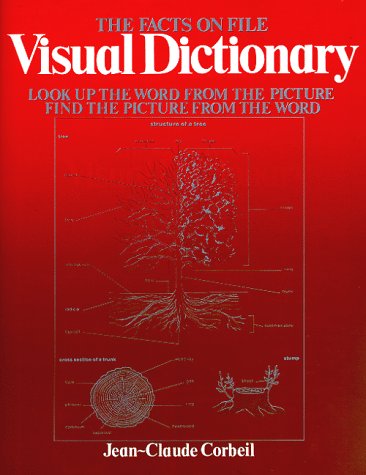
A society (and age) increasingly dependent on visual language is badly in need of a tool to guide in refining use of terminology and in relating terms to clearly illustrated visual objects. Corbeil, linguist and authority on terminology, is largely successful in his effort. In this work information is presented under 28 major subjects (themes) further divided into numerous categories and sub-categories, beginning with the natural world and progressing through human and social topics. Except for preface and introduction, there is no narrative; the book is composed of black-and-white drawings of the object, activity, etc., labeled by precise term or terms. Three indexes and selected bibliography complete the volume. Reginald Bragonier's What's What: a Visual Glossary of the Physical World ( LJ 2/1/82) invites comparison. The Facts on File Visual Dictionary 's scholarly preparation, linguistic basis, and emphasis on precision distinguish it. For most public and academic libraries. Harry E. Whitmore, Arrowhead Lib. System, Virginia, Minn. (c) Copyright 2010. Library Journals LLC, a wholly owned subsidiary of Media Source, Inc. No redistribution permitted.
Booklist Review
This useful reference tool, intended for the generalist struggling to keep up with the flood of technical terminology generated by an industrial society, provides a visual context for more than 25,000 words. Graphic representations (i.e., 3,000 black-and-white diagrams, tables, and maps) carry the burden of clarifying terms, since there are no written definitions. Words included must lend themselves to visual portrayal, so ``abstract words, adjectives, verbs and adverbs'' must be omitted. Rather than an alphabetical, word-by-word approach, the dictionary is arranged in 30 broad subject areas encompassing both technical and everyday items (e.g., kitchen utensils, computer keyboard, architectural styles). Within each subject category there are further subsets of information, e.g., under ``Human Being,'' topics include Cell, Skeleton, Teeth, Osteology of Skull, and Family Ties. To locate a particular word, one must consult an index. The ``General Index'' is the most accessible starting point, providing the page number for each word that appears on a drawing. The ``Thematic Index'' takes the 30 broad subject areas in which the book is arranged and lists under them all the items associated with that theme. The ``Specialized Index'' is an alphabetical listing of more narrow selected subjects, e.g., Bicycles and Railroads, which are listed under ``Transportation'' in the table of contents. The editor has provided a succinct introduction that covers the rationale and methodology of the linguists, terminologists, and graphic artists who compiled the work. American standards of English usage were followed. Compiled in Quebec, the work profits from its producers' extensive experience in terminological research and bilingual publications. A number of bilingual editions are planned. The format is clear, uncluttered, and effective in communicating the exact terms for each item portrayed. Many pages display a full-page diagram, e.g., an elevator, the digestive system, an outfitted scuba diver. Others show related parts of a whole, e.g., Fencing includes weapons, positions, and target areas. There are other similar titles extant. The Oxford-Duden Pictorial English Dictionary (1981) includes 28,000 objects in greater technical detail and employs double-page layouts of vocabulary and illustrations of each subject (facing each other). What's What: A Visual Glossary of the Physical World (Hammond, 1981) and the same publisher's What's What in Sports: The Visual Glossary of the Sports World (1984) are organized the same way. However, they use more photographs in proportion to drawings. Librarians who found these titles useful will probably want this new one too, even though there is overlap. It is particularly recommended for institutions teaching English as a second language.