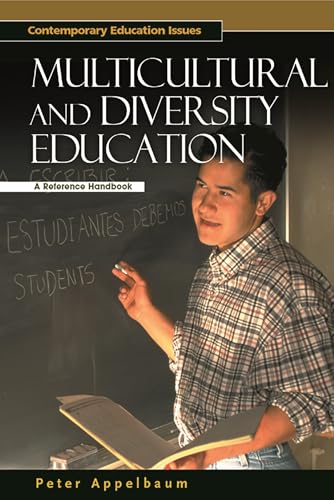

Multicultural and diversity education a reference handbook Peter Appelbaum.
Series Contemporary education issuesDetalles de publicación: California ABC-CLIO c2002.Descripción: xx, 191 p. 24 cmISBN:- 1576072649
| Imagen de cubierta | Tipo de ítem | Biblioteca actual | Biblioteca de origen | Colección | Ubicación en estantería | Signatura topográfica | Materiales especificados | Info Vol | URL | Copia número | Estado | Notas | Fecha de vencimiento | Código de barras | Reserva de ítems | Prioridad de la cola de reserva de ejemplar | Reservas para cursos | |
|---|---|---|---|---|---|---|---|---|---|---|---|---|---|---|---|---|---|---|
| Libro | Biblioteca de Mayagüez Colección General mb | LC1099.3 .A66 2002 (Navegar estantería(Abre debajo)) | Disponible | 50000002121183 |
Descripciones mejoradas de Syndetics:
A state-of-the-art resource concentrating on the practical applications, philosophical and social policy motivations, and historical development of various approaches to multicultural education in the United States.
In this comprehensive introduction to multicultural education, author Peter Appelbaum reveals that Native American-run schools in the early 19th century produced nearly 100 percent literacy rates--higher among western Oklahoma Cherokees than among whites in nearby Texas or Arkansas. Today, as the country rapidly becomes more racially and ethnically diverse, he discusses how success in diversity education requires that administrators, teachers, and students change the way they look at each other, the curriculum, and the structures and policies that govern schools.
Diversity and Multicultural Education: A Reference Handbook examines the political and educational arguments for and against multicultural education, provides a range of curriculum approaches, describes the dilemmas of assessment, and explores political and legal issues. Also included are a chronology, directories, and bibliographies.
Includes bibliographical references and index.
Tabla de contenidos provista por Syndetics
- Series Editor's Preface(p. xi)
- Preface(p. xiii)
- Introduction(p. xv)
- Chapter 1 Overview(p. 1)
- What Is Multicultural and Diversity Education?(p. 1)
- Competing and Conflicting Visions for Multicultural Education(p. 4)
- Political and Educational Arguments "for" and "against" Multicultural Education(p. 12)
- References and Further Reading(p. 18)
- Chapter 2 Origins of Multicultural Education(p. 21)
- The Danger of Revisionist History(p. 21)
- Deculturalization, Segregation, and Integration(p. 23)
- Chronology(p. 27)
- References and Further Reading(p. 38)
- Chapter 3 Curricular Approaches(p. 41)
- Why Multicultural Education?(p. 41)
- Equity Issues(p. 41)
- Teachers' Frustrations(p. 42)
- Students' Frustrations(p. 42)
- Families' and Communities' Frustrations(p. 43)
- Administrators' Frustrations(p. 43)
- Assessment for Multicultural Education(p. 44)
- Classroom Management(p. 45)
- Grouping Practices(p. 46)
- Curricular Approaches(p. 47)
- Comparing Lesson and Unit Plans(p. 48)
- Teaching the Exceptional and Culturally Different(p. 49)
- Human Relations Approach(p. 50)
- Single-Group Studies(p. 52)
- Multicultural Education (Cultural Democracy)(p. 55)
- Education That Is Multicultural and Social Reconstructionist(p. 57)
- Critical Multiculturalism(p. 59)
- Critical Pedagogy for Diversity Education(p. 61)
- Border Literacies(p. 62)
- References and Further Reading(p. 64)
- Chapter 4 Case Studies(p. 65)
- Westview District's Education for an Integrated Community(p. 65)
- Technology in a Fifth-Grade Classroom(p. 68)
- Intergeneration Orchestra of Omaha(p. 69)
- Two Districts Working Together on Media Awareness(p. 71)
- Carol Cornelius and Culture-Based Curricula(p. 72)
- Bob Moses and the Algebra Project(p. 74)
- National Multicultural Interpreter Project(p. 76)
- Facing History and Ourselves(p. 80)
- Theater of the Oppressed Laboratory(p. 82)
- Two-Way Immersion Bilingual Education at Madawaska Elementary School and Gateway Elementary School, L'Acadien du Haut St-Jean(p. 85)
- Teaching about Whiteness(p. 89)
- The Importance of Leadership(p. 91)
- Final Comments(p. 92)
- References and Further Reading(p. 93)
- Chapter 5 Political and Legal Issues(p. 95)
- Diversity, Identity, and Citizenship(p. 95)
- State and National Frameworks and Standards(p. 98)
- Social Studies and Citizenship Education(p. 99)
- Other Curricular Areas(p. 103)
- Using the Standards to Achieve Multicultural and Diversity Education(p. 106)
- High-Stakes Testing(p. 108)
- Unions(p. 111)
- Challenges to Multiculturalism(p. 112)
- References and Further Reading(p. 115)
- Chapter 6 Barriers to Multiculturalism(p. 117)
- Grouping Students(p. 118)
- Economic and Social Reproduction(p. 121)
- Recruitment and Training(p. 124)
- School Culture(p. 127)
- School Governance(p. 129)
- The Ideology of Tolerance(p. 134)
- Questions(p. 136)
- References and Further Reading(p. 138)
- Chapter 7 Associations and Organizations(p. 141)
- Chapter 8 Print and Nonprint Resources(p. 157)
- Community-Building Resources(p. 157)
- Curriculum Resources(p. 158)
- General Works(p. 163)
- Talking Points(p. 172)
- Nonprint Resources(p. 175)
- Glossary(p. 179)
- Index(p. 183)
- About the Author(p. 193)