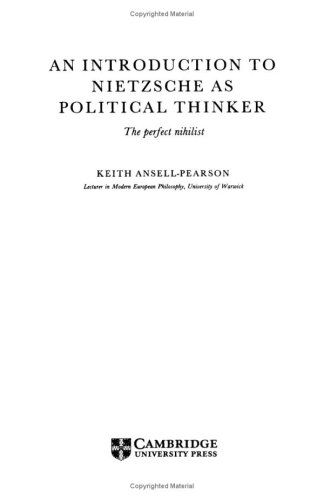

An introduction to Nietzsche as political thinker the perfect nihilist Keith Ansell-Pearson.
Detalles de publicación: Cambridge [England] New York Cambridge University Press 1994.Descripción: xix, 243 p. 23 cmISBN:- 0521417228
- 0521427215 (pbk.)
- 320/.01 20
- JC233.N52 A56 1994
| Imagen de cubierta | Tipo de ítem | Biblioteca actual | Biblioteca de origen | Colección | Ubicación en estantería | Signatura topográfica | Materiales especificados | Info Vol | URL | Copia número | Estado | Notas | Fecha de vencimiento | Código de barras | Reserva de ítems | Prioridad de la cola de reserva de ejemplar | Reservas para cursos | |
|---|---|---|---|---|---|---|---|---|---|---|---|---|---|---|---|---|---|---|
| Libro | Biblioteca Encarnación Valdés Colección General bev | 320.01 A618i (Navegar estantería(Abre debajo)) | Disponible | 80000001747750 |
Descripciones mejoradas de Syndetics:
This is a lively and engaging introduction to the contentious topic of Nietzsche's political thought. It traces the development of Nietzsche's thinking on politics from his earliest writings to the mature work in which he advocates aristocratic radicalism as opposed to 'petty' European nationalism. The key ideas of the will to power, eternal return and the overman are discussed and all Nietzsche's major works analysed in detail, such as Beyond Good and Evil and The Genealogy of Morals, within the context of the concerns of modern political theory. The book concludes with an assessment of Nietzsche's enduring relevance and of the insights afforded by contemporary liberal and feminist readings. This textbook will be essential for all students of Nietzsche and of the history of political ideas. It includes a chronology of Nietzsche's life and works and a guide to further reading.
Includes bibliographical references (p. 225-239) and indexes.