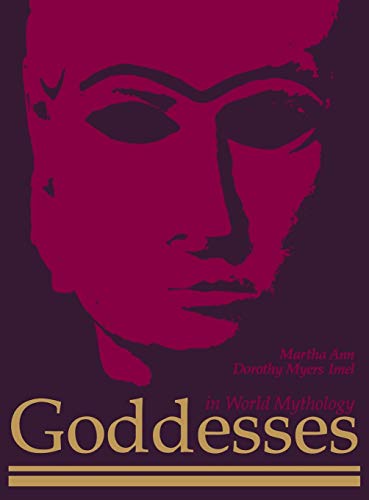

Goddesses in world mythology / Martha Ann, Dorothy Myers Imel.
Idioma: Español Detalles de publicación: Santa Barbara, Calif. : ABC-CLIO c1993.Descripción: xx, 655 p. ill. ;29 cmISBN:- 0874367158 (acid-free paper)
- 291.2/114/03 20
- BL473.5 .A66 1993
| Imagen de cubierta | Tipo de ítem | Biblioteca actual | Biblioteca de origen | Colección | Ubicación en estantería | Signatura topográfica | Materiales especificados | Info Vol | URL | Copia número | Estado | Notas | Fecha de vencimiento | Código de barras | Reserva de ítems | Prioridad de la cola de reserva de ejemplar | Reservas para cursos | |
|---|---|---|---|---|---|---|---|---|---|---|---|---|---|---|---|---|---|---|
| Libro | Biblioteca de Mayagüez Sala de Referencia mb | BL473.5 .A66 1993 (Navegar estantería(Abre debajo)) | Disponible | 50000001956423 | ||||||||||||||
| Referencia | Biblioteca Encarnación Valdés Sala de Referencia bev | 291.211 A613g (Navegar estantería(Abre debajo)) | Disponible | 80000001868481 |
Descripciones mejoradas de Syndetics:
Covering 30,000 years of goddess worship, this fascinating book is the first and most comprehensive biographical dictionary devoted exclusively to mythological deities.
Spanning 30,000 years of goddess worship, Goddesses in World Mythology provides access to nearly 11,500 entries from many cultures: Greek, Celtic, Indian, African, Chinese, Slavic, Mesoamerican, Japanese, and more. Organized alphabetically within geographical regions such as Egypt, the Far East, Oceania, North America, and the Himalayan region, entries identify each goddess by her most common anthropological, mythological, or religious name, then identifies the culture recognizing that goddess, summarizing her powers or attributes, often providing a brief story characterizing her personality and motivations.
The most comprehensive and comprehensible work of its kind, Goddesses in World Mythology features two indexes that divide the goddesses by name and attribute, over 2,000 cross references that guide the reader to other entries, and an extensive bibliography. This unique and easy to use guide shows that goddesses were not just wives, sisters, mothers, or fertility figures, but supreme deities themselves.
Includes bibliographical references (p. 531-542) and indexes.
Reseñas proporcionadas por Syndetics
Library Journal Review
This excellent dictionary compiles information on 9500 female deities, deified women, female spirits, nymphs, and fairies. The entries are alphabetically listed under geographic locations: Africa, Central and Mesoamerican, Eastern Europe, Egypt, the Far East, the Greek and Roman empires, the Himalayas, the Indian subcontinent, the Near East, North America, Northern Europe, Oceana, Southeast Asia, and Western Europe. Each entry lists the name, country of origin, major attribute and characterization of the goddess in question, and entries marked with an icon relate succinctly a portion of her legend. A name index and an index by attribute are included, and an extensive bibliography provides an excellent resource for further scholarship. Highly recommended for any reference collection.-Gail Wood, SUNY Coll. of Technology Lib., Alfred (c) Copyright 2010. Library Journals LLC, a wholly owned subsidiary of Media Source, Inc. No redistribution permitted.CHOICE Review
Ann and Imel's immense undertaking includes goddesses, monsters, witches, spirits, and fairies from around the world. Organized by subcontinent, the entries include the region and the people of the deity, her multiple names and attributes, a description, cross-references, bibliographic references, and occasionally a brief story about her. Indexes by name and by attribute expand access, and an 11-page bibliography includes books and articles in mythology, anthropology, religion, psychology, literature, sociology, art, and archaeology from the past hundred years. The authors "... consider this to be only a first step in the serious study of female deities," and they clearly chose breadth over depth. This is most evident in the bibliography, which includes many secondary sources (and every ABC-Clio work on the subject), but omits primary materials such as the Kalevala, the Upanishads, or the Mabinogion. Also absent are any contemporary reinterpretations of the goddesses (making the inclusion of Jean Shinoda Bolen puzzling), though this is in keeping with the intent of the work to focus on story and oral tradition rather than reinvention or recovery. Scholars will probably quarrel with the juxtaposition of Mircea Eliade and Merlin Stone as sources of equal weight, but this is a book for beginners, not experts. As such, it is a fine achievement. General and undergraduate readers. M. R. Pukkila; Colby CollegeBooklist Review
The authors aim "to compile as much accurate information as possible about goddesses," thus "adding to the pool of potential female role models, both fierce and gentle." The scope includes monsters, evil spirits, and witches. Ann has a graduate degree in religious studies; Imel is a professional writer. Twelve consultants are listed, most from the University of Colorado. Entries are listed geographically, within 12 regions (Africa, Indian Subcontinent, Western Europe, etc.). They vary in scope; they may note region, people, attributes, description, translation of name, synonyms, cross-references, variant forms, and citations to the bibliography. For example, Esesar, a goddess of the Gbanya people of Ghana, has the attributes of earth and nature. She is described as an "earth goddess whose husband is the sky god, Ebore," and a reference is given to a source in the bibliography. Typically terse, few entries include detail. Occasionally, longer entries relate stories about the goddess and are highlighted with an icon that is specific to that chapter. Goddesses are indexed by name and by attribute (e.g., agriculture, household affairs), subdivided by region. The bibliography, to which entries are keyed, is lengthy. No new ground is broken here; however, the more than 8,000 entries make this larger than any other collection of women deities. Whether this is a way to identify role models is debatable. Leach's more general Guide to the Gods [RBB Mr 15 92] is cited often here and is preferred for most libraries. Specialized collections (e.g., women's studies, anthropology, religion) will want to consider Goddesses in World Mythology. (Reviewed Apr 15, 1994)Notas de autor provistas por Syndetics
Martha Ann Imel has an advanced degree in religious studies from the University of Colorado, Boulder, CO.
Dorothy Myers Imel is a professional writer and editor.