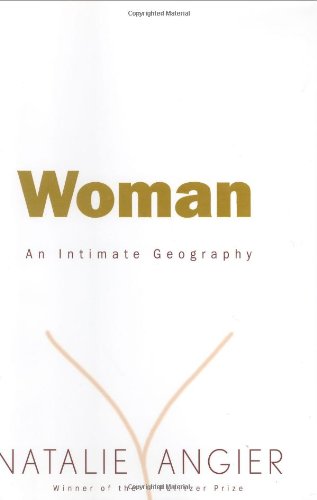

Woman an intimate geography Natalie Angier.
Detalles de publicación: Boston, MA Houghton Mifflin c1999.Descripción: xvi, 398 p. 24 cmISBN:- 0-395-69130-3
| Imagen de cubierta | Tipo de ítem | Biblioteca actual | Biblioteca de origen | Colección | Ubicación en estantería | Signatura topográfica | Materiales especificados | Info Vol | URL | Copia número | Estado | Notas | Fecha de vencimiento | Código de barras | Reserva de ítems | Prioridad de la cola de reserva de ejemplar | Reservas para cursos | |
|---|---|---|---|---|---|---|---|---|---|---|---|---|---|---|---|---|---|---|
| Libro | Biblioteca de Mayagüez Colección General mb | QP 38 .A54 1999 (Navegar estantería(Abre debajo)) | Disponible | 50000002088440 |
Descripciones mejoradas de Syndetics:
A Pulitzer Prize-winner offers a book about femaleness --- in body and mind --- that could prove as important as The Second Sex or Our Bodies, Our Selves and as fresh as Women's Bodies, Women's Wisdom. With the clarity, insight, and sheer joy of language that has secured her reputation as one of the New York Times's premier stylists, Natalie Angier lifts the veil of secrecy from that most enigmatic of evolutionary masterpieces, the female body, exploring the essence of what it means to be awoman. Angier's thoughts on everything from organs to orgasm evince her famously playful originality, yet stand their ground in scientific fact. She also dives into hot topics such as menopause and evolutionary psychologists' faddish views of "female nature," creating a sparkling, fresh vision of womanhood.
"A Peter Davison Book."
Includes bibliographical references (p. 369-382) and index.
Tabla de contenidos provista por Syndetics
- Introduction: Into the Light(p. xiii)
- 1. Unscrambling the Egg: It Begins with One Perfect Solar Cell(p. 1)
- 2. The Mosaic Imagination: Understanding the "Female" Chromosome(p. 18)
- 3. Default Line: Is the Female Body a Passive Construct?(p. 39)
- 4. The Well-Tempered Clavier: On the Evolution of the Clitoris(p. 62)
- 5. Suckers and Horns: The Prodigal Uterus(p. 90)
- 6. Mass Hysteria: Losing the Uterus(p. 120)
- 7. Circular Reasonings: The Story of the Breast(p. 134)
- 8. Holy Water: Breast Milk(p. 157)
- 9. A Gray and Yellow Basket: The Bounteous Ovary(p. 176)
- 10. Greasing the Wheels: A Brief History of Hormones(p. 193)
- 11. Venus in Furs: Estrogen and Desire(p. 211)
- 12. Mindful Menopause: Can We Live Without Estrogen?(p. 226)
- 13. There's no Place Like Notoriety: Mothers, Grandmothers, and Other Great Dames(p. 235)
- 14. Wolf Whistles and Hyena Smiles: Testosterone and Women(p. 260)
- 15. Spiking the Punch: In Defense of Female Aggression(p. 287)
- 16. Cheap Meat: Learning to Make a Muscle(p. 311)
- 17. Labor of Love: The Chemistry of Human Bondage(p. 328)
- 18. Of Hoggamus and Hogwash: Putting Evolutionary Psychology on the Couch(p. 352)
- 19. A Skeptic in Paradise: A Call for Revolutionary Psychology(p. 389)
- References(p. 403)
- Acknowledgments(p. 421)
- Index(p. 423)
Extracto provisto por Syndetics
Reseñas proporcionadas por Syndetics
Library Journal Review
A Pulitzer Prize winner for the New York Times on being female, both physically and mentally. (c) Copyright 2010. Library Journals LLC, a wholly owned subsidiary of Media Source, Inc. No redistribution permitted.Publishers Weekly Review
Did postmenopausal women invent the human race? Are males more similar to females than females are to males? These are among the many stimulating questions at the core of Angier's provocative "scientific fantasia of womanhood," a spirited and thoroughly informedÄif admittedly biasedÄstudy of how the body is "a map of meaning and freedom." Angier (The Beauty of the Beastly; Natural Obsessions) presents new theories on the evolution of women's anatomy, physiology and social behaviors. She points out, for example, that the X chromosome has a "vastly higher gene richness" than the Y, which by contrast is "a depauperized little stump," and she champions the argument of anthropologist Kristen Hawkes that the role of postmenopausal grandmothers, who could help younger females nurture their weaned but still dependent offspring, "invented youth.... And in inventing childhood, they invented the human race. They created Homo imperialis, a species that can go anywhere and exploit everything." With wit and verve, Angier discusses such topics as ovulation, conception and birth; the social and physiological functions of breasts; orgasm, mate selection and child-rearing behavior; the complex workings of estrogen; hysterectomy; muscle strength; and female aggression and bonding. Her wide-ranging celebration of the female body engages the intellect but, more importantly, also offers a rigorous challenge to male-oriented theories of biology. BOMC selection; author tour. (Apr.) (c) Copyright PWxyz, LLC. All rights reservedBooklist Review
Angier, a Pulitzer Prize^-winning New York Times science writer, takes her readers on a fantastic voyage deep inside the female body and kicks over myriad misconceptions about womanhood. She begins with the source, the egg, and travels on from there, celebrating the awe-inspiring complexities of the ovaries, uterus, vagina, breast, and clitoris. Angier's science is exacting yet high-spirited, and her prose is zestfully descriptive and inventive. Her dismantlement of sexist assumptions about everything from lust to women's muscular strength is deft and witty, and her analyses of the mechanics and experiences of menstruation, pregnancy, birth, breastfeeding, mother love, the aggressiveness of girls, and relationships among women are thorough, thrillingly candid, and wholly celebratory. As Angier marvels at and demystifies the transformational powers of the female body, she focuses on the pleasure principle, revealing just how essential the nurturing comfort of touch and the blissful chemistry of orgasm are to our species' survival. Every woman reader will be astonished at all that she didn't know about her own body, and every man will find his admiration and fears confirmed, and all will be edified by Angier's knowledge, lucidity, reasonableness, and warmth. --Donna SeamanNotas de autor provistas por Syndetics
Natale Angier is a Pulitzer Prize winning writer for the New York Times and a frequent contributor to many magazines. Her honors include the Lewis Thomas Award and the AAAS Science Journalism Award. Her books include Natural Obsessions: Striving to Unlock the Deepest Secrets of the Cancer Cell and The Beauty of the Beastly: New Views on the Nature of Life.She lives near Washington D.C.
(Bowker Author Biography)