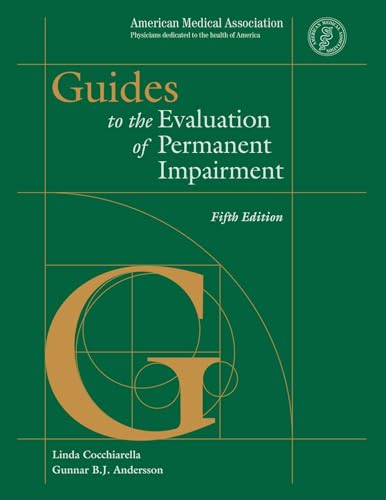

Guides to the evaluation of permanent impairment Linda Cocchiarella, Gunnar B.J. Anderson, [editors].
Detalles de publicación: [Chicago] American Medical Association c2001.Edición: 5th edDescripción: xxii, 613 p. ill. 29 cmISBN:- 1579470858
- 614.1 G9469 21
- RA1055.5 .G85 2001
| Imagen de cubierta | Tipo de ítem | Biblioteca actual | Biblioteca de origen | Colección | Ubicación en estantería | Signatura topográfica | Materiales especificados | Info Vol | URL | Copia número | Estado | Notas | Fecha de vencimiento | Código de barras | Reserva de ítems | Prioridad de la cola de reserva de ejemplar | Reservas para cursos | |
|---|---|---|---|---|---|---|---|---|---|---|---|---|---|---|---|---|---|---|
| Referencia | Biblioteca Encarnación Valdés Sala de Referencia bev | 614.1 G9469 (Navegar estantería(Abre debajo)) | 2005 | Disponible | 80000002285339 | |||||||||||||
| Libro | Biblioteca Encarnación Valdés Sala de Referencia bev | 614.1 G9469 (Navegar estantería(Abre debajo)) | 2001 | Disponible | 80000002110610 |
Descripciones mejoradas de Syndetics:
From its inception in 1971, the AMA Guides quickly became the acknowledged authority in its field. The new edition of Guides carries on this legacy, giving practitioners and non-medical professionals an updated standard in quality evaluations. It is the approved uniform way to evaluate, measure and report impairment. This edition incorporates the latest diagnostic criteria, using the most current scientific evidence from each specialty and a clinical consensus. It was developed by experts representing the major medical specialties. It covers all body systems and contains significant improvements in major chapters including cardiology, respiratory, musculoskeletal and skin. New conditions covered include HIV and latex allergy. In addition, this edition offers user-friendly formatting with consistency among chapters, and improved references and bibliography. Guides is legally mandated or recommended for use in 40 states, and is also used in Australia and Canada.
Features and Benefits Enhanced coverage of chronic pain assessment Information on common conditions and diseases, including HIV and latex allergy Treatment and assessment considerations involving cardiology, dermatology, ocular, respiratory and musculoskeletal systems Standardized formatting across topics
Includes bibliographical references and index.
Ch. 1. Philosophy, purpose, and appropriate use of the Guides -- Ch. 2. Practical application of the Guides -- Ch. 3. The cardiovascular system: heart and aorta -- Ch. 4. The cardiovascular system: systemic and pulmonary arteries -- Ch. 5. The respiratory system -- Ch. 6. The digestive system -- Ch. 7. The urinary and reproductive systems -- Ch. 8. The skin -- Ch. 9. The hematopoietic system -- Ch. 10. The endocrine system -- Ch. 11. Ear, nose, throat, and related structures -- Ch. 12. The visual system -- Ch. 13. The central and peripheral nervous system -- Ch. 14. Mental and behavioral disorders -- Ch. 15. The spine -- Ch. 16. The upper extremities -- Ch. 17. The lower extremities -- Ch. 18. Pain.
Tabla de contenidos provista por Syndetics
- Chapter 1 Philosophy, Purpose, and Appropriate Use of the Guides(p. 1)
- 1.1 History(p. 1)
- 1.2 Impairment, Disability, and Handicap(p. 2)
- 1.3 The Organ System and Whole Body Approach to Impairment(p. 9)
- 1.4 Philosophy and Use of the Combined Values Chart(p. 9)
- 1.5 Incorporating Science With Clinical Judgment(p. 10)
- 1.6 Causation, Apportionment Analysis, and Aggravation(p. 11)
- 1.7 Use of the Guides(p. 12)
- 1.8 Impairment Evaluations in Workers' Compensation(p. 13)
- 1.9 Employability Determinations(p. 13)
- 1.10 Railroad and Maritime Workers(p. 14)
- 1.11 The Physician's Role Based on the Americans with Disabilities Act (ADA)(p. 14)
- 1.12 Summary(p. 15)
- Chapter 2 Practical Application of the Guides(p. 17)
- 2.1 Defining Impairment Evaluations(p. 18)
- 2.2 Who Performs Impairment Evaluations?(p. 18)
- 2.3 Examiners' Roles and Responsibilities(p. 18)
- 2.4 When Are Impairment Ratings Performed?(p. 19)
- 2.5 Rules for Evaluation(p. 19)
- 2.6 Preparing Reports(p. 21)
- Chapter 3 The Cardiovascular System: Heart and Aorta(p. 25)
- 3.1 Principles of Assessment(p. 26)
- 3.2 Vavular Heart Disease(p. 29)
- 3.3 Coronary Heart Disease(p. 35)
- 3.4 Congenital Heart Disease(p. 42)
- 3.5 Cardiomyopathies(p. 47)
- 3.6 Pericardial Heart Disease(p. 52)
- 3.7 Arrhythmias(p. 56)
- 3.8 Cardiovascular Impairment Evaluation Summary(p. 60)
- Chapter 4 The Cardiovascular System: Systemic and Pulmonary Arteries(p. 65)
- 4.1 Hypertensive Cardiovascular Disease(p. 66)
- 4.2 Disease of the Aorta(p. 70)
- 4.3 Vascular Diseases Affecting the Extremities(p. 73)
- 4.4 Diseases of the Pulmonary Arteries(p. 79)
- 4.5 Cardiovascular Impairment Evaluation Summary(p. 82)
- Chapter 5 The Respiratory System(p. 87)
- 5.1 Principles of Assessment(p. 88)
- 5.2 Symptoms Associated With Respiratory Disease(p. 89)
- 5.3 Tobacco Use and Environment Exposure Associated With Respiratory Disease(p. 90)
- 5.4 Examinations, Clinical Studies, and Other Tests for Evaluating Respiratory Disease(p. 91)
- 5.5 Asthma(p. 102)
- 5.6 Obstructive Sleep Apnea(p. 105)
- 5.7 Hypersensitivity Pneumonitis(p. 105)
- 5.8 Penumoconiosis(p. 106)
- 5.9 Lung Cancer(p. 106)
- 5.10 Permanent Impairment Due to Respiratory Disorders(p. 107)
- 5.11 Respiratory Impairment Evaluation Summary(p. 112)
- Chapter 6 The Digestive System(p. 117)
- 6.1 Principles of Assessment(p. 118)
- 6.2 Upper Digestive Tract(p. 120)
- 6.3 Colon, Rectum, and Anus(p. 128)
- 6.4 Enterocutaneous Fistulas(p. 132)
- 6.5 Liver and Biliary Tract(p. 133)
- 6.6 Hernias(p. 136)
- 6.7 Digestive System Impairment Evaluation Summary(p. 138)
- Chapter 7 The Urinary and Reproductive Systems(p. 143)
- 7.1 Principles of Assessment(p. 144)
- 7.2 The Urinary System(p. 144)
- 7.3 Upper Urinary Tract(p. 145)
- 7.4 Urinary Diversion(p. 150)
- 7.5 Bladder(p. 151)
- 7.6 Urethra(p. 153)
- 7.7 Male Reproductive Organs(p. 157)
- 7.8 Female Reproductive Organs(p. 163)
- 7.9 Urinary and Reproductive Systems Impairment Evaluation Summary(p. 170)
- Chapter 8 The Skin(p. 173)
- 8.1 Principles of Assessment(p. 174)
- 8.2 Disfigurement(p. 175)
- 8.3 Scars and Skin Grafts(p. 176)
- 8.4 Contact Dermatitis(p. 176)
- 8.5 Natural Rubber Latex Allergy(p. 177)
- 8.6 Skin Cancer(p. 177)
- 8.7 Criteria for Rating Permanent Impairment Due to Skin Disorders(p. 178)
- 8.8 Skin Impairment Evaluation Summary(p. 188)
- Chapter 9 The Hematopoietic System(p. 191)
- 9.1 Principles of Assessment(p. 192)
- 9.2 Anemia(p. 192)
- 9.3 Polycythemia and Myelofibrosis(p. 196)
- 9.4 White Blood Cell Disease or Abnormalities(p. 197)
- 9.5 Hemorrhagic and Platelet Disorders(p. 203)
- 9.6 Thrombotic Disorders(p. 206)
- 9.7 Hematologic Impairment Evaluation Summary(p. 208)
- Chapter 10 The Endocrine System(p. 211)
- 10.1 Principles of Assessment(p. 212)
- 10.2 Hypothalamic. Pituitary Axis(p. 212)
- 10.3 Thyroid(p. 217)
- 10.4 Parathyroids(p. 219)
- 10.5 Adrenal Cortex(p. 222)
- 10.6 Adrenal Medulla(p. 228)
- 10.7 Pancreas (Islets of Langerhans)(p. 230)
- 10.8 Gonads(p. 237)
- 10.9 Mammary Glands(p. 239)
- 10.10 Metabolic Bone Disease(p. 240)
- 10.11 Endocrine System Impairment Evaluation Summary(p. 241)
- Chapter 11 Ear, Nose, Throat, and Related Structures(p. 245)
- 11.1 Principles of Assessment(p. 246)
- 11.2 The Ear(p. 246)
- 11.3 The Face(p. 255)
- 11.4 The Nose, Throat, and Related Structures(p. 259)
- 11.5 Ear, Nose, Throat, and Related Structures Impairment Evaluation Summary(p. 272)
- Chapter 12 The Visual System(p. 277)
- 12.1 Principles of Assessment(p. 278)
- 12.2 Impairment of Visual Acuity(p. 281)
- 12.3 Impairment of the Visual Field(p. 287)
- 12.4 Impairment of the Visual System(p. 296)
- 12.5 Visual Acuity Measurement at Near (Reading Acuity)(p. 300)
- Chapter 13 The Central and Peripheral Nervous System(p. 305)
- 13.1 Principles of Assessment(p. 305)
- 13.2 Criteria for Rating Impairment Due to Central Nervous System Disorders(p. 308)
- 13.3 Criteria for Rating Cerebral Impairments(p. 309)
- 13.4 Criteria for Rating Impairments of the Cranial Nerves(p. 327)
- 13.5 Criteria for Rating Impairments of Station, Gait, and Movement Disorders(p. 336)
- 13.6 Criteria for Rating Impairments of Upper Extremities Related to Central Impairment(p. 338)
- 13.7 Criteria for Rating Spinal Cord and Related Impairments(p. 340)
- 13.8 Criteria for Rating Impairments Related to Chronic Pain(p. 343)
- 13.9 Criteria for Rating Impairments of the Peripheral Nervous System, Neuromuscular Junction, and Muscular System(p. 344)
- 13.10 Nervous System Impairment Evaluation Summary(p. 352)
- Chapter 14 Mental and Behavioral Disorders(p. 357)
- 14.1 Principles of Assessment(p. 358)
- 14.2 Psychiatric Diagnosis and Impairment(p. 359)
- 14.3 A Method of Evaluating Psychiatric Impairment(p. 361)
- 14.4 Assessing Impairment Severity(p. 364)
- 14.5 Examples of Impairment Due to Mental and Behavioral Disorders(p. 367)
- 14.6 Format of the Impairment Report(p. 370)
- Chapter 15 The Spine(p. 373)
- 15.1 Principles of Assessment(p. 374)
- 15.2 Determining the Appropriate Method for Assessment(p. 379)
- 15.3 Diagnosis-Related Estimates Method(p. 381)
- 15.4 DRE: Lumbar Spine(p. 384)
- 15.5 DRE: Thoracic Spine(p. 388)
- 15.6 DRE: Cervical Spine(p. 392)
- 15.7 Rating Corticospinal Tract Damage(p. 395)
- 15.8 Range-of-Motion Method(p. 398)
- 15.9 ROM: Lumbar Spine(p. 405)
- 15.10 ROM: Thoracic Spine(p. 411)
- 15.11 ROM: Cervical Spine(p. 417)
- 15.12 Nerve Root and/or Spinal Cord(p. 423)
- 15.13 Criteria for Converting Whole Person Impairment to Regional Spine Impairment(p. 427)
- 15.14 The Pelvis(p. 427)
- 15.15 Spine Evaluation Summary(p. 429)
- Chapter 16 The Upper Extremities(p. 433)
- 16.1 Principles of Assessment(p. 434)
- 16.2 Amputations(p. 441)
- 16.3 Sensory Impairment Due to Digital Nerve Lesions(p. 445)
- 16.4 Evaluating Abnormal Motion(p. 450)
- 16.5 Impairment of the Upper Extremities Due to Peripheral Nerve Disorders(p. 480)
- 16.6 Impairment of the Upper Extremities Due to Vascular Disorders(p. 497)
- 16.7 Impairment of the Upper Extremities Due to Other Disorders(p. 498)
- 16.8 Strength Evaluation(p. 507)
- 16.9 Summary of Steps for Evaluating Impairments of the Upper Extremity(p. 511)
- 16.10 Clinical Examples(p. 512)
- Chapter 17 The Lower Extremities(p. 523)
- 17.1 Principles of Assessment(p. 524)
- 17.2 Methods of Assessment(p. 525)
- 17.3 Lower Extremity Impairment Evaluation Procedure Summary and Examples(p. 555)
- Chapter 18 Pain(p. 565)
- 18.1 Principles of Assessment(p. 566)
- 18.2 Overview of Pain(p. 566)
- 18.3 Integrating Pain-Related Impairment Into the Conventional Impairment Rating System(p. 569)
- 18.4 Behavioral Confounders(p. 581)
- 18.5 How to Rate Pain-Related Impairment: A Sample Protocol(p. 583)
- 18.6 Psychogenic Pain(p. 585)
- 18.7 Malingering(p. 585)
- 18.8 Conclusion(p. 586)
- 18.9 Case Examples(p. 586)
- Appendix Recording Range-of-Motion Measurements(p. 593)
- Glossary(p. 599)
- Combined Values Chart(p. 604)
- Index(p. 607)