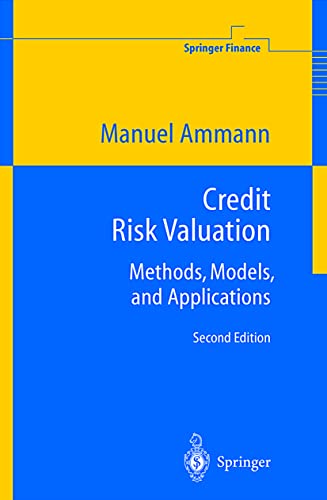

Credit risk valuation methods, models, and applications Manuel Ammann.
Series Springer financeDetalles de publicación: Berlin New York Springer c2001.Edición: 2nd edDescripción: x, 255 p. ill. 24 cmISBN:- 3540678050
- 332.632 A518c2 21
- HG6024.A3 .A465 2001
| Imagen de cubierta | Tipo de ítem | Biblioteca actual | Biblioteca de origen | Colección | Ubicación en estantería | Signatura topográfica | Materiales especificados | Info Vol | URL | Copia número | Estado | Notas | Fecha de vencimiento | Código de barras | Reserva de ítems | Prioridad de la cola de reserva de ejemplar | Reservas para cursos | |
|---|---|---|---|---|---|---|---|---|---|---|---|---|---|---|---|---|---|---|
| Libro | Biblioteca Mons. Iñaki Mallona (Arecibo) Colección General ab | 332.632 A518c2 (Navegar estantería(Abre debajo)) | Disponible | 60000010024104 |
Descripciones mejoradas de Syndetics:
Credit risk is an important consideration in most financial transactions. As for any other risk, the risk taker requires compensation for the undiversifiable part of the risk taken. In bond markets, for example, riskier issues have to promise a higher yield to attract investors. But how much higher a yield? Using methods from contingent claims analysis, credit risk valuation models attempt to put a price on credit risk. This monograph gives an overview of the current methods for the valu ation of credit risk and considers several applications of credit risk models in the context of derivative pricing. In particular, credit risk models are in corporated into the pricing of derivative contracts that are subject to credit risk. Credit risk can affect prices of derivatives in a variety of ways. First, financial derivatives can be subject to counterparty default risk. Second, a derivative can be written on a security which is subject to credit risk, such as a corporate bond. Third, the credit risk itself can be the underlying vari able of a derivative instrument. In this case, the instrument is called a credit derivative. Fourth, credit derivatives may themselves be exposed to counter party risk. This text addresses all of those valuation problems but focuses on counterparty risk. The book is divided into six chapters and an appendix. Chapter 1 gives a brief introduction into credit risk and motivates the use of credit risk models in contingent claims pricing.
"Originally published as volume 470 in the series Lecture notes in economics and mathematical systems with the title Pricing derivative credit risk"--T.p. verso.
Includes bibliographical references (p. [237]-246) and index.
Tabla de contenidos provista por Syndetics
- 1. Introduction(p. 1)
- 1.1 Motivation(p. 1)
- 1.1.1 Counterparty Default Risk(p. 2)
- 1.1.2 Derivatives on Defaultable Assets(p. 6)
- 1.1.3 Credit Derivatives(p. 7)
- 1.2 Objectives(p. 8)
- 1.3 Structure(p. 10)
- 2. Contingent Claim Valuation(p. 13)
- 2.1 Valuation in Discrete Time(p. 14)
- 2.1.1 Definitions(p. 14)
- 2.1.2 The Finite Setting(p. 15)
- 2.1.3 Extensions(p. 18)
- 2.2 Valuation in Continuous Time(p. 18)
- 2.2.1 Definitions(p. 19)
- 2.2.2 Arbitrage Pricing(p. 20)
- 2.2.3 Fundamental Asset Pricing Theorem(p. 25)
- 2.3 Applications in Continuous Time(p. 25)
- 2.3.1 Black-Scholes Model(p. 26)
- 2.3.2 Margrabe's Model(p. 30)
- 2.3.3 Heath-Jarrow-Morton Framework(p. 33)
- 2.3.4 Forward Measure(p. 38)
- 2.4 Applications in Discrete Time(p. 41)
- 2.4.1 Geometric Brownian Motion(p. 41)
- 2.4.2 Heath-Jarrow-Morton Forward Rates(p. 43)
- 2.5 Summary(p. 45)
- 3. Credit Risk Models(p. 47)
- 3.1 Pricing Credit-Risky Bonds(p. 47)
- 3.1.1 Traditional Methods(p. 48)
- 3.1.2 Firm Value Models(p. 48)
- 3.1.2.1 Merton's Model(p. 48)
- 3.1.2.2 Extensions and Applications of Merton's Model(p. 51)
- 3.1.2.3 Bankruptcy Costs and Endogenous Default(p. 52)
- 3.1.3 First Passage Time Models(p. 53)
- 3.1.4 Intensity Models(p. 58)
- 3.1.4.1 Jarrow-Turnbull Model(p. 58)
- 3.1.4.2 Jarrow-Lando-Turnbull Model(p. 62)
- 3.1.4.3 Other Intensity Models(p. 65)
- 3.2 Pricing Derivatives with Counterparty Risk(p. 66)
- 3.2.1 Firm Value Models(p. 66)
- 3.2.2 Intensity Models(p. 67)
- 3.2.3 Swaps(p. 68)
- 3.3 Pricing Credit Derivatives(p. 70)
- 3.3.1 Debt Insurance(p. 70)
- 3.3.2 Spread Derivatives(p. 71)
- 3.4 Empirical Evidence(p. 73)
- 3.5 Summary(p. 74)
- 4. A Firm Value Pricing Model for Derivatives with Counter-party Default Risk(p. 77)
- 4.1 The Credit Risk Model(p. 77)
- 4.2 Deterministic Liabilities(p. 79)
- 4.2.1 Prices for Vulnerable Options(p. 80)
- 4.2.2 Special Cases(p. 82)
- 4.2.2.1 Fixed Recovery Rate(p. 83)
- 4.2.2.2 Deterministic Claims(p. 84)
- 4.3 Stochastic Liabilities(p. 85)
- 4.3.1 Prices of Vulnerable Options(p. 87)
- 4.3.2 Special Cases(p. 88)
- 4.3.2.1 Asset Claims(p. 89)
- 4.3.2.2 Debt Claims(p. 89)
- 4.4 Gaussian Interest Rates and Deterministic Liabilities(p. 90)
- 4.4.1 Forward Measure(p. 91)
- 4.4.2 Prices of Vulnerable Stock Options(p. 93)
- 4.4.3 Prices of Vulnerable Bond Options(p. 95)
- 4.4.4 Special Cases(p. 95)
- 4.5 Gaussian Interest Rates and Stochastic Liabilities(p. 96)
- 4.5.1 Prices of Vulnerable Stock Options(p. 97)
- 4.5.2 Prices of Vulnerable Bond Options(p. 99)
- 4.5.3 Special Cases(p. 99)
- 4.6 Vulnerable Forward Contracts(p. 99)
- 4.7 Numerical Examples(p. 100)
- 4.7.1 Deterministic Interest Rates(p. 100)
- 4.7.2 Stochastic Interest Rates(p. 103)
- 4.7.3 Forward Contracts(p. 110)
- 4.8 Summary(p. 113)
- 4.9 Proofs of Propositions(p. 115)
- 4.9.1 Proof of Proposition 4.2.1(p. 115)
- 4.9.2 Proof of Proposition 4.3.1(p. 120)
- 4.9.3 Proof of Proposition 4.4.1(p. 125)
- 4.9.4 Proof of Proposition 4.5.1(p. 132)
- 5. A Hybrid Pricing Model for Contingent Claims with Credit Risk(p. 141)
- 5.1 The General Credit Risk Framework(p. 141)
- 5.1.1 Independence and Constant Parameters(p. 143)
- 5.1.2 Price Reduction and Bond Prices(p. 145)
- 5.1.3 Model Specifications(p. 146)
- 5.1.3.1 Arrival Rate of Default(p. 146)
- 5.1.3.2 Recovery Rate(p. 147)
- 5.1.3.3 Bankruptcy Costs(p. 148)
- 5.2 Implementations(p. 149)
- 5.2.1 Lattice with Deterministic Interest Rates(p. 149)
- 5.2.2 The Bankruptcy Process(p. 153)
- 5.2.3 An Extended Lattice Model(p. 155)
- 5.2.3.1 Stochastic Interest Rates(p. 157)
- 5.2.3.2 Recombining Lattice versus Binary Tree(p. 158)
- 5.3 Prices of Vulnerable Options(p. 159)
- 5.4 Recovering Observed Term Structures(p. 160)
- 5.4.1 Recovering the Risk-Free Term Structure(p. 160)
- 5.4.2 Recovering the Defaultable Term Structure(p. 161)
- 5.5 Default-Free Options on Risky Bonds(p. 162)
- 5.5.1 Put-Call Parity(p. 163)
- 5.6 Numerical Examples(p. 164)
- 5.6.1 Deterministic Interest Rates(p. 164)
- 5.6.2 Stochastic Interest Rates(p. 168)
- 5.7 Computational Cost(p. 171)
- 5.8 Summary(p. 173)
- 6. Pricing Credit Derivatives(p. 175)
- 6.1 Credit Derivative Instruments(p. 176)
- 6.1.1 Credit Derivatives of the First Type(p. 176)
- 6.1.2 Credit Derivatives of the Second Type(p. 178)
- 6.1.3 Other Credit Derivatives(p. 178)
- 6.2 Valuation of Credit Derivatives(p. 178)
- 6.2.1 Payoff Functions(p. 180)
- 6.2.1.1 Credit Forward Contracts(p. 180)
- 6.2.1.2 Credit Spread Options(p. 182)
- 6.3 The Compound Pricing Approach(p. 183)
- 6.3.1 Firm Value Model(p. 183)
- 6.3.2 Stochastic Interest Rates(p. 187)
- 6.3.3 Intensity and Hybird Credit Risk Models(p. 188)
- 6.4 Numerical Examples(p. 189)
- 6.4.1 Deterministic Interest Rates(p. 189)
- 6.4.2 Stochastic Interest Rates(p. 193)
- 6.5 Pricing Spread Derivatives with a Reduced-Form Model(p. 194)
- 6.6 Credit Derivatives as Exchange Options(p. 198)
- 6.6.1 Process Specifications(p. 198)
- 6.6.2 Price of an Exchange Option(p. 200)
- 6.7 Credit Derivatives with Counterparty Default Risk(p. 205)
- 6.7.1 Price of an Exchange Option with Counterparty Default Risk(p. 205)
- 6.8 Summary(p. 215)
- 7. Conclusion(p. 217)
- 7.1 Summary(p. 218)
- 7.2 Practical Implications(p. 220)
- 7.3 Future Research(p. 220)
- A. Useful Tools from Martingale Theory(p. 223)
- A.1 Probabilistic Foundations(p. 223)
- A.2 Process Classes(p. 225)
- A.3 Martingales(p. 225)
- A.4 Brownian Motion(p. 227)
- A.5 Stochastic Integration(p. 229)
- A.6 Change of Measure(p. 233)
- References(p. 237)
- List of Figures(p. 247)
- List of Tables(p. 249)
- Index(p. 251)