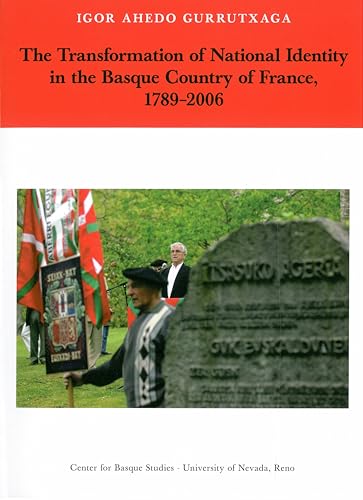

The transformation of national identity in the Basque country of France, 1789-2006 Igor Ahedo Gurrutxaga ; translated by Cameron J. Watson.
Idioma: Inglés Lenguaje original: Español Series Conference papers series ; 15 | Occasional papers series ; 15Detalles de publicación: Reno, NV Center for Basque Studies 2008.Descripción: 399 p. 25 cmTipo de contenido:- 9781877802782 (hardcover)
- 944.716 A2853t 22
- DC611.B318 A44 2008
| Imagen de cubierta | Tipo de ítem | Biblioteca actual | Biblioteca de origen | Colección | Ubicación en estantería | Signatura topográfica | Materiales especificados | Info Vol | URL | Copia número | Estado | Notas | Fecha de vencimiento | Código de barras | Reserva de ítems | Prioridad de la cola de reserva de ejemplar | Reservas para cursos | |
|---|---|---|---|---|---|---|---|---|---|---|---|---|---|---|---|---|---|---|
| Libro | Biblioteca Encarnación Valdés Colección General bev | 944.716 A2853t (Navegar estantería(Abre debajo)) | Disponible | 80000002374901 |
Descripciones mejoradas de Syndetics:
The emergence of modern France is typically cited as the prime example of a strong model of state construction. At the same time, the Basque Country is renowned for its own distinct identity. This work demonstrates how feelings of national identity have changed over the last two hundred years in Iparralde, or the Basque Country of France. It charts how the construction of the French state involved imprinting a French national identity on that part of the Basque Country within its borders. This was a lengthy process, beginning with the French Revolution and culminating in France's involvement in twentieth-century world and colonial wars, and involved creating and disseminating a French national mythology while at the same time denying any strong feelings of Basque particularity. The author then shows how a distinct sense of Basque national identity resurfaced in the 1960s with the first overtly politicized Basque nationalist movement in Iparralde and how, by the turn of the millennium, different political forces were competing to articulate diverse notions of national attachment, with territory forming a central feature of Basque nationalist claims to people's primary identity.
Includes bibliographical references and index.
"This work traces the meaning of identity in the Basque Country of France between the late eighteenth century and the present, including French state-building efforts in promoting a French national identity, attempts to encourage French and Basque sentiment, and the emergence of Basque nationalism with its emphasis on a Basque national identity"--Provided by publisher.