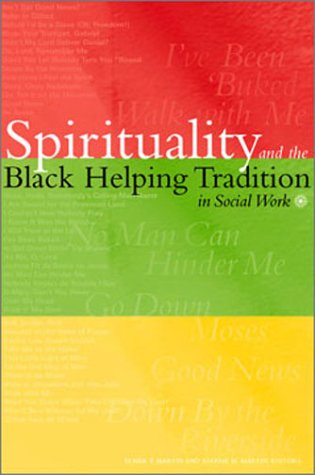

Spirituality and the Black helping tradition in social work Elmer P. Martin and Joanne M. Martin.
Detalles de publicación: Washington, DC NASW Press c2002.Descripción: viii, 296 p. ill. 23 cmISBN:- 0871013223 (pbk.)
- 361.3/089/96073 21
- HV3181 .M372 2002
| Imagen de cubierta | Tipo de ítem | Biblioteca actual | Biblioteca de origen | Colección | Ubicación en estantería | Signatura topográfica | Materiales especificados | Info Vol | URL | Copia número | Estado | Notas | Fecha de vencimiento | Código de barras | Reserva de ítems | Prioridad de la cola de reserva de ejemplar | Reservas para cursos | |
|---|---|---|---|---|---|---|---|---|---|---|---|---|---|---|---|---|---|---|
| Libro | Biblioteca Encarnación Valdés Colección General bev | 361.3089 M3791s (Navegar estantería(Abre debajo)) | Disponible | 80000002251737 |
Descripciones mejoradas de Syndetics:
In the black helping tradition, spirituality is the sense of the sacred and divine. It is a critical value deeply rooted in the African worldview and used by African Americans as a tool for survival. Provocative and well-written, this is the first book to draw a relationship between social work, spirituality, and the helping tradition among African Americans. Offering a wealth of historical detail and narrative, Elmer and Joanne Martin explore spirituality as a foundation for understanding people of African descent and as a skill to evoke self-help. This ground-breaking book raises compelling questions about the limitations and strengths of mainstream social work in issues of black spirituality and its role in strengthening the black community today.
Includes bibliographical references (p. 261-275) and index.
Spirituality and the traditional African helper -- Spirituality and the enslaved Black helper -- Religious mythomania and the fight for freedom -- Spirituality and the race work in the free Black community -- Alexander Crummell, W.E.B. Du Bois, and the transition of race work to social work -- Early Black male social workers and the integration of spirituality and science -- Early Black female social workers, spirituality, and fictive kinship -- Black spirituality and mainstream social work -- Spirituality and African-centered and Black experience-based social work approaches.
Tabla de contenidos provista por Syndetics
- List of Figures and Tables(p. vi)
- Dedication(p. vii)
- Chapter 1 Introduction(p. 1)
- Chapter 2 Spirituality and the Traditional African Helper(p. 15)
- Chapter 3 Spirituality and the Enslaved Black Helper(p. 39)
- Chapter 4 Religious Mythomania and the Fight for Freedom(p. 63)
- Chapter 5 Spirituality and Race Work in the Free Black Community(p. 93)
- Chapter 6 Alexander Crummell, W.E.B. Du Bois, and the Transition of Race Work to Social Work(p. 115)
- Chapter 7 Early Black Male Social Workers and the Integration of Spirituality and Science(p. 137)
- Chapter 8 Early Black Female Social Workers, Spirituality, and Fictive Kinship(p. 165)
- Chapter 9 Black Spirituality and Mainstream Social Work(p. 193)
- Chapter 10 Spirituality and African-Centered and Black Experience-Based Social Work Approaches(p. 227)
- Bibliography(p. 261)
- Index(p. 277)