Imagen de Amazon.com

Portada de Syndetics
Imagen de OpenLibrary
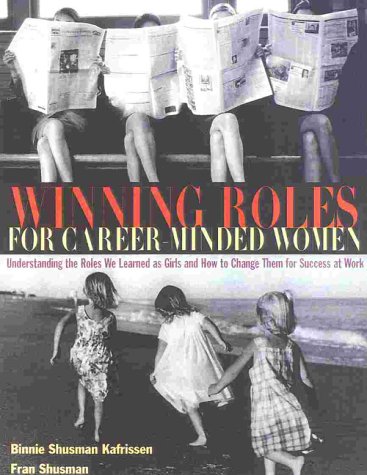
Winning roles for career-minded women understanding the roles we learned as girls and how to change them for success at work Binnie Shusman Kafrissen and Fran Shusman ; foreword by Joanna Smith Bers.
Detalles de publicación: Palo Alto, California Davies-Black Publishing c2000.Edición: 1st edDescripción: xviii, 172 p. ill. 23 cmISBN:- 0891061460 (pbk.)
| Imagen de cubierta | Tipo de ítem | Biblioteca actual | Biblioteca de origen | Colección | Ubicación en estantería | Signatura topográfica | Materiales especificados | Info Vol | URL | Copia número | Estado | Notas | Fecha de vencimiento | Código de barras | Reserva de ítems | Prioridad de la cola de reserva de ejemplar | Reservas para cursos | |
|---|---|---|---|---|---|---|---|---|---|---|---|---|---|---|---|---|---|---|
| Libro | Biblioteca de Mayagüez Colección General mb | HQ1206 .K34 2000 (Navegar estantería(Abre debajo)) | Disponible | 50000002170727 |
Total de reservas: 0
Descripciones mejoradas de Syndetics:
From peacemaker, maverick, and pleaser to caregiver, survivor, and entrepreneur, the authors examine the different roles of women in the workplace and then offer tools to identify strengths, weaknesses, and a sound strategy for change.
Includes bibliographical references (p. 167-168) and index.
Tabla de contenidos provista por Syndetics
- Foreword(p. ix)
- Preface(p. xi)
- About the Authors(p. xiii)
- Introduction(p. xv)
- Part 1 The Roles We Play(p. 1)
- 1 Roles in the Family(p. 3)
- 2 Role of the Peacekeeper(p. 19)
- 3 Role of the Maverick(p. 31)
- 4 Role of the Pleaser(p. 43)
- 5 Role of the Caregiver(p. 55)
- 6 Role of the Survivor(p. 67)
- 7 Role of the Entrepreneur(p. 79)
- 8 Comparing and Combining Roles(p. 91)
- Part 2 Changing Our Roles to Succeed at Work(p. 101)
- 9 Understanding Roles in the Workplace(p. 103)
- 10 Changing the Way We Think(p. 123)
- 11 Changing the Way We Act(p. 143)
- 12 Creating Our Future(p. 159)
- References(p. 167)
- Index(p. 169)
Reseñas proporcionadas por Syndetics
Library Journal Review
Obviously aimed at working women, these two books explore how women manage to hold themselves back in the workplaceDand how they can change such counterproductive behavior. But the books approach their topic in vastly different ways. Kafrissen, an organizational psychologist with Fortune 500 clients, and Shusman, a counseling psychologist and clinical associate at the University of Pennsylvania, posit that women tend to bring the roles they grew up with to the workplace. They identify six rolesDthe Peacekeeper, Maverick, Pleaser, Caregiver, Survivor, and EntrepreneurDand explain the pluses and minuses of staying in these roles once one has left the family. The authors include worksheets so that readers can decide how their roles are inhibiting or advancing their careers. They also provide some cognitive and behavioral exercises that readers can use to help break out of the negative aspects of their roles. Management consultant Swiss (Women and the Work/Family Dilemma) has a completely different focus. She interviewed 52 men to find out what they really think about working with women. Some men gave repulsive answers, such as those who still propagate double standards (e.g., he's "got balls," she's "a bitch"). Others offered surprising views for the 21st century, for example, the 34-year-old who said he would "rather there were not women working here." All of the answers were fascinating, however, and Swiss does a great job of weaving the quotes together to make broad points. She also gives hints, which she calls "codebreakers," on how women can get ahead with the information she imparts here. Both these books are recommended for any public library. Swiss's book is particularly recommended as a sociological study of the "old boy's club," although it lacks a bibliography of all of the books that she mentions.DPam Matthews, Gettysburg Coll. Lib., PA (c) Copyright 2010. Library Journals LLC, a wholly owned subsidiary of Media Source, Inc. No redistribution permitted.Booklist Review
Two Philadelphia psychologists type female business roles--without resorting to too many cliches or stereotypes--and set forth ways to change behavior and problem-solving abilities. Many of the six roles will sound familiar because they represent names we use daily to describe personalities: maverick, pleaser, caregiver, peacekeeper, survivor, and entrepreneur. Yet don't get too trapped by the individual definitions. Of tremendous help are, first, the authors' insistence that roles can be combined and, second, the very thorough elaboration of strength and weaknesses of each role. Where the mother-and-daughter authors excel is in providing the concrete steps of action for success, looking very practically at benefit-cost analyses of the role and pursuing strategies to enable change. Disguised case histories help bring the theories to life, while exercises and questions unearth the true sense of selves and redefinitions in business and personal worlds. --Barbara JacobsNotas de autor provistas por Syndetics
Binnie Shusman Kafrissen, Ph.D., is an organizational psychologistFran Shusman, Ph.D., is a licensed counseling psychologist in private practice and a clinical associate in the Department of Psychiatry, University of Pennsylvania