Imagen de Amazon.com

Portada de Syndetics
Imagen de OpenLibrary
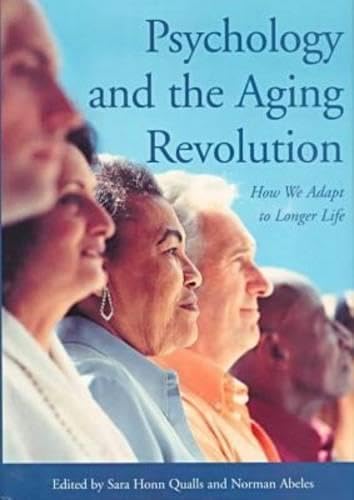
Psychology and the aging revolution how we adapt to longer life edited by Sara Honn Qualls and Norman Abeles.
Detalles de publicación: Wshington, DC American Psychological Association 2000.Descripción: ix, 313 p. ill. 25 cmISBN:- 1557987076
- 21 155.67 P9746
- BF724.55 .A35 P794 2000
| Imagen de cubierta | Tipo de ítem | Biblioteca actual | Biblioteca de origen | Colección | Ubicación en estantería | Signatura topográfica | Materiales especificados | Info Vol | URL | Copia número | Estado | Notas | Fecha de vencimiento | Código de barras | Reserva de ítems | Prioridad de la cola de reserva de ejemplar | Reservas para cursos | |
|---|---|---|---|---|---|---|---|---|---|---|---|---|---|---|---|---|---|---|
| Libro | Biblioteca Encarnación Valdés Colección General bev | 155.67 P9746 (Navegar estantería(Abre debajo)) | Disponible | 80000002102880 |
Total de reservas: 0
Descripciones mejoradas de Syndetics:
Focuses on how longer life expectancies will change the fabric of soci ety and individual lives. Examines the latest theories and research o n how aging affects a wide variety of aspects -- memory, social relati onships, emotion, and mental health.
Includes bibliographical references and index.
Tabla de contenidos provista por Syndetics
- Contributors(p. vii)
- Acknowledgments(p. ix)
- Chapter 1. Psychology and the Aging Revolution(p. 3)
- Chapter 2. Using the Gift of Long Life: Psychological Implications of the Age Revolution(p. 11)
- I. Neuropsychology and Cognitive Aging
- Chapter 3. Neuropsychology and Cognitive Aging: What Have We Taught Each Other?(p. 25)
- Chapter 4. Toward a Neuropsychology of Cognitive Aging(p. 43)
- II. Memory and Aging
- Chapter 5. Memory Changes in Adulthood(p. 73)
- Chapter 6. Can Acquired Knowledge Compensate for Age-Related Declines in Cognitive Efficiency?(p. 99)
- III. Emotion and Aging
- Chapter 7. Expressive, Physiological, and Subjective Changes in Emotion Across Adulthood(p. 123)
- IV. Social Relationships in Later Life
- Chapter 8. What Is Being Optimized?: Self-Determination Theory and Basic Psychological Needs(p. 145)
- Chapter 9. The Evolution of Social Relationships in Later Adulthood(p. 173)
- V. Health Psychology and Aging
- Chapter 10. A Behavioral Medicine Perspective on Aging and Health(p. 197)
- Chapter 11. Aging Research and Health: A Status Report(p. 207)
- VI. Depression and Aging
- Chapter 12. Depression: Current Developments and Controversies(p. 223)
- Chapter 13. Variations on Depression in Later Life(p. 239)
- VII. Psychotherapy and Aging
- Chapter 14. Psychotherapy and Aging in the 21st Century: Integrative Themes(p. 259)
- Author Index(p. 287)
- Subject Index(p. 305)
- About the Editors(p. 313)