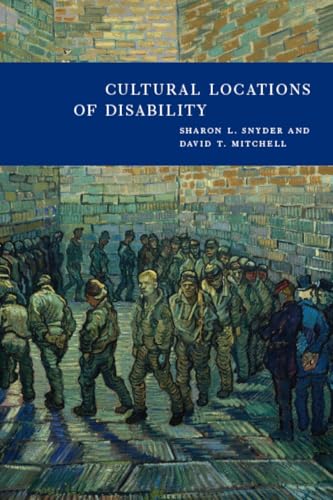

Cultural locations of disability Sharon L. Snyder and David T. Mitchell.
Detalles de publicación: Chicago University of Chicago Press 2006.Descripción: xiv, 245 p. ill. 24 cmISBN:- 0226767329 (pbk. : alk. paper)
- 9780226767321 (pbk. : alk. paper)
- 305.908 S6751c 22
- HV1568 .S69 2006
- 2006 F-691
- HV 1568
| Imagen de cubierta | Tipo de ítem | Biblioteca actual | Biblioteca de origen | Colección | Ubicación en estantería | Signatura topográfica | Materiales especificados | Info Vol | URL | Copia número | Estado | Notas | Fecha de vencimiento | Código de barras | Reserva de ítems | Prioridad de la cola de reserva de ejemplar | Reservas para cursos | |
|---|---|---|---|---|---|---|---|---|---|---|---|---|---|---|---|---|---|---|
| Libro | Biblioteca Encarnación Valdés Colección General bev | 305.908 S6751c (Navegar estantería(Abre debajo)) | Disponible | 80000002344805 |
Descripciones mejoradas de Syndetics:
In Cultural Locations of Disability, Sharon L. Snyder and David T. Mitchell trace how disabled people came to be viewed as biologically deviant. The eugenics era pioneered techniques that managed "defectives" through the application of therapies, invasive case histories, and acute surveillance techniques, turning disabled persons into subjects for a readily available research pool. In its pursuit of normalization, eugenics implemented disability regulations that included charity systems, marriage laws, sterilization, institutionalization, and even extermination. Enacted in enclosed disability locations, these practices ultimately resulted in expectations of segregation from the mainstream, leaving today's disability politics to focus on reintegration, visibility, inclusion, and the right of meaningful public participation.
Snyder and Mitchell reveal cracks in the social production of human variation as aberrancy. From our modern obsessions with tidiness and cleanliness to our desire to attain perfect bodies, notions of disabilities as examples of human insufficiency proliferate. These disability practices infuse more general modes of social obedience at work today. Consequently, this important study explains how disabled people are instrumental to charting the passage from a disciplinary society to one based upon regulation of the self.
Includes bibliographical references (p. 217-235) and index.
Tabla de contenidos provista por Syndetics
- Preface(p. ix)
- Introduction: Cultural Locations of Disability(p. 3)
- Part I Dis-locations of Culture
- 1 Masquerades of Impairment: Charity as a Confidence Game(p. 37)
- 2 Subnormal Nation: The Making of a U.S. Disability Minority(p. 69)
- 3 The Eugenic Atlantic: Disability and the Making of an International Science(p. 100)
- Part II Echoes of Eugenics
- 4 After the Panopticon: Contemporary Institutions as Documentary Subject(p. 133)
- 5 Body Genres and Disability Sensations: The Challenge of the New Disability Documentary Cinema(p. 156)
- Part III Institutionalizing Disability Studies
- 6 Conclusion: Compulsory Feral-ization(p. 185)
- Notes(p. 205)
- Works Cited(p. 217)
- Index(p. 237)