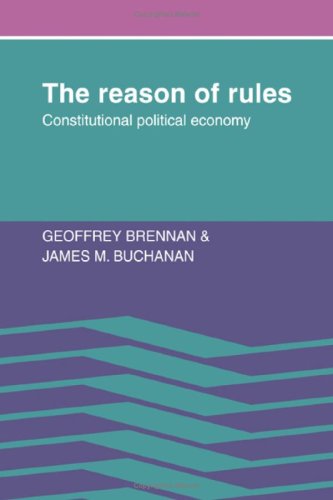

The reason of rules constitutional political economy Geoffrey Brennan, James M. Buchanan.
Detalles de publicación: Cambridge New York Cambridge University Press 1985.Descripción: xiv, 153 p. ill. 24 cmISBN:- 0521256550
| Imagen de cubierta | Tipo de ítem | Biblioteca actual | Biblioteca de origen | Colección | Ubicación en estantería | Signatura topográfica | Materiales especificados | Info Vol | URL | Copia número | Estado | Notas | Fecha de vencimiento | Código de barras | Reserva de ítems | Prioridad de la cola de reserva de ejemplar | Reservas para cursos | |
|---|---|---|---|---|---|---|---|---|---|---|---|---|---|---|---|---|---|---|
| Libro | Biblioteca de Derecho Mons. Fremiot Torres Oliver Colección General biblioteca derecho | HB 73 .B74 1985 (Navegar estantería(Abre debajo)) | Disponible | 70000000005269 |
Descripciones mejoradas de Syndetics:
Societies function on the basis of rules. These rules, rather like the rules of the road, coordinate the activities of individuals who have a variety of goals and purposes. Whether the rules work well or ill, and how they can be made to work better, is a matter of major concern. Appropriately interpreted, the working of social rules is also the central subject matter of modern political economy. This book is about rules - what they are, how they work, and how they can be properly analysed. The authors' objective is to understand the workings of alternative political institutions so that choices among such institutions (rules) can be more fully informed. Thus, broadly defined, the methodology of constitutional political economy is the subject matter of The Reason of Rules. The authors have examined how rules for political order work, how such rules might be chosen, and how normative criteria for such choices might be established.
Includes bibliographical footnotes and index.
Tabla de contenidos provista por Syndetics
- 1 The constitutional imperative
- 2 The contractarian vision
- 3 The myth of benevolence
- 4 Modelling the individual for constitutional analysis
- 5 Time, temptation, and the constrained future
- 6 Politics without rules, I: Time and non-constrained collective action
- 7 rules and justice
- 8 Politics without rules, II: Distributive justice and distributive politics
- 9 Is constitutional revolution possible in democracy?