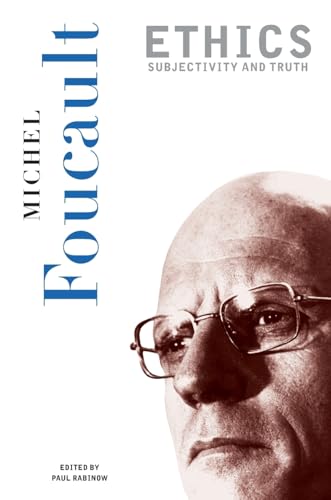

Ethics : subjectivity and truth. / by Michael Foucault; edited by Paul Rabinow; translated by Robert Hurley and others. txt
United States of America : Editions Gallimard , 1997Descripción: v. 1 24 cmTipo de contenido:- text
- unmediaded
- volume
- 9781565844346
- 1565844343
- The Essential Works of Foucault, 1954-1984
- 194 21
- B2430.F722 E5 1997
| Imagen de cubierta | Tipo de ítem | Biblioteca actual | Biblioteca de origen | Colección | Ubicación en estantería | Signatura topográfica | Materiales especificados | Info Vol | URL | Copia número | Estado | Notas | Fecha de vencimiento | Código de barras | Reserva de ítems | Prioridad de la cola de reserva de ejemplar | Reservas para cursos | |
|---|---|---|---|---|---|---|---|---|---|---|---|---|---|---|---|---|---|---|
| Libro | CARIBET Biblioteca Arquitectura Colección General CARIBET | General B2430.F722 E5 1997 (Navegar estantería(Abre debajo)) | 1 | Disponible | 91000000040642 |
Descripciones mejoradas de Syndetics:
The definitive edition of articles, interviews, and seminars by the renowned philosopher and historian
Few philosophers have had as strong an influence on the way we think about power and knowledge as Michel Foucault (1926-1984). His work has influenced the teaching of any number of disciplines and remains critically important. This lucid and accessible volume is drawn from the complete collection of all of Foucault's courses, articles, and interviews, and brings his most important work to a new generation of readers.
Ethics (edited by Paul Rabinow) contains the summaries of Foucault's renowned courses at the Collège de France, paired with key writings and interviews on friendship, sexuality, and the care of the self and others.
Include index.
Include bibliographical references.
"Few philosophers have had as strong an influence on the twentieth century as Michel Foucault. In 1994, ten years after his death, his French publisher, Gallimard, issued Dits et ecrits, the first complete collection of all Foucault's publications outside his monographs." "It is a great pleasure for The New Press to bring the most important work from Dits et ecrits - including much never before published in the United States - to English-speaking readers in a definitive three-volume series edited by Paul Rabinow." "This first volume contains the famous course summaries Foucault submitted to the College de France each year from 1970 and 1982. Never before available in English, these writings provide a lucid and accessible overview of Foucault's work in progress during this time, including his groundbreaking analyses of penal institutions, psychiatry, "biopolitics," and the modern subject." "A second section contains interviews, along with Foucault's key writings on ethics, including some of the riskiest and most personal writing of Foucault's career. These pieces illustrate the attempt to elaborate new ways of life and modes of "care of the self" that concerned him during the last years of his life." --
Notas de autor provistas por Syndetics
Michel Foucault was born on October 15, 1926, in Poitiers, France, and was educated at the Sorbonne, in Paris. He taught at colleges all across Europe, including the Universities of Lill, Uppsala, Hamburg, and Warsaw, before returning to France. There he taught at the University of Paris and the College of France, where he served as the chairman of History of Systems of Thought until his death.Regarded as one of the great French thinkers of the twentieth century, Foucault's interest was in the human sciences, areas such as psychiatry, language, literature, and intellectual history. He made significant contributions not just to the fields themselves, but to the way these areas are studied, and is particularly known for his work on the development of twentieth-century attitudes toward knowledge, sexuality, illness, and madness.
Foucault's initial study of these subjects used an archaeological method, which involved sifting through seemingly unrelated scholarly minutia of a certain time period in order to reconstruct, analyze, and classify the age according to the types of knowledge that were possible during that time. This approach was used in Madness and Civilization: A History of Insanity in the Age of Reason, for which Foucault received a medal from France's Center of Scientific Research in 1961, The Birth of the Clinic, The Order of Things, and The Archaeology of Knowledge.
Foucault also wrote Discipline and Punishment: The Birth of the Prison, a study of the ways that society's views of crime and punishment have developed, and The History of Sexuality, which was intended to be a six-volume series. Before he could begin the final two volumes, however, Foucault died of a neurological disorder in 1984.
(Bowker Author Biography)