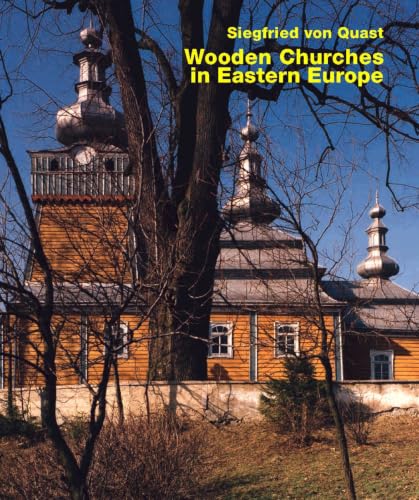

Wooden churches in Eastern Europe Siegrid von Quast; Geleitwort/Preface Rudolf Moser txt
Stuttgart ; London : Edition Axel Menges, 2024Descripción: 79 pages : color illustrations ; 29 cmTipo de contenido:- still image
- unmediaded
- volume
- 9783869050362
- 3869050365
- NA5450 Q37 2024
| Imagen de cubierta | Tipo de ítem | Biblioteca actual | Biblioteca de origen | Colección | Ubicación en estantería | Signatura topográfica | Materiales especificados | Info Vol | URL | Copia número | Estado | Notas | Fecha de vencimiento | Código de barras | Reserva de ítems | Prioridad de la cola de reserva de ejemplar | Reservas para cursos | |
|---|---|---|---|---|---|---|---|---|---|---|---|---|---|---|---|---|---|---|
| Libro Col. General CARIBET | CARIBET Biblioteca Arquitectura Colección General CARIBET | General NA5450 Q37 2024 (Navegar estantería(Abre debajo)) | 1 | Disponible | 91000000754259 |
Descripciones mejoradas de Syndetics:
What all these buildings have in common is that with the available material, wood, and the most modest means, places of worship, centres in the villages, were built with much feeling and love. The constructions in wood were derived in an old tradition from the dwellings and farm buildings of the peasant population. Their architecture, the typological forms probably penetrated into this seclusion as an idea. "The idea of a church as a building", brought with them by clergymen and wandering master craftsmen from the more fertile plains and the rich, large mining and trading towns.
The oldest churches were built as early as in the 15th century, most of those still standing were built in the 18th and 19th centuries, and quite a few are still being built today. Many were destroyed in the two world wars, many fell victim to ethnic cleansing after 1945. Many were destroyed in the two world wars, many fell victim to ethnic cleansing after 1945, some fell into disrepair during the Soviet era, others were burnt down by lightning or short circuits, and quite a few simply gave way to the more "representative" stone churches as early as the 19th century. But a large number are still standing, consecrated, and believers gather in them. In fact, almost all of them in the various Carpathian countries are protected monuments, and many have been lovingly restored in recent times.
More than the architectural-historical value, the question arises here of the aesthetic assessment of these small buildings. It is not a refined canon of forms of great architecture that can be derived and proven from the history of architecture that inspires us so much. Basically, they are not overly sophisticated constructions in terms of craftsmanship, they are safe and beautiful in their simplicity. Their aesthetic appeal, however, also includes the surface-weathered material, deformed structures, colour improvisations, recently ornamented sheet metal, inside wall paintings, altar and iconostasis furnishings derived from Renaissance and Baroque periods, but above all their location in the village, mostly isolated, often elevated, surrounded by old trees, enclosures and graves without cemetery order.
"What all these buildings have in common is that with the available material, wood and the most modest means, places of worship, centres in the villages, were built with much feeling and love. The constructions in wood were derived in an old tradition from the dwellings and farm buildings of the peasant population. Their architecture with their typological forms probably penetrated into this seclusion as an idea. The idea of a church as a building was brought with them by clergymen and wandering master craftsmen from the more fertile plains and the rich, large mining and trading towns. The oldest churches were built as early as in the 15th century, most of those still standing were built in the 18th and 19th centuries, and quite a few are still being built today. Many were destroyed in the two world wars, many fell victim to ethnic cleansing after 1945, some fell into disrepair during the Soviet era, others were burnt down by lightning or short circuits, and quite a few simply gave way to the more "representative" stone churches as early as the 19th century. But a large number are still standing, consecrated, and believers gather in them. In fact, almost all of them in the various Carpathian countries are protected monuments, and many have been lovingly restored in recent times. Nevertheless, some are in poor condition." -- back of cover
7 Rudolf Moser: About my friend Siegfried von Quast --
9 Siegfried von Quast: From the introduction to the planned, but no longer realized book on the wooden churches in Eastern Europe --
10 Picture section --
Illustrations:
Bilá Moravskoslezky kraj, Tschechien Friedrichskirche, nach Kardinal Friedrich Egon von Furstenberg bennant 1873/74 Architekt: A. Kybasta 11 --
Botosana Suceava, Rumanien Sankt Demetrius 1810 --
Braesti Botosani, Rumanien Entschlafen der Gottesmutter 1745 17 --
Czertez Sanok, Polen Verklarung Christi 1742 19 --
Colesti Bihor, Rumanien Hll. Erzengel 18. Jh. 19 --
Gemzse Szabolcs Szatmár Bereg, Ungarn 1889 21 --
Hervatov Presov, Slowakei 1500 21 --
Jupanesti Gorj, Rumanien 1742 23 --
Jupanesti Gorj, Rumanien 1742 25 --
Malé Ozorovce Kosice, Slowakei Anfang 15. Jh. Glockenturm 1619 27 --
Moraresti Arges, Rumanien 1832 29 --
Agristeu (Balauseri) Mures, Rumanien 31 --
Deleni (Bagaciu) Mures, Rumanien 31 --
Nagyszekeres Szabolcs Szatmar Bereg, Ungarn 1819 und 1836 33 --
Nyírbátor Szabolcs Szatmáar Bereg, Ungarn Ende 15. Jh. Glockenturm 1640 37 --
Pausa Bihor, Rumanien St. Nikolaus 1730 37 --
Pistyn Ivano Frankvsk, Ukraine Entschlafen der Gottesmutter 1858 39 --
Poarta Salajului Salaj, Rumanien Hll. Erzengel 1670 39 --
Rozavlea Maramures, Rumanien 1716 41 --
Rusky Potok Presov, Slowakei Erzengel Michael 18. Jh. 41 --
Rzepedz Sanok, Polen Hl. Nikolaus 1826 43 --
Sanok Sanok, Polen transloz, aus Baczal Dolny, Jaslo, Polen St. Nikolaus 1667 45 --
Skwirtne Gorlice, Polen Hll. Cosmas und Damian 1837 47 --
Spytkowice Wadowice, Polen Gottensmutter 49 --
Stará Halic Lucenec, Slowakei um 1300 Glockednturm 1673 51 --
Svidník Presov, Slowakei transloz, aus Nová Polianka, Presov Hl. Paraskeva 1766 51 --
Swiatkowa Mala Jaslo, Polen Erzengel Michael 1757 53 --
Swiatkowa Wielka Jaslo, Polen Erzengel Michael 1757 55 --
Szalonna Borsod Abaúj Zamplén, Ungarn 1765 57 --
Szczawne Sanok, Polen Entschlafen der Gottesmutter 1888 57 --
Tákos szabolcs Szatmár Bereg, Urgan 18. Jh. 59 --
Topol’a Presov, Slowakei Erzengel Michael 1700 61 --
Trocany Presov, Slowakei Ev. Lukas 1739 63 --
Turzansk Sanok, Polen Erzengel Michael 1801 65 --
Tylicz Nowy Sacz, Polen Hll. Cosmas und Damian 1742 67 --
Tyshiv Zakarpatska, Ukraine Entschlafen der Gottesmutter 1898 67 --
Ulicské Krivé Presov, Slowakei Erzengel Michael 18 Jh. 69 --
Uscie Gorlice, Polen Hl. Paraskeva 1786 71 --
Uzhhorod Zakarpattia, Ukraine transloz, aus Shelestovo, Kharkivs’ka, Ukraine 1777 73 --
Uzhhorod Zakarpattia, Ukraine transloz. Aus Shelestovo, Kharkivs’ka, Ukraine 1777 75 --
Uzhhorod Zakarpattia, Ukraine transloz, aus Shelestovo, Kharkivs’ka, Ukraine 1777 77 --
Wysowa Zdrój Gorlice, Polen Erzengel Michael 1779 79 --
What all these buildings have in common is that with the available material, wood, and the most modest means, places of worship, centres in the villages, were built with much feeling and love. The constructions in wood were derived in an old tradition from the dwellings and farm buildings of the peasant population. Their architecture, the typological forms probably penetrated into this seclusion as an idea. "The idea of a church as a building", brought with them by clergymen and wandering master craftsmen from the more fertile plains and the rich, large mining and trading towns.
The oldest churches were built as early as in the 15th century, most of those still standing were built in the 18th and 19th centuries, and quite a few are still being built today. Many were destroyed in the two world wars, many fell victim to ethnic cleansing after 1945. Many were destroyed in the two world wars, many fell victim to ethnic cleansing after 1945, some fell into disrepair during the Soviet era, others were burnt down by lightning or short circuits, and quite a few simply gave way to the more "representative" stone churches as early as the 19th century. But a large number are still standing, consecrated, and believers gather in them. In fact, almost all of them in the various Carpathian countries are protected monuments, and many have been lovingly restored in recent times.
More than the architectural-historical value, the question arises here of the aesthetic assessment of these small buildings. It is not a refined canon of forms of great architecture that can be derived and proven from the history of architecture that inspires us so much. Basically, they are not overly sophisticated constructions in terms of craftsmanship, they are safe and beautiful in their simplicity. Their aesthetic appeal, however, also includes the surface-weathered material, deformed structures, colour improvisations, recently ornamented sheet metal, inside wall paintings, altar and iconostasis furnishings derived from Renaissance and Baroque periods, but above all their location in the village, mostly isolated, often elevated, surrounded by old trees, enclosures and graves without cemetery order.
Parallel texts in English and German
Notas de autor provistas por Syndetics
Siegfried von Quast came from an old Prussian noble family. His great-grandfather, Alexander Ferdinand von Quast (1807-1877), was a pupil of Karl Friedrich Schinkel and from 1843 the first Prussian state conservator. In addition to his work in Prussia, he also took part in Schinkel's considerations for a royal residence for Otto I on the Acropolis in Athens. Siegfried von Quast (1931-2017) first studied philosophy, German literature and art history, and then architecture (among others with Egon Eiermann in Karlsruhe). As an architectural photographer, he was a sought-after partner for renowned architectural firms. His freelance artistic activity was primarily the photographic recording of the wooden churches in Eastern Europe. He devoted himself almost exclusively to this task for many years.