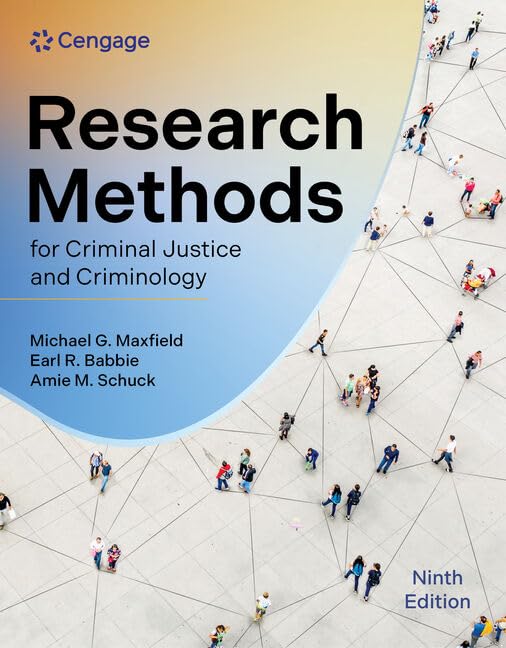

Research methods : for criminal justice and criminology / Michael G. Maxfield, Earl R. Babbie, Amie M. Schuck.
Editor: Australia : Cengage, 2025Edición: Ninth editionDescripción: xiv, 430 pages : illustrations ; 28 cmTipo de contenido:- text
- unmediated
- volume
- 9780357763735
- HV7419.5 .M38 2025
| Imagen de cubierta | Tipo de ítem | Biblioteca actual | Biblioteca de origen | Colección | Ubicación en estantería | Signatura topográfica | Materiales especificados | Info Vol | URL | Copia número | Estado | Notas | Fecha de vencimiento | Código de barras | Reserva de ítems | Prioridad de la cola de reserva de ejemplar | Reservas para cursos | |
|---|---|---|---|---|---|---|---|---|---|---|---|---|---|---|---|---|---|---|
| Libro mb | Biblioteca de Mayagüez Colección General mb | HV7419.5 .M38 2025 (Navegar estantería(Abre debajo)) | c. 1 | Disponible | 52000003299389 |
Descripciones mejoradas de Syndetics:
Featuring real-world examples and comprehensive coverage of qualitative methods, Maxfield/Babbie/Schuck's market-leading RESEARCH METHODS FOR CRIMINAL JUSTICE AND CRIMINOLOGY combines the scholarship, accuracy and conversational tone of Earl Babbie's best-selling THE PRACTICE OF SOCIAL RESEARCH with Mike Maxfield's expertise in criminology and criminal justice. Amie Schuck joins this edition with special expertise in a variety of criminal justice research areas. Providing the most comprehensive, authoritative introduction to criminal justice research available today -- and enhanced by new examples (e.g., cannabis cultivation, violence prevention), research, applications, and built-in study tools -- this edition continues its focus on engaging readers like you in DOING research.
Includes bibliographical references and indexes.
Part 1. An Introduction to Criminal Justice Inquiry -- A Study Skills Module -- Chapter 1. Crime, Criminal Justice, and Scientific Inquiry -- Chapter 2. Foundations of Criminal Justice Research -- Chapter 3. Ethics and Criminal Justice Research -- Part 2. Structuring Criminal Justice Inquiry -- Chapter 4. General Issues in Research Design -- Chapter 5. Concepts, Operationalization, and Measurement -- Chapter 6. Measuring Crime -- Chapter 7. Experimental and Quasi-Experimental Designs -- Part 3. Modes of Observation -- Chapter 8. Sampling -- Chapter 9. Survey Research -- Chapter 10. Qualitative Interviewing -- Chapter 11. Field Observation -- Chapter 12. Agency Records, Content Analysis, and Secondary Data -- Part 4. Application and Analysis -- Chapter 13. Evaluation Research and Problem Analysis -- Chapter 14. Interpreting Data -- References.
RESEARCH METHODS FOR CRIMINAL JUSTICE AND CRIMINOLOGY combines the scholarship, accuracy, and conversational tone of Earl Babbie's best-selling THE PRACTICE OF SOCIAL RESEARCH with Mike Maxfield's expertise in criminology and criminal justice. Providing the most comprehensive, authoritative introduction to criminal justice research available today -- and enhanced by new examples, research, applications, and built-in study tools -- the eighth edition continues its focus on getting students to DO research. Updates include the latest techniques and technologies for sampling and surveys as well as current methods in content analysis and secondary data analysis. What’s more, the MindTap that accompanies this text helps students practice and master techniques and key concepts while engaging them with career-based decision-making scenarios, visual summaries, and more.