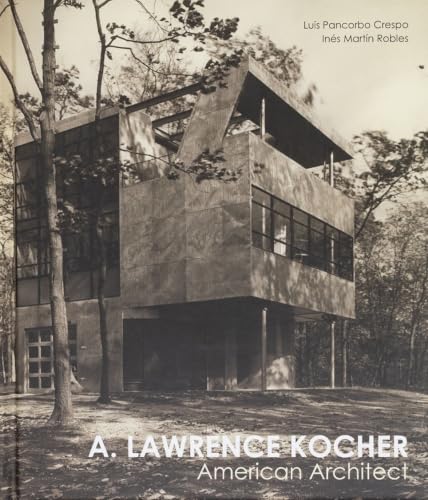

A. Lawrence Kocher : American architect. / Luis Pancorbo Crespo, Ph.D., Inés Martín Robles, Ph.D. txt
San Francisco, California : Applied Research and Design Publishing, 2025Edición: First editionDescripción: 379 p. : ill. ; col. ; plans ; 29 cmTipo de contenido:- text
- unmediaded
- volume
- 9781961856615
- 1961856611
- NA737.K616 P36 2025
| Imagen de cubierta | Tipo de ítem | Biblioteca actual | Biblioteca de origen | Colección | Ubicación en estantería | Signatura topográfica | Materiales especificados | Info Vol | URL | Copia número | Estado | Notas | Fecha de vencimiento | Código de barras | Reserva de ítems | Prioridad de la cola de reserva de ejemplar | Reservas para cursos | |
|---|---|---|---|---|---|---|---|---|---|---|---|---|---|---|---|---|---|---|
| Libro Col. General CARIBET | CARIBET Biblioteca Arquitectura Colección General CARIBET | General NA737.K616 P36 2025 (Navegar estantería(Abre debajo)) | 1 | Disponible | 91000000753368 |
Descripciones mejoradas de Syndetics:
The book offers a new conceptual and historical framework for the study of Kocher's body of work that relocates it within the history of American modern architecture.
Kocher's work as an independent designer has gotten very little critical attention. The book devotes several chapters to this little-known part of Kocher's practice and resituates him as one of the main protagonists in the history of American Modern architecture and reveals the profound relationship between Kocher's designs and existing American domestic traditions. Kocher' concept of the vernacular included not only the different residential types of Colonial and Early Republican America, but most importantly, other kinds of transitional dwelling artifacts. This book tries to provide evidence about Kocher's intention of using these vernacular artifacts, alongside the concepts of prefabrication and industrialization inherent to them as a base to construct a new national architecture in which to graft the European modernist tradition.
Kocher's ideological position and his continuous eagerness for experimentation transformed him into an atypical practitioner. While many of his contemporaries were purely design focused, he established a very avant-garde symbiosis among his three main endeavors: his work as an educator, as a scholar, and as a practitioner. Some of his architectural works can be seen as manifestos that would later further develop in the articles of Architectural Record. Some others are the direct and material demonstrations of industrial systems and materials previously explored in his articles. Even other works are conceived and executed as part of a pedagogical activity. It is rare to find an architectural design in Kocher's body of work that does not demonstrate a multitude of interconnections among his pedagogy, his editorial work, and his scholarship.
Includes bibliographical references (pages 375-378).
Foreword A. Lawrence Kocher : American Architect By Edward R Ford 6 --
Introduction From Disassembly to Display : The Aluminaire House ‘s Desert Resurrection By Leo Marmol 8 --
1930 Aluminaire House : The Migrating Villa 11 --
1920-1929 Before Aluminaire : In Search of a New American Architecture 61 --
1931-1933 The Experimental Weekend House and Parallel Experiences 99 --
1933-1935 Building on Two Coasts : from the Subsistence Farmsteads to the Kocher – Samson Building 149 --
1933-1935 Building on Two Coasts : From the Subsistence Farmsteads to the Kocher – Samson Building 149 --
1935-1941 The Carnegie Tech and Black Mountain College Years 203 --
1941-1969 Innovation and Tradition : Form Back Mountain to Williamsburg 253 --
Conclusions and Notes on the Graphic Reconstruction 311 --
Bibliography 375 --
Illustration Credits 379 --
The book offers a new conceptual and historical framework for the study of Kocher's body of work that relocates it within the history of American modern architecture.
Kocher's work as an independent designer has gotten very little critical attention. The book devotes several chapters to this little-known part of Kocher's practice and resituates him as one of the main protagonists in the history of American Modern architecture and reveals the profound relationship between Kocher's designs and existing American domestic traditions. Kocher' concept of the vernacular included not only the different residential types of Colonial and Early Republican America, but most importantly, other kinds of transitional dwelling artifacts. This book tries to provide evidence about Kocher's intention of using these vernacular artifacts, alongside the concepts of prefabrication and industrialization inherent to them as a base to construct a new national architecture in which to graft the European modernist tradition.
Kocher's ideological position and his continuous eagerness for experimentation transformed him into an atypical practitioner. While many of his contemporaries were purely design focused, he established a very avant-garde symbiosis among his three main endeavors: his work as an educator, as a scholar, and as a practitioner. Some of his architectural works can be seen as manifestos that would later further develop in the articles of Architectural Record. Some others are the direct and material demonstrations of industrial systems and materials previously explored in his articles. Even other works are conceived and executed as part of a pedagogical activity. It is rare to find an architectural design in Kocher's body of work that does not demonstrate a multitude of interconnections among his pedagogy, his editorial work, and his scholarship.