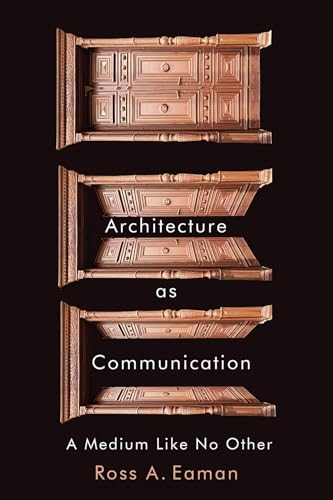

Architecture as communication : a medium like no other. / txt
Montreal : McGill-Queen's University Press, 2025Descripción: 247 p. : 22 cmTipo de contenido:- text
- unmediaded
- volume
- 9780228024255
- 9780228024279
- 9780228024262
- 0228024277
- 0228024269
- NA2584 E26 2025
| Imagen de cubierta | Tipo de ítem | Biblioteca actual | Biblioteca de origen | Colección | Ubicación en estantería | Signatura topográfica | Materiales especificados | Info Vol | URL | Copia número | Estado | Notas | Fecha de vencimiento | Código de barras | Reserva de ítems | Prioridad de la cola de reserva de ejemplar | Reservas para cursos | |
|---|---|---|---|---|---|---|---|---|---|---|---|---|---|---|---|---|---|---|
| Libro Col. General CARIBET | CARIBET Biblioteca Arquitectura Colección General CARIBET | General NA2584 E26 2025 (Navegar estantería(Abre debajo)) | 1 | Disponible | 91000000752931 |
Descripciones mejoradas de Syndetics:
Media theory has long overlooked the built environment and its communicative capacity: how built structures and spaces convey meaning through material embodiment and symbolization.
Architecture as Communication advances the idea that built environments function as media of communication. Using practice theory in conjunction with the concept of style, this book is anchored in three historical determinants: the quest for perfect proportion in buildings, the belief in architectural determinism, and the ongoing efforts within other media to influence how those who experience built environments understand them. Ross Eaman explores how houses, schools, places of worship, factories, office buildings, stores, malls, opera houses, plazas, and parks have meaning for people as subjective life-worlds. Architecture as Communication proposes media theory that articulates the social construction of meaning as a unique way of understanding the built environment - one in which the users and observers of structures and spaces participate along with architects and designers. Architecture, according to Eaman, encompasses the multiplicity of communication as human interaction, preparing people for what they are about to encounter, signalling how they should act, and selectively enabling them to perform their expected role.
Using examples across many historical periods and cultures, Architecture as Communication argues that we judge our built environments by the values they communicate.
Includes bibliographical references and index.
Acknowledgements vii --
Introduction 3 --
1 Architecture as Cosmic Communication 25 --
2 The Evolution of Architectural Determinism 49 --
3 The Mediation of Architectural Meaning 78 --
4 Encoding Meaning in Buildings: Ends and Means 104 --
5 Decoding Meaning in Buildings: Means and Ends 140 --
Conclusion 175 --
Notes 179 --
Index 239 --
"The aim of the work is to advance ideas about how the built environment, including but not restricted to architecture, functions as a medium of communication. The built environment and its communicative capacity have long been overlooked as a medium within an otherwise robust history of media theory in communications and media studies. The book examines early metaphors of communication such as the transmission of messages or the performance of rituals, finding that subsequent media theory hinging on the social construction of meaning provides a particularly fertile way of understanding the built environment: one in which the users and observers of structures and spaces participate along with their architects or designers. This metaphor of how houses, schools, places of worship, factories, office buildings, stores, malls, opera houses, plazas, parks, and numerous other built environments have meaning for people as subjective life-worlds is the main avenue of exploration in the book. Using practice theory in conjunction with the concept of style, the book is anchored in three historical determinants: the longstanding politically-motivated ideal of achieving harmony with the universe through perfect proportion in buildings; the implication of the belief in architectural determinism in this quest for cosmic communication; and the ongoing efforts within other media to influence how built environments, or those considered architecture, are understood by those experiencing them. Using historical materials and case studies ranging over many centuries and cultures, the basic thesis is what might be called architectural communicability - that built environments are judged by the values they communicate."-- Provided by publisher
Tabla de contenidos provista por Syndetics
- Acknowledgments(vii)
- Introduction(3)
- 1 Architecture as Cosmic Communication(25)
- 2 The Evolution of Architectural Determinism(49)
- 3 The Mediation of Architectural Meaning(78)
- 4 Encoding Meaning in Buildings: Ends and Means(104)
- 5 Decoding Meaning in Buildings: Means and Ends(140)
- Conclusion(175)
- Notes(179)
- Index(239)