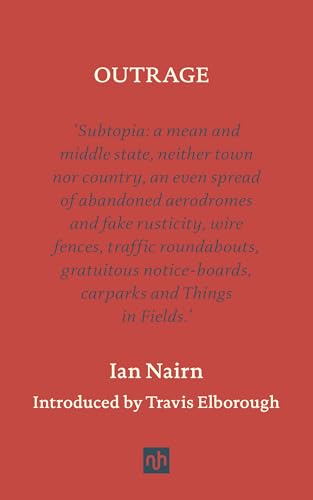

Outrage. / introduced by Travis Elborough txt
Series FLOK DesignBerlin, Germany : Notting Hill Editions Ltd, 2024Descripción: 172 p. : ill. ; maps ; 19 cmTipo de contenido:- text
- unmediaded
- volume
- 9781912559633
- NA9185 N15 2024
| Imagen de cubierta | Tipo de ítem | Biblioteca actual | Biblioteca de origen | Colección | Ubicación en estantería | Signatura topográfica | Materiales especificados | Info Vol | URL | Copia número | Estado | Notas | Fecha de vencimiento | Código de barras | Reserva de ítems | Prioridad de la cola de reserva de ejemplar | Reservas para cursos | |
|---|---|---|---|---|---|---|---|---|---|---|---|---|---|---|---|---|---|---|
| Libro Col. General CARIBET | CARIBET Biblioteca Arquitectura Colección General CARIBET | General NA9185 N15 2024 (Navegar estantería(Abre debajo)) | 1 | Disponible | 91000000751701 |
Descripciones mejoradas de Syndetics:
In 1955, Britain's most prestigious architectural magazine, The Architectural Review, published a special issue featuring a single essay by Ian Nairn, a famously opinionated (and untrained) architectural critic. Based on observations made on a journey Nairn took across the UK in a Morris Minor, Outrage is a searing critique of urban sprawl, or 'Subtopia'. In this manifesto, Nairn warns that 'if what is called development is allowed to multiply at the present rate', Britain's natural - and urban - landscapes will lose their individuality and spirit. A call-to-arms against the 'greying out' of our towns and countryside before it's too late, Outrage is widely considered to be Nairn's masterpiece.
Introduction x --
Subtopia 1--
Agents 13 --
Route Book 49 --
The Highlands 129 --
Summing Up 161 --
Anthology 161 --
Tabla de contenidos provista por Syndetics
- Introduction(x)
- Subtopia(1)
- In this reprint of the Architectural Review is uttered a prophecy of doom - the doom of an England reduced to universal Subtopia, a mean and middle state, neither town nor country, an even spread of abandoned aerodromes and fake rusticity, wire fences, traffic roundabouts, gratuitous notice-boards, car-parks and Things in Fields. It is a morbid condition which spreads both ways from suburbia, out into the country, and back into the devitalised hearts of towns, so that the most sublime backgrounds, urban or rural, English or foreign, are now to be seen only over a foreground of casual and unconsidered equipment, litter and lettered admonitions - Subtopia is the world of universal low-density mess.
- The Review attacks this situation on visual grounds, which are its proper province, but philosophical justifications for a categorical condemnation of Subtopia are not wanting. Man's triumphs of conscience and consciousness have been achieved at the cost of a specialisation that has cut him off from the rest of nature. His mental and physical health require that he shall be able to recreate himself in environments that are conspicuously nature-made, not man-made, that he shall be able to distinguish wild from tame, country from town. Subtopia smudges over this vital difference, destroys country without making town. Britain is a small and over-loaded island where the natural scene is already at a premium, but patches of spreading Subtopian blight are already beginning to coalesce, minor thoughtlessnesses are beginning to agglomerate into a major disaster. To battle with this amorphous destroyer is a daunting task, but bigger problems are being tackled in other fields, and something must be done, now, because the alternative is the abyss.
- Agents(13)
- Subtopia is made with human artefacts, often inoffensive in themselves, disastrous in the places, quantities and associations in which they are found. Within the town the agents of Subtopia are demolition and decay, buildings replaced by bijou gardens, car-parks and underscale structures, reduction of density where it should be increased, reduction of vitality by false genteelism, of which Municipal Rustic is the prime agent, the transporter of Subtopian blight to town and country alike, as is the badly detailed arterial road and its accompaniment of crank-necked concrete lamp-posts. The essential ancillaries of the road, garages and cafés, falsely genteelised and casually sited, merely spread Subtopia instead of functioning as elements in a coherent transport pattern. Public bodies lend their support to the spread, draping wire across town and country indifferently, for power, light or fencing - this last a speciality of the great super-agents of Subtopia, the Ministries of the Crown, with their camps and dumps, aerodromes and atom-plants; whether in use, but widely dispersed, or disused, but not cleaned up; bringing Subtopia to areas that might have seemed remote from attack.
- Route Book(49)
- A black guide to England along a line ruled across the map from Carlisle to Southampton. A line that passes through no great conurbations or other areas where blight might confidently be expected, but nevertheless finds in town and village and once-unspoiled country Subtopian indifference and thoughtlessness visibly expressed in malpractices that can be photographed and located on the map, documentary proof that Subtopia is all around us, and a warning that we can afford to take no isolated objects for granted because we are already approaching a density of such objects when they can no longer be taken as isolated, at which point it is already too late.
- The Highlands(129)
- Britain's last great reservoir of non-Subtopia, of rugged unspoiled landscape that is as natural as one can have it, lies in the Highlands of Scotland, an area that must gain increasing importance as the psychological balance to the Subtopian south. Certain things need to be done for the inhabitants of the Highlands - they need power and light and social services - but an opening-up of the Highlands to industry and charabanc tourism would be their ruin as a reservoir of wilderness. Action is needed now, for spots of Subtopian infection have already appealed, in the form of insensitive forestry, badly designed and ill-sited hydro-electric plant, thoughtless road building and plain suburbanism in house design.
- Summing Up(151)
- What must we do to be saved? These pages offer a Manifesto and a call to action, a programme, precepts and a check-list of malpractices for which the opponents of Subtopia must be ever on the alert. The programme calls for the development and the enhancement of the differences between places, it is oriented toward topographical responsibilities, rather than administrative ones, what can be seen rather than what it says on a piece of paper. Decisions, private or departmental, affect the ground around us every day, may place a site in jeopardy, may require immediate action. That action must be directed to the right quarter, and in the right tone of voice, but it is needed now, and from all of us. The defence of the individuality of places is the defence of the individuality of ourselves.
- Anthology(161)
Notas de autor provistas por Syndetics
Ian Nairn (1930-1983) was a British architectural critic and topographer who coined the term "Subtopia" for the areas around cities that had in his view been failed by urban planning, losing their individuality and spirit of place. In the 1960s he contributed to the volumes on Surrey and Sussex in Nikolaus Pevsner's Buildings of England series and published a number of his own books, including Nairn's Paris and Modern Buildings in London , published by Notting Hill Editions.Travis Elborough is the author of many books, including Wish You Were Here: England on Sea , The Long-Player Goodbye , Through the Looking Glasses: The Spectacular Life of Spectacles , and Atlas of Vanishing Places , winner of the Edward Stanford Travel Book Award in 2020.