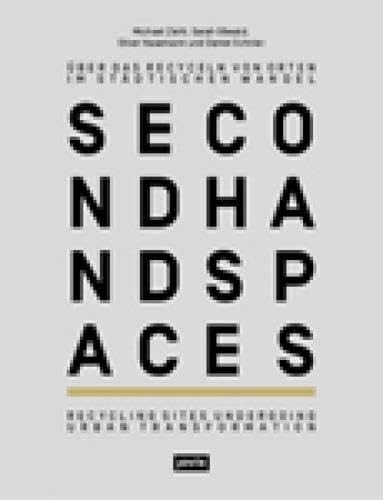

Second Hand Spaces : recycling sites undergoing urban transformation = Über das Recyceln von Orten im städtischen Wandel. / txt
Berlin : Jovis Verlag Gmbh , 2012Descripción: 463 p. ill. ; 22 cmTipo de contenido:- text
- unmediaded
- volume
- 9783868591552
- 711.50943
- HT166 S43 2012
| Imagen de cubierta | Tipo de ítem | Biblioteca actual | Biblioteca de origen | Colección | Ubicación en estantería | Signatura topográfica | Materiales especificados | Info Vol | URL | Copia número | Estado | Notas | Fecha de vencimiento | Código de barras | Reserva de ítems | Prioridad de la cola de reserva de ejemplar | Reservas para cursos | |
|---|---|---|---|---|---|---|---|---|---|---|---|---|---|---|---|---|---|---|
| Libro Col. General CARIBET | CARIBET Biblioteca Arquitectura Colección General CARIBET | General HT166 S43 2012 (Navegar estantería(Abre debajo)) | 1 | Disponible | 91000000045989 |
Descripciones mejoradas de Syndetics:
In this volume, 27 urban planning experts highlight the backgrounds, users and effects of so-called "second hand spaces"--vacant sites which have been repurposed in areas undergoing urban change. The new functions of these spaces range from activities as simple as sunbathing in a defunct swimming pool to the installation of an open-air boxing ring.
Includes Index.
Translated from German: Über das Recyceln von Orten im städtischen Wandel.
Includes Bibliographical References (p.451).
Introduction 298 --
Chapter 1 Backdrop 302 --
Martina Baum Future Viability Requires Adaptability and Stability Dynamic, Stable Structures in the Context of Sustainable Urban Development 304 --
To Leck Lopatta From the Brownfield as a Problem to Becoming a Resource for Creative Urban Development The Experience of a Breme-Based Planning Practitioner 309 --
Wolfang Kil Field of Patience Slow City Real Estate Charts? Recurring Inspections of a Perforated Landscape 314 --
Projects:
Carsten Joost YAAM & Bar25, Berlin Temporary Uses as a Means of Establishing an Identity in Order to Promote Marketing? 321 --
Sarah Oßwald Tentstation, Berlin Big City Camping 325 --
Siri Frech and Klaus Overmeyer Mellowpark, Berlin Urban Pilot for Tomorrow 329 --
Jakob Sturm basis, Frankfurt am Main Space for Creative Folks 332 --
Oliver Hasemann, Daniel Schnier, Sarah Oßswald and Michael Ziel ZwishchenZeiZentrale, Bremen Opening Doors and Windows of Time 336 --
Profiles 340 --
Chapter 2 Actors 344 --
Arndt Neumann Not Yet Entrepreneurs or Still in Limbo? Temporary Users between Valorization and Precariousness 346 --
Bastian Lange New Forms of Working in Networks 352 --
Florian Haydn At a Special Place 360 --
Projects:
Andreas Krauth Eichbaumoper, Mülheim an der Ruhr Experimental Urban Redevelopment 366 --
Nils Grube Frappant, Hamburg Arrival, Action, Impact On the Vitalization of Grosse Bergstrasse by Temporary Users 370 --
Philippe Cabane nt/Areal, Basel City of Citizens vs. City of Customers 374 --
Peter Birke Ungdomshuset, Copenhagen Between the Poles of Normalization and Gentrification 378 --
Michael Ziehl Gängeviertel, Hamburg On the Production of an Alternative Urban Space 382 --
Profiles 386 --
Chapter 3 Atmosphere 390 --
Stephan Willinger Wild Participations What the Informal Use of Space Has to Do with Civic Involvement 393 --
Angelus Eisinger and Jörg Seifert urbanRESET Fields for Identifying the Sustainability of Urban Practices 398 --
Niko Paech and Annika Rehm second hand spaces Spaces of Opportunity for Urban Subsistence 404 --
Projects:
Christina Vogelsang Sproutbau, Bremen Legacy of a Summeer in Concrete 409 --
Patrick T. Augenstein Susiburg, Feiburg im Breisgau The Wish for a Trailer Park Becomes Reality A Success Story on Four Wheels 412 --
Ragna Körby Prinzessinnengärten, Berlin A Temporary Paradise in Kreuzbrg 416 --
Michael Rostalski RAW Gelände, Berlin Where Projects -in-Progress Test Settling Down Informal Uses by Neighborhood Residents 420 --
Oliver Hasemann and Daniel Schnier AUFAUF, Bremen On the Recycling a Used Site 424 --
Profiles 428 --
Authors 439 --
Bibliography 451 --
Photo Credits 458 --
Imprint 462 --
At vacant sites, second hand spaces draw on the atmosphere, the traces, the remains, and the history of their previous uses. Their actors develop an individual aesthetic out of such sites, which stand out due to their simplicity and improvised quality. Second hand spaces evolve against a background of diverse demands on urban spaces and provide opportunities for interaction, participation, and start ups. They open up new courses of action for urban planning and at the same time make a contribution to the sustainable design of urban transformation. In nine essays and fifteen project des