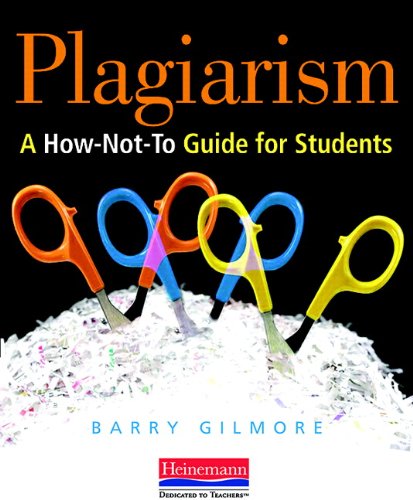

Plagiarism : A How-Not-To Guide for Students / Barry Gilmore
Idioma: ENG Editor: Portsmouth, New Hampshire : Heinemann, 2009Descripción: vi, 98 pages : illustrationsTipo de contenido:- text
- unmediated
- volume
- 9780325026435
- 808 23
| Imagen de cubierta | Tipo de ítem | Biblioteca actual | Biblioteca de origen | Colección | Ubicación en estantería | Signatura topográfica | Materiales especificados | Info Vol | URL | Copia número | Estado | Notas | Fecha de vencimiento | Código de barras | Reserva de ítems | Prioridad de la cola de reserva de ejemplar | Reservas para cursos | |
|---|---|---|---|---|---|---|---|---|---|---|---|---|---|---|---|---|---|---|
| Libro Referencia ev | Biblioteca Encarnación Valdés Sala de Referencia bev | R 808.025 G4881p (Navegar estantería(Abre debajo)) | Disponible | 80000002629825 |
Descripciones mejoradas de Syndetics:
Barry Gilmore is participating in a FREE on-line roundtable webinar "Plagiarism in the Digital Age: Voices from the Front Lines -- What's Happening in High Schools Now." To learn more visit www.plagiarism.org .
Plainly put, plagiarism isn't acceptable. But what's not so simple for students to understand is what exactly plagiarism is, how it happens, and how to avoid it. That's why Barry Gilmore's Plagiarism: A How-Not-To Guide for Students is a must-have for student writers.
In Plagiarism: A How-Not-To Guide for Students, Barry Gilmore follows up on his teacher's guide Plagiarism: Why It Happens How to Prevent It. Gilmore doesn't sugarcoat plagiarism, but he offers writers reasoned and reasonable solutions. His savvy handbook:
speaks directly to students in lively language about what plagiarism is and how it happens presents case studies drawn from real-world events as well as student examples never talks down and invites students to think and talk about plagiarism outlines the consequences of plagiarism without resorting to fear or intimidation. Gilmore provides all the dos and don'ts students need. With his book students will: get explicit guidelines for MLA and APA citation find out how to use search engines well and document their results appropriately learn to properly summarize and paraphrase third-party material understand what is common knowledge and what isn't.Plagiarism: A How-Not-To Guide for Studentsgoes well beyond plagiarism avoidance. It builds students' ethical awareness about what cheating is. And it leads them to understand why using their own words is important and, ultimately, more satisfying.
Give your students Plagiarism: A How-Not-To Guide for Students for every paper they will write-across the years, across the content areas. Or better yet, use it alongside Barry Gilmore's teacher's guide, Plagiarism: Why It Happens How to Prevent It. Because your greatest allies in preventing academic dishonesty are well-informed students.
Hear a podcast where Barry Gilmore answers Carol Jago's questions about responding to and preventing plagiarism.
Includes bibliographical references and index.
This book discusses the issue of academic misconduct and publication ethics in general and plagiarism in particular, with a focus on case studies in various universities around the world (notably in Japan, Singapore, Australia, USA, and Canada). We are especially interested in students' and teachers' perception of academic misconduct and their definition and understanding of plagiarism. Most chapters discuss undergraduates' understanding of academic dishonesty and students' experiences using plagiarism softwares. The book also analyzes teachers' perception of cheating and how they respond to it. Writing is perceived by all of the teachers to be the most important form of assessment that required preventative measures in order to reduce the occurrence of academic dishonesty among students. Each chapter recommends strategies to fight plagiarism, such as establishing guidelines and regulations concerning academic integrity, awareness of the scale of the issue (scandals at all levels in most countries, even including famous scholars, administrators, and elected officials), assessing the damage done to academic reputation and credibility, developing trust and credibility on social media (especially with the recent disturbing growth of fake news and data), minimizing the proliferation of dishonest accreditation, of identity theft, of fake peer-reviews, and fighting the growing number of fake papers, with or without the use of computer-generated academic works.
Tabla de contenidos provista por Syndetics
- Chapter 1 Introduction: Taking the Plague Out of Plagiarism(p. 1)
- Case Study: Blind Justice?(p. 3)
- Find Out More(p. 4)
- Talking Points(p. 5)
- Chapter 2 Copies (and Robberies): How and Why Plagiarism Happens(p. 6)
- Murky Waters: Plagiarism in Middle and High School(p. 8)
- How Plagiarism Happens(p. 9)
- How Good Are Electronic Detection Services?(p. 15)
- Good Intentions(p. 16)
- Boiling It Down: Rules for Paraphrasing and Summarizing(p. 19)
- Aye, Madam, 'Tis Common: The Spirit of Common Knowledge and Citation(p. 24)
- Case Study: Take It or Leave It(p. 28)
- Chapter 3 Write from Wrong: Why You Should Avoid Plagiarism(p. 30)
- The Ethics Gap(p. 30)
- The Bottom Line: Paying the Consequences(p. 36)
- Mother Knows Best (but She Still Shouldn't Write Your Papers for You)(p. 41)
- Reasons? I'd Call Them Excuses(p. 43)
- Case Study: Summary Judgment(p. 45)
- Chapter 4 Copy That!: Strategies for Avoiding Plagiarism(p. 46)
- Out of Cite: The Skill of Attributing Information(p. 49)
- Start Your Engines: Searching for Information Online(p. 63)
- The Attribution Solution: Considering Why to Cite(p. 66)
- Taking It Back: Owning the Assignments You're Given(p. 67)
- Case Study: Two of a Kind(p. 70)
- Chapter 5 Making It Personal: Plagiarism and the Culture of Your School(p. 71)
- Making the Grade: Rankings and Grades in Middle and High School(p. 72)
- May I Have the Honor? Thinking About Honor Codes(p. 77)
- Team Efforts: Collaboration and Cheating(p. 80)
- Get Cut, or Cut and Paste? Other Factors That May Influence Academic Honesty(p. 81)
- Final Thoughts: Being an Original, Not a Copy(p. 84)
- Case Study: Figures of Speech(p. 85)
- Appendix: A Guide to Basic Citation in MLA and APA Styles(p. 87)
- Works Cited(p. 89)
- Index(p. 93)
Notas de autor provistas por Syndetics
Barry Gilmore, Ed.D., taught English and social studies for over 15 years before becoming a middle school principal in Memphis, TN. Barry was a National Board Certified teacher and Past-President of the Tennessee Council of Teachers of English. He was the author of seven books for teachers and numerous articles on topics ranging from the common core to plagiarism and classroom discussion methods. Gilmore received numerous honors for his teaching, including the NCTE's Outstanding High School Educator Award, the U.S. Department of Education's American Star of Teaching Award, and the Tennessee Holocaust Commission's Educator of the Year.