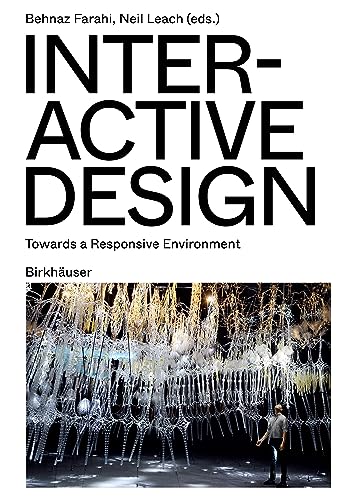

Interactive design : towards a responsive environment. / Behnaz Farahi, Neil Leach, Philip Yuan. txt
Editor: Boston : Birkhauser, 2023Descripción: 239p. : ill. ; col. ; 24cmTipo de contenido:- text
- unmediated
- volume
- 9783035626889
- NA2543.T43 I58 2023
| Imagen de cubierta | Tipo de ítem | Biblioteca actual | Biblioteca de origen | Colección | Ubicación en estantería | Signatura topográfica | Materiales especificados | Info Vol | URL | Copia número | Estado | Notas | Fecha de vencimiento | Código de barras | Reserva de ítems | Prioridad de la cola de reserva de ejemplar | Reservas para cursos | |
|---|---|---|---|---|---|---|---|---|---|---|---|---|---|---|---|---|---|---|
| Libro Col. General CARIBET | CARIBET Biblioteca Arquitectura Colección General CARIBET | General NA2543.T43 I58 2023 (Navegar estantería(Abre debajo)) | 1 | Disponible | 91000000073825 |
Descripciones mejoradas de Syndetics:
Designers and forward thinkers in the field of interactive designshare their reflections and show examples of different models of aresponsive future environment.
Interactive design hasexploded in recent years with a number of inspiring projects that haveopened up a new field of research and design.
This book bringstogether some of the most prominent actors and thinkers in the field ofinteractive design, with theoretical articles highlighting differentaspects of this work and describing them through current practices andprojects.
Supplemented with numerous illustrations, this bookoffers an overview of the emergence of interactive design andarchitecture based on the theory of cybernetics. At the same time, itintroduces models of interactivity ranging from dynamic andshapechanging materials to wearables, architecture, andtransdisciplinary and alternative design methods.
History of the development of interactive design Overview of the state of the art and its possibilities Models of interactivity in theory and practice
9 Preface --
11 A Brief History of Interactive Architecture Behnaz Farahi, Neil Leach --
Part I: From Cybernetics to Interactive Design --
27 The Architectural Relevance of Cybernetics Gordon Pask --
35 From Cybernetics to Interactive Design Interview with John Frazer by Neil Leach --
42 Architecture, Interaction, Systems Usman Haque --
48 Adaption: Towards a Theory of Interactivity Neil Leach --
Projects:
58 A teamLabPlanets Tokyo, teamlab --
64 B Border Turner, Lozano Hemmer --
68 C Epiphyte Chamber, Beesley --
72 D Cerebral Hut Ozel --
Part II: New Kinds of Interaction --
77 Fragile Architecture: Notes for a New Model of Interaction Philip Beesley --
84 From Cybernetics to Affective Computing in Design Behnaz Farahi --
95 Neurospace Mona Ghandi --
106 Balance, Body Awareness, and MOVEMENT in Interactive Experiences Elyne Legarnisson --
Projects:
114 A Ada, Sabin --
116 B Mirror Mirror, SOFTlab --
118 C Touch, Lab(au) --
120 D Eunoia, Park --
Part III:
Material Interactivities --
125 Active Matter --
Interview with Skylar Tibbits by Behnaz Farahi --
137 Activating the Physical Toward Material Experience Design Yasuaki Kakehi --
151 Architected Morphing Matter: The Confluence of Geometry and Hidden Forces Lining Yao, Harshika Jain --
158 Tomorrowland Manuel Kretzer --
Projects:
168 A Glowing Nature, Roosegaarde --
172 B biologic, Tangible Media Group, MIT Media Lab --
174 C Halo, Kimchi and Chips --
176 D Caress of the Gaze, Farahi --
Designers and forward thinkers in the field of interactive design share their reflections and show examples of different models of a responsive future environment. Interactive design has exploded in recent years with a number of inspiring projects that have opened up a new field of research and design. This book brings together some of the most prominent actors and thinkers in the field of interactive design, with theoretical articles highlighting different aspects of this work and describing them through current practices and projects. Supplemented with numerous illustrations, this book offers an overview of the emergence of interactive design and architecture based on the theory of cybernetics. At the same time, it introduces models of interactivity ranging from dynamic and shape changing materials to wearables, architecture, and transdisciplinary and alternative design methods. History of the development of interactive design Overview of the state of the art and its possibilities Models of interactivity in theory and practice.
Tabla de contenidos provista por Syndetics
- Preface(9)
- A Brief History of Interactive Architecture(11)
- Part I From Cybernetics to Interactive Design
- The Architectural Relevance of Cybernetics(27)
- From Cybernetics to Interactive Design Interview with John Frazer(35)
- Architecture, Interaction, Systems(42)
- Adaption: Towards a Theory of Interactivity(48)
- Projects
- A TeamLabPlanetsTokyo, teamLab(58)
- B Border Tuner, Lozano-Hemmer(64)
- C Epiphyte Chamber, Beesley(68)
- D Cerebral Hut, Özel(72)
- Part II New Kinds of Interaction
- Fragile Architecture: Notes for a New Model of Interaction(77)
- From Cybernetics to Affective Computing in Design(84)
- Neurospace(95)
- Balance, Body Awareness, and Movement in Interactive Experiences(106)
- Projects
- A Ada, Sabin(114)
- B Mirror Mirror, SOFTlab(116)
- C Touch, LAb[au](118)
- D Eunoia, Park(120)
- Part III Material Interactivities
- Active Matter Interview with Skylar Tibbits(125)
- Activating the Physical Toward Material Experience Design(137)
- Architected Morphing Matter: The Confluence of Geometry and Hidden Forces(151)
- Tomorrowland(158)
- Projects
- A Glowing Nature, Roosegaarde(168)
- B BioLogic, Tangible Media Group, MIT Media Lab(172)
- C Halo, Kimchi and Chips(174)
- D Caress of the Gaze, Farahi(176)
- Part IV Transdisciplinary Approaches
- Cyberphysical Architecture in the Era of Digital Eclecticism: Transdisciplinarity and Conflation of Technological Milieus(181)
- A New Assemblage: Interactive Art Experiences of a Human-Machine Reality(193)
- Trans-Disciplinary Interactions(203)
- Demystification: The Evolving Design Process of Interactive Architecture(213)
- Projects
- A MegaFaces, Khan(222)
- B Neuro-Architectures, Sciotto(224)
- C Remnant, DigitallO
- D Petting Zoo, Minimaforms(230)
- Conclusion: By Way of Conclusion, we Have a Panel Discussion Between Philip Beesley, Guvenc Ozel, and Ruairi Glynn Led(235)
Notas de autor provistas por Syndetics
Behnaz Farahi is a designer, creative technologist and critical maker. Trained as an architect, she explores how to foster an empathetic relationship between the human body and the surrounding space through the implementation of emerging technologies. Her work addresses issues such as feminism, emotion, bodily perception and social interaction. She specializes in computational design, interactive technologies, additive manufacturing and digital fabrication technologies.Farahi has won several awards including the Cooper Hewitt Smithsonian Design Museum Digital Design Award, Fast Company Innovation By Design Linda Tischler Award, World Technology Award (WTN).
She has received her PhD in Interdisciplinary Media Arts and Practice at the USC School of Cinematic Arts. Currently, she is an Assistant Professor at the Department of Design, California State University, Long Beach.
Neil Leach is an architect, curator and writer. His research interests fall broadly into two fields, critical theory and digital design. In the field of critical theory, he has published many monographs and edited volumes, dealing largely with the impact of importing theoretical tools from critical theory into an architectural arena.
He has taught at numerous international universities including Columbia GSAPP, Dessau Institute of Architecture, IaaC, London Consortium, Royal Danish School of Fine Arts, University of Bath.
He is currently Visiting Professor at Harvard University GSD, Professor at the European Graduate School, Gao Feng Professor at Tongji University, and Adjunct Professor at the University of Southern California.