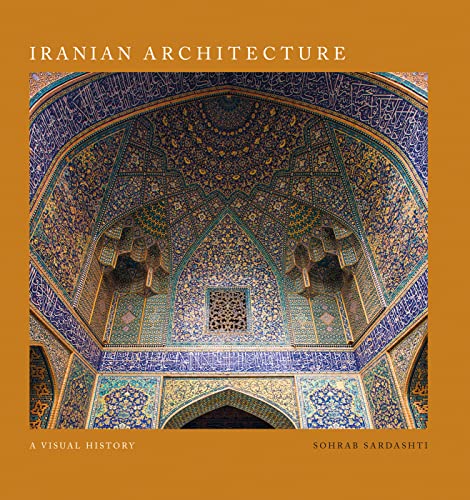

Iranian architecture : a visual history. / txt
Woodbridge : ACC Art Books, 2023Descripción: 397 p. : ill. ; col. ; 26 cmTipo de contenido:- text
- unmediaded
- volume
- 9781788841849
- 1788841840
- NA1483 S27 2023
| Imagen de cubierta | Tipo de ítem | Biblioteca actual | Biblioteca de origen | Colección | Ubicación en estantería | Signatura topográfica | Materiales especificados | Info Vol | URL | Copia número | Estado | Notas | Fecha de vencimiento | Código de barras | Reserva de ítems | Prioridad de la cola de reserva de ejemplar | Reservas para cursos | |
|---|---|---|---|---|---|---|---|---|---|---|---|---|---|---|---|---|---|---|
| Libro Col. General CARIBET | CARIBET Biblioteca Arquitectura Colección General CARIBET | General NA1483 S27 2023 (Navegar estantería(Abre debajo)) | 1 | Disponible | 91000000072603 |
Descripciones mejoradas de Syndetics:
"An ode to the architectural wonders of Iran." -- AD Middle East
"A book that you enjoy picking up because there are always new and exciting things to discover in the photos. A very special kind of eye journey and absolutely worth reading!" -- Lovely Books
Iran, the former Persia, lies at an interface between West-East and North-South. Several early trade routes crossed the country, connecting Asia, Africa and Europe, and the cultural wealth and scenic beauty of this region has attracted travelers for over 2,000 years. This rich past makes Iran one of the most culturally interesting countries of Asia.
The art of building has a special significance here. In contrast to other fields of knowledge, visual communication is particularly important in architecture. Much cannot be fully described; it must be made visible.
In his book, Sohrab Sardashti immerses us in the dreamlike world of Iranian architecture. At the beginning of the book, the history of Iranian architecture is briefly described. Then an impressive variety of buildings is presented, divided according to their different functions. Mosques, tombs, madrassas, hammams, castles, palaces and more are all covered. The text at the beginning of each chapter briefly explains the nature and history of that type of building, followed by a series of examples with a short text on each, and an abundance of photos taken especially for this book.
The book allows one to experience the great diversity and fascination of Iranian architecture and is a visual treat for the reader.
Include bibliography
Preface by Jörg Kurt Grütter 4 --
Introduction 6 --
Part 1: A Brief History of Iranian Architecture 10 --
Part 2: Architecture Types 38 --
Mosque 40 --
Tomb and Shrine --
Pre-Islamic 98 --
Post-Islamic 102 --
Madrasa 166 --
Bazaar 206 --
Hammam 222 --
Caravanserai 238 --
House 254 --
Arg 282 --
Palace 302 --
Garden 332 --
Church 342 --
Village 356 --
Bridge 372 --
Ab-anbar 378 --
Yakhchal 382 --
Kabutar-Khaneh 384 --
Badgir 386 --
Minaret 390 --
Glossary 394 --
Bibliography 396 --
Iran, the former Persia, lies at an interface between West-East and North-South. Several early trade routes crossed the country, connecting Asia, Africa and Europe, and the cultural wealth and scenic beauty of this region has attracted travellers for over 2,000 years. This rich past makes Iran one of the most culturally interesting countries of Asia.0The art of building has a special significance here. In contrast to other fields of knowledge, visual communication is particularly important in architecture. Much cannot be fully described; it must be made visible.0In his book, Sohrab Sardashti immerses us in the dreamlike world of Iranian architecture. At the beginning of the book, the history of Iranian architecture is briefly described. Then an impressive variety of buildings is presented, divided according to their different functions. Mosques, tombs, madrassas, hammams, castles, palaces and more are all covered. The text at the beginning of each chapter briefly explains the nature and history of that type of building, followed by a series of examples with a short text on each, and an abundance of photos taken especially for this book. 0The book allows one to experience the great diversity and fascination of Iranian architecture and is a visual treat for the reader.