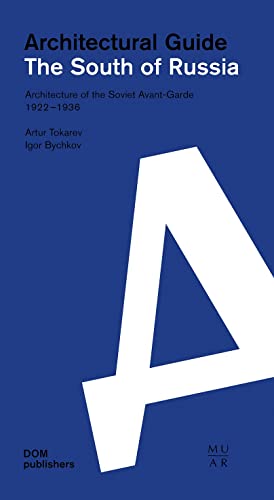

The South of Russia : buildings of the Soviet avant-garde 1922-1936, architectural guide. / txt
Series An architectural guide. The South of RussiaDOM PUB : Berlin, 2021Descripción: 199p. ill. ; photo.; maps ; col. ; 25 cmTipo de contenido:- text
- unmediaded
- volume
- 9783869223049
- 3869223049
- 724.6
- NA1188.5.A83 T65 2021
| Imagen de cubierta | Tipo de ítem | Biblioteca actual | Biblioteca de origen | Colección | Ubicación en estantería | Signatura topográfica | Materiales especificados | Info Vol | URL | Copia número | Estado | Notas | Fecha de vencimiento | Código de barras | Reserva de ítems | Prioridad de la cola de reserva de ejemplar | Reservas para cursos | |
|---|---|---|---|---|---|---|---|---|---|---|---|---|---|---|---|---|---|---|
| Libro Col. General CARIBET | CARIBET Biblioteca Arquitectura Colección General CARIBET | General NA1188.5.A83 T65 2021 (Navegar estantería(Abre debajo)) | 1 | Disponible | 91000000071399 |
Descripciones mejoradas de Syndetics:
The Soviet avant-garde architecture of the 1920s to the mid-1930s has increasingly been attracting attention from researchers worldwide. Yet, in spite of this, entire regions remain unstudied. One of these is the south of Russia.
Based on extensive research, this guidebook aims to correct the omission. It explores Russia's South and North Caucasus federal districts: Astrakhanskaya, Volgogradskaya, and Rostovskaya regions, Krasnodarsky kray, Crimea, Kalmykiya, Mineralnye Vody, Dagestan, Kabardino-Balkariya, Karachaevo-Cherkesiya, Severnaya Osetiya, and Chechnya. During the Second World War, the south of Russia was the scene of fighting and mass destruction. Post-war reconstruction saw many buildings redesigned in the neoclassical style and the loss of an entire stratum of avant-garde structures.
Since the end of the USSR, the way the surviving buildings have been used and run has been equally destructive. For this reason, the structures examined here are divided into two categories: those that have survived and those that have been lost forever. This volume enables readers to view 100 Soviet avant-garde buildings with their own eyes.
Includes bibliographical references and index.
Buildings of the Soviet Avant-Garde 1922-1936
Introduction 7 --
Rostovskaya oblast 12 --
Rostov-on-Don 26 --
Volgograd 56 --
Astrakhanskaya oblast. Republic of Kalmykia. Republic of Dagestan.
Republic of North Ossetia-Alania. Republic of Kabardino-Balkaria. Karachay-Cherkess Republic. 70 --
Stavropolsky kray 96 --
Kislovodsk 106 --
Krasnodarsky kray 120 --
Crimea 142 --
Demolished and altered buildings 158 –
Rostovskaya oblast --
Monument to Red Army Members Who Died during the Civil War. Krasny Sulin 001 --
Shakhty Mining Technical School. Shakhty 002 --
Novocherkassk Flour-Mill-Elevator Technical School. Novocherkassk 003 --
Round House. Taganrog 004 --
Metal-Workers' Club. Taganrog 005 --
Training/experimental Collective Grain Farm No. 2. Zernograd 006 --
Grain Farm No. 1. Gigant housing estate (Salsky District) 007 --
State Bank building. Salsk 008 --
Rostov-on-Don --
Palace of Labour in Lengorodok 09 --
Polyclinic of the Health Department of Water-Transport Workers 010 --
Central hospital 011 --
Main building of the Rostov Institute of Transport Engineers 012 --
Monument to V.I. Lenin 013 --
Factory Kitchen No. 1 014 --
Technical school for studies in vehicular roads 015 --
Bathhouse and laundry in the settlement of Selmashstroy 016 --
Gorky Drama Theatre 017 --
Hotel Rostov 018 --
The building of the editorial board and publishing house of Molot newspaper 019 --
Substations 2 and 3 for the Rostov tram network 020 --
Residential buildings in the settlement of Selmashstroy (Rostselmash) 021 --
Rostselmash Agricultural-Machinery Factory 022 --
Residential complex on Budennovsky Prospekt 023 --
Residential complex of the Novy byt cooperative 024 --
Gigant No. 1 025 --
Gigant No. 2, Lengorodok 026 --
House in Rybny lane027 –
Volgograd --
Stalingrad State District Power Station 028 --
Stalingrad Tractor Factory (STZ) 029 --
Educational establishments at Stalingrad Tractor Factory (STZ) 030 --
Factory kitchen for Stalingrad Tractor Factory (STZ) 031 --
State circus at Stalingrad Tractor Factory (STZ) 032 --
House for visitors at Stalingrad Tractor Factory (STZ) 033 --
300-apartment residential building for specialists 034 --
Central Automatic Telephone Station (ATS) 035 --
Main office of the Red October Factory 036 --
Workers' settlements for the Stalingrad Tractor Factory (STZ) 037 –
Astrakhanskaya oblast. Republic of Kalmykia. Republic of Dagestan --
Republic of North Ossetia-Alania. Republic of Kabardino-Balkaria. Karachay Cherkess Republic --
Turbine building at Astrakhan City Power Station. Astrakhan 038 --
Club of the Third International Ship-Repair Yard. Astrakhan 039 --
Workers' club for salt-miners. The village of Nizhny Baskunchak 040 –
Development in Elista. Elista 041 --
House of Soviets in Elista. Elista 042 --
The House of Soviets in Makhachkala. Makhachkala 043 --
Republican Hospital in Makhachkala. Makhachkala 044 --
Workshop No. 8 at Dvigatelstroy Factory. Kaspiysk 045 --House of Specialists. Vladikavkaz 046 --
Factory kitchen at Elektrotsink Factory. Vladikavkaz 047 --
Entrance to Proletarsky Park. Vladikavkaz 048 --
House of Engineers and Technical Workers at Elektrotsink
Factory. Vladikavkaz 049 --
Gizeldon Hydroelectric Station (Gizeldon GES). Koban village 050 --
House of the Soviets in Beslan. Beslan 051 --
Regional Hospital and Polyclinic in Nalchik. Nalchik 052 --
Development of Baksankaya Street. Oblsnab Regional Supplies
building. Nalchik 053 --
Baksan Hydroelectric Station (Baksan GES). Atazhukino village 054 –
Development of Mikoyan-Shakhar. Karachaevsk 055 --
Stavropolsky kray --
A.P. Smirnov Sanatorium. Zheleznovodsk 056 --
Tsusstrakh Sanatorium No. 2. Zheleznovodsk 057 --
Smirnovsky istochnik, Drinking Gallery. Zheleznovodsk 058 --
Water-tower and fire station for V.I. Lenin Wool-Washing
Factory No. 1. Nevinnomyssk 059 --
Post-office building. Mineralnye Vody 060 --
Dormitory block of the Central Military Sanatorium. Essentuki 061 --
Administrative and residential building. Pyatigorsk 062 --
Kislovodsk --
Bas relief of V.I. Lenin 063 --
Narodny Pump-Room 064 --
House of M.I. Merzhanov 065 --
NKVD Sanatorium 066 --
Block for patients with cardiovascular illnesses at the 10th Anniversary
of October Sanatorium 067 --
October Narzan Baths 068 --
Sanatorium No. 10 'For Industrialisation' 069 --
G.K. Ordzhonikidze Sanatorium of the People's Commissariat for Heavy Industry 070 –
Krasnodarsky kray --
Factory kitchen of the locomotive-repair factory in Tikhoretsk. Tikhoretsk 071 --
Water-tower of the type devised by engineer V.G. Shukhov. Krasnodar 072 --
Residential building on Krasnaya Ulitsa. Krasnodar 073 --
Dormitory block of Falshivy Gelendzhik House of Recreation. Divnomorskoe village 074 –
Club of Kuban Collective Farm. Kuban village (Gulkevichsky District) 075 --
Railway Workers' Palace of Culture. Belorechensk 076 --
Hotel of the First Five-Year Plan. Anapa 077 --
Hospital in Neftegorsk. Neftegorsk 078 --
Novorossiysk District Power Station (NovoRES). Novorossiysk 079 --
Public and residential complex of the NKVD. Novorossiysk 080 --
Branch of the State Bank. Novorossiysk 081 --
Arch in Honour of the Millionth Barrel of Cement. Novorossiysk 082 --
Creche of the Proletarian Cement Factory. Novorossiysk 083 --
Oil-workers' district. Tuapse 084 --
Hotel Sanatorium. Sochi 085 --
Gorny Vozdukh Sanatorium. Sochi 086 --
Voroshilov Central Sanatorium of the Workers' and Peasants' Red Army (RKKA). Sochi 087 –
Crimea --
First Surgical Hospital. Dzhankoy 088 --
NKVD Club. Simferopol 089 --
Residential building of the Government of the Crimean Autonomous Soviet Socialist Republic (ASSR). Simferopol 090 --
Surgical block named after Semashko of the First Soviet Hospital. Simferopol 091 --
House in Memory of 1905. Simferopol 092 --
Gynaecological Sanatorium. Saki 093 --
Actinometric station. Evpatoriya 094 --
Moynaki, mud-therapy centre. First mud block. Evpatoriya 095 --
Hydrophysical station. Katsiveli village 096 --
The naval diving technical school at Expedition for Special Underwater
Operations (EPRON). Sevastopol 097 --
Zhilkombinat ('Residential combine') No. 1. Sevastopol 098 --
Dinamo Aquatic Sports Station. Sevastopol 099 --
Main block of Sevastopol GRES District Power Station. Sevastopol 100 –
Demolished and altered buildings --
Factory apprenticeship school at Krasny Sulin Metal Factory. Krasny Sulin 101 --
Stadium of Soviet Workers in Trade. Rostov-on-Don 102 --
Water-supply station, second stage. Shakhty 103 --
Rostselmash Palace of Culture. Rostov-on-Don 104 --
Main block of Hospital No. 7. Volgograd 105 --
Monument to V.I. Lenin. Volgograd 106 --
Fire depot at Stalingrad Tractor Factory (STZ). Volgograd 107 --
M. Gorky Club at Stalingrad Tractor Factory (STZ). Volgograd 108 --
Development on Pavshikh Bortsov Square. Volgograd 109 --
Residential and public buildings in Grozny. Grozny 110 --
Priyut Odinnadtsati Mountain Hotel. Terskol 111 --
Monument to V.I. Lenin. Zheleznovodsk 112 --
House of Chauffeurs. Nalchik 113 --
Sanatorium of the Committee for Assistance to Academics (KSU). Teberda 114 --
Entrance to Tsvetnik Park. Pyatigorsk 115 --
The canteen block of the Red Star Sanatorium. Kislovodsk 116 --
Factory kitchen for workers at the railway junction. Tikhoretsk 117 --
Armavir Power Station. Armavir 118 --
General Store No. 6 in the oil workers' district. Tuapse 119 --
Monument to V.I. Lenin. Sochi 120 --
Kalifornia Bus Stop. Sochi 121 --
Y. Fabrizius Sanatorium. Sochi 122 --
Crimean Wind-Electric Station VES-20. Balaclava 123 --
Monument to the 10th Anniversary of the Capture of Crimea. Yalta 124 --
The architecture of the Soviet avant-garde of the 1920s and mid-1930s is attracting more and more attention from both domestic and foreign researchers, but in spite of this, entire regions remain unexplored. One of them, until recently, was the South of Russia - an area that encompasses the Southern Federal District and the North Caucasus Federal District. The state of this architectural heritage deserves special mention. In the South of Russia during the Second World War, there were active hostilities and mass destruction. Over the course of post-war reconstruction, many buildings were rebuilt in a neoclassical style, and a whole layer of avant-garde works nearly disappeared. During the post-Soviet years, the management of these buildings was no less destructive. The product of extensive research, this guidebook divides the objects in question into two groups: those that have survived and those that have been lost forever. Fortunately, Architectural Guide The South of Russia allows readers to see more than 100 selected buildings of the Soviet avant-garde with their own eyes.