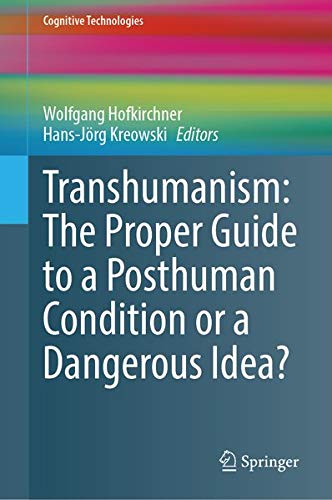

Transhumanism : the Proper Guide to a Posthuman Condition or a Dangerous Idea? / Wolfgang Hofkirchner and Hans-Jörg Kreowski, editors.
Series Cognitive Technologies SerEditor: Cham : Springer International Publishing AG, 2020Fecha de copyright: ©2021Descripción: 1 online resource (248 pages)Tipo de contenido:- text
- computer
- online resource
- 9783030565466
- 144
- B842.5 .T736 2020
| Imagen de cubierta | Tipo de ítem | Biblioteca actual | Biblioteca de origen | Colección | Ubicación en estantería | Signatura topográfica | Materiales especificados | Info Vol | URL | Copia número | Estado | Notas | Fecha de vencimiento | Código de barras | Reserva de ítems | Prioridad de la cola de reserva de ejemplar | Reservas para cursos | |
|---|---|---|---|---|---|---|---|---|---|---|---|---|---|---|---|---|---|---|
| Libro electrónico | Biblioteca de Mayagüez Acceso en línea | QA75.5 .T736 2020 (Navegar estantería(Abre debajo)) | Ebook c. 1 | Disponible | 50000003293486 | |||||||||||||
| Libro electrónico | Biblioteca Encarnación Valdés Acceso en línea | 144 (Navegar estantería(Abre debajo)) | Disponible | EBC6424519 | ||||||||||||||
| Libro electrónico | Biblioteca Mons. Iñaki Mallona (Arecibo) Acceso en línea | 642 (Navegar estantería(Abre debajo)) | Ebooks | Disponible | 60000010174776 |
ALA COVID Relief Fund
Part I: Philosophical Aspects -- Chapter 1: Aspects of Mind Uploading -- 1 Introduction -- 2 Is It Technically Doable? -- 3 Consciousness -- 4 Personal Identity -- 5 Ethical Concerns -- 6 A Society of Uploads -- 7 Conclusion -- References -- Chapter 2: Transhumanism as a Derailed Anthropology -- 1 Introduction: The Story so Far -- 2 Manifestations of Transhumanism -- 2.1 Three Types of Transhumanism -- 2.2 Future Paradise as a Kind of Transhumanism? -- 2.3 Marxism -- 2.4 Gaia Hypothesis -- 3 Anthropology and the AI Image of Man -- 3.1 Man, Animal, Machine -- 3.2 Man Embedded in Systems -- 4 Autonomy as a Presupposition for Singularity -- 5 Interests, Concrete and Future -- 5.1 Religious Motivations and Interests in Transcendence -- 5.2 Economic Interests -- 5.3 Epistemological Interests -- 6 A New Man, a New World: For Whom? -- 6.1 Religious Borderlines -- 6.2 Reductionism -- 7 Resist the Beginnings -- 7.1 Objections -- 7.2 Moralizing Business Models -- 7.3 Eight Rules -- 8 Concluding Remarks -- References -- Chapter 3: Transhumanism and Philosophy of Technology -- 1 Introduction -- 2 Technophobia and Technophilia -- 2.1 Technophobic Derivative -- 2.2 Transhumanism -- 2.3 The Substrate-Independent Mind -- 2.4 The Limits of the Humanist Heritage -- 3 Towards a Different Philosophy of Technology (and Nature) -- 3.1 Beyond the Failure of Modern Categories -- 3.2 Culture Is Nature -- 3.3 The Constitutive Role of the Technical Mediation -- 4 Conclusions -- References -- Chapter 4: Senseless Transhumanism -- 1 Introduction -- 2 Three Man´s Activities -- 3 Intentionality -- 4 Transhumanism and Utopias -- 5 Loss of Sense in Transhumanism -- 6 Conclusion -- References -- Chapter 5: Elements of a Posthuman Philosophy of Art -- 1 Introduction -- 2 Non-duality, Technology and Posthuman Works of Art.
3 Elements of a Posthuman Philosophy of Art -- 4 Sven Helbig -- 5 Bioart -- 6 Total Works of Art -- 7 Posthuman Art and Non-totalitarian Works of Art -- 8 Conclusion -- References -- Part II: Military Aspects -- Chapter 6: Transcending Natural Limitations: The Military-Industrial Complex and the Transhumanist Temptation -- 1 Introduction -- 2 Transhumanism -- 3 The Contemporary Transhumanist Milieu -- 4 Military Research and Transhumanism -- 5 Military ``Human Enhancement´´? -- References -- Chapter 7: When CRISPR Meets Fantasy: Transhumanism and the Military in the Age of Gene Editing -- 1 Introduction -- 2 Gene Editing: The ``CRISPR Revolution´´ -- 3 Transhumanist Visions: Enhancing Human Evolution -- 4 Gene Editing in a Military Context -- 5 Outlook: Focusing on Biohazard Threats and Not Super Soldiers -- References -- Chapter 8: War in Times of ``Beyond Man´´: Reflections on a ``Grand´´ Contemporary Topic -- 1 Introduction -- 2 The Core Contradiction: Healing the Sick or ``Enhancing´´ the Healthy Person? -- 3 Less Human Warfare = More Humanism? -- 4 Are Conflicts Going Extinct Because People Disappear from Them? -- 5 Transhumanism and Artificial Intelligence -- 6 Human Enhancement and Military-Relevant Technology Innovation -- 7 The Military as a Social Indicator -- 8 Outlook: An Ambiguous Perspective -- References -- Part III: Technological Aspects -- Chapter 9: The Singularity Hoax: Why Computers Will Never Be More Intelligent than Humans -- 1 Introduction -- 2 The Ground of Intelligence: What Is Missing in Computers -- 3 The 3.5 Billion Year Evolution of Human Intelligence -- 4 Conclusions: How Computers Will Make us Humans Smarter -- References -- Chapter 10: Ethical Machine Safety Test -- 1 Introduction -- 2 Key Terms -- 3 Where We Are with MST -- 4 Machine Safety Test: What It Should Be? -- 5 Claim: What We Are Testing.
6 What Should the Test Be? -- 7 Use Case Framework for the MST -- 8 Operational Concerns -- 9 Review and Summary -- 10 How Would We Evaluate Results? -- 11 Parting Comments -- References -- Chapter 11: ``Action´´ and Ascription: On Misleading Metaphors in the Debate About Artificial Intelligence and Transhumanism -- 1 Introduction -- 2 Conceptual Domains and Everyday Language -- 3 The Case of Artificial Intelligence -- 4 Basic Structure of Artificial Neural Networks -- 5 Configuring the Networks -- 6 Speaking About the Networks -- 7 Considering Human Concepts -- 8 Instances and Consequences -- 9 Malicious Metaphors -- 10 Transhumanism and Regimes of Enhancement -- 11 Closing Remarks -- References -- Part IV: Sociological Aspects -- Chapter 12: Transhumanism and/as Whiteness -- 1 Introduction -- 2 Methodological Precedents -- 3 Transhumanism and Its Genealogy -- 4 Transhumanist Demographics -- 5 Whiteness and ``White Crisis´´ -- 6 Algorithmic Racism -- 7 Conclusion -- References -- Chapter 13: Promethean Shame Revisited: A Praxio-Onto-Epistemological Analysis of Cyber Futures -- 1 Introduction -- 2 Praxiology: Hubris and/or Humiliation? -- 2.1 Colonized Man-Machine Designs: Technomorphic and Anthropomorphic Conflation of Practices -- 2.1.1 Technomorphic Colonization: Aspiring to ``Homo Deus´´ -- 2.1.2 Anthropomorphic Colonization: Aspiring to ``Techno Sapiens´´ -- 2.2 Compartmentalized Man-Machine Designs: Anthropocentric, Technocentric and Interactivistic Distinctions of Practices -- 2.2.1 Anthropocentric Compartmentation: Appreciating Human Status as ``Pride of Creation´´ Versus Depreciating ``Trumpery´´ -- 2.2.2 Technocentric Compartmentation: Creating the ``Übermensch´´ Ex Machina Versus Deploring ``Human Obsolescence´´ -- 2.2.3 Interactivistic Compartmentation: Assembling Humans and Machines into Hybrid Networks.
2.3 Synergistic Man-Machine Design: Technosocial System Integration of Practices for the Good Society -- 3 Ontology: Agents and/or Patients? -- 3.1 Monistic Man-Machine Models: Technomorphic and Anthropomorphic Conflation of Concepts -- 3.1.1 Technomorphic Monism: Man-A Machine -- 3.1.2 Anthropomorphic Monism: Machine, Human/Social in the Proper Sense -- 3.2 Dualistic Man-Machine Models: Anthropocentric, Technocentric and Interactivistic Distinctions of Concepts -- 3.2.1 Anthropocentric Dualism: Man-Not a Machine -- 3.2.2 Technocentric Dualism: Machine-Superior to Man -- 3.2.3 Interactivistic Dualism: ``Actants´´ and ``Intra-Action´´ -- 3.3 Emergentist Man-Machine Model: Technosocial System Integration of Actor and Artefact Concepts for the Sake of the Whole -- 4 Epistemology: Cross- and/or Mono- or Multi- and Interdisciplinarity? -- 4.1 Cross-Disciplinary Man-Machine Frames: Technomorphic and Anthropomorphic Conflation of Methods -- 4.1.1 Technomorphic Cross-Disciplinarity: Engineerability of Social Subject Matter -- 4.1.2 Anthropomorphic Cross-Disciplinarity: Engineering as a Social-Scientific Enterprise -- 4.2 Mono- and Multi-Interdisciplinary Man-Machine Frames: Anthropocentric, Technocentric and Interactivist Distinctions of Met... -- 4.2.1 Anthropocentric Mono-Disciplinarity: Sociologism -- 4.2.2 Technocentric Mono-Disciplinarity: Technologism -- 4.2.3 Interactivist Multi- and Interdisciplinarity: Socio-Technology -- 4.3 Transdisciplinary Man-Machine Frame: Technosocial Systems Integration of Methods for the Bigger Picture -- 5 Conclusion -- References -- Chapter 14: Where from and Where to: Transhumanistic and Posthumanistic Phantasms: Antichrist, Headbirth and the Feminist Cybo... -- 1 Introduction -- 2 The History of Ideas and a New Religion -- 3 Transhumanism in Fiction -- 4 Transhumanism, New Materialism, STS and Gender -- 4.1 Cyborgism.
4.2 Inclusive Humanism Contra Optimization Ideology -- 4.3 Elite Sports -- 4.4 Posthumanism, Agential Realism and Diffraction: How Does It Link to Transhumanism? -- References -- Chapter 15: Co-creation in Transhuman Realities: Setting the Stage for Transformative Learning -- 1 Introduction -- 2 Transhumanist System Development -- 3 Grounding Transhumanist System Development on Agogic Principles -- 4 Informing Co-creation Through Reflection -- 4.1 Reflection as Trigger of Transformative Learning Cycles -- 4.2 Skilful Reflective Practice -- 4.3 Utilizing Explanations for Transformative Learning Cycles -- 5 Conclusions -- References.
This book examines the contributions of the transhumanism approach to technology, in particular the contributed chapters are wary of the implications of this popular idea. The volume is organized into four parts concerning philosophical, military, technological and sociological aspects of transhumanism, but the reader is free to choose various reading patterns. Topics discussed include gene editing, the singularity, ethical machines, metaphors in AI, mind uploading, and the philosophy of art, and some perspectives taken or discussed examine transhumanism within the context of the philosophy of technology, transhumanism as a derailed anthropology, and critical sociological aspects that consider transhumanism in the context of topical concerns such as whiteness, maleness, and masculinity. The book will be of value to researchers engaged with artificial intelligence, and the ethical, societal, and philosophical impacts of science and technology.
Description based on publisher supplied metadata and other sources.
Electronic reproduction. Ann Arbor, Michigan : ProQuest Ebook Central, 2021. Available via World Wide Web. Access may be limited to ProQuest Ebook Central affiliated libraries.